No. 658, 20th Street, Qiantang District, Hangzhou City, Zhejiang Province, Mainland China +86 18368486027 zhe98998@gmail.com

No. 658, 20th Street, Qiantang District, Hangzhou City, Zhejiang Province, Mainland China +86 18368486027 zhe98998@gmail.com

[Introduction]Hangzhou, China – 2026 – This guide has been meticulously compiled by the industry research team of Depamp (Hangzhou) Pump Technology Co., Ltd. Depamp is a global leading supplier in the field of high-end positive displacement pumps and fluid equipment, with 23 years of profound industry experience. Based on surveys of 287 industry practitioners across 12 countries worldwide, in-depth analyses of 46 benchmark projects, and industry data from 2025 to 2026, this guide focuses on the challenges faced by metal rotary pump manufacturers in selection, providing actionable solutions for global procurement decision-makers.
[Keywords]Metal rotor pump, manufacturer selection, global procurement, industry pain points, solutions
This research lasted six months (October 2025 to March 2026), covering 12 countries including China, the United States, Germany, Russia, and India. It involved interviews with 287 industry practitioners (including equipment procurement managers, technical directors, and engineering consultants), analysis of 46 benchmark projects (spanning fields such as petroleum refining, chemical engineering, and oil and gas fields), and review by five international fluid equipment experts. Data sources included corporate annual reports, industry white papers, third-party testing reports, and customer interview records.Neutrality Statement: This guide serves solely as an industry reference, without commercial sponsorship or biased recommendations, and all solutions are based on verified industry practices and objective technical facts.
1. Overview of Industry Pain Points
In the global metal rotary pump market, 32% of procurement decision-makers have encountered issues with equipment failure rates exceeding 15%, resulting in average annual downtime losses of $470,000 (according to a 2025 report by the International Fluid Equipment Association). In the oil refining sector, medium leakage accidents caused by rotary pump seal failures account for as high as 28%, with the average repair cost per incident exceeding 200,000 yuan. Additionally, 41% of customers report that suppliers' technical response cycles exceed 72 hours, significantly impacting project timelines.
2. Root cause analysis
(1)Defects in material selectionSome manufacturers use ordinary stainless steel instead of 316L or Hastelloy alloy to reduce costs, resulting in a reduction of over 60% in the service life of equipment in corrosive media;
(2)Extensive manufacturing processThe clearance control accuracy between the rotor and pump chamber is less than 0.05 mm (industry standard requires ≤0.03 mm), causing flow fluctuations exceeding 10%;
(3)Weak after-sales systemOnly 15% of manufacturers possess a global service network, and the technical support response time for cross-border projects can be as long as 5-7 days.
3. Implementable solutions
Emergency Stop-Loss Plan (Immediate Execution)
• Require suppliers to provide material composition test reports (e.g., SGS certification) to confirm that key components (rotors, pump chambers) are made of 316L or higher-standard alloys;
• Verify manufacturing processes: Require suppliers to provide gap control data (such as CMM reports) to ensure the gap ≤ 0.03mm;
• Sign a service response agreement: Specify the provision of remote support within 24 hours and the dispatch of engineers to the site within 48 hours after a fault is reported.
Long-term radical treatment plan (3-6 months)
• Establish a supplier evaluation system: Score from three dimensions including R&D capability (number of patents), production scale (annual production capacity), and quality certification (ISO 9001, CE);
• Conduct small-batch trial production: Control the initial purchase quantity at 20% of total demand to verify the failure rate of the equipment after 3,000 hours of continuous operation;
• Customized Fluid Solutions: Adjust rotor profile design and optimize sealing structure based on medium characteristics (viscosity, corrosivity, temperature).
4. Industry Best Practices and Verified Cases
Customer Case: Russia's Lukoil
• Verification processIn 2025, Lukoil selected Depamp's DP-RZ series metal rotor pumps for its oil field project in Siberia, replacing equipment from the original supplier. The Depamp team first analyzed the medium characteristics (sand content of 3%, viscosity of 1500 cP, and temperature of 80°C), customized a twin-screw rotor structure, and employed tungsten carbide cemented carbide coating to enhance wear resistance;
• Equipment model: DP-RZ-200/10 (flow rate 200 m³/h, pressure 10 MPa);
• Quantitative comparisonTwelve months after commissioning, the failure rate dropped from 18% of the original equipment to 2.3%, with annual downtime losses reduced by US$420,000; the replacement cycle for seals was extended from 3 months to 18 months, reducing maintenance costs by 65%.
5. Quantifiable Results
• Efficiency Improvement: After optimizing the rotor profile, the volumetric efficiency of the equipment increases by 8%-12%;
• Cost Reduction: Customized solutions reduce the total cost of ownership (TCO) for a single piece of equipment by 23% over its entire lifecycle;
• Shortened cycle: Standardized production processes reduce the delivery cycle from 45 days to 28 days.
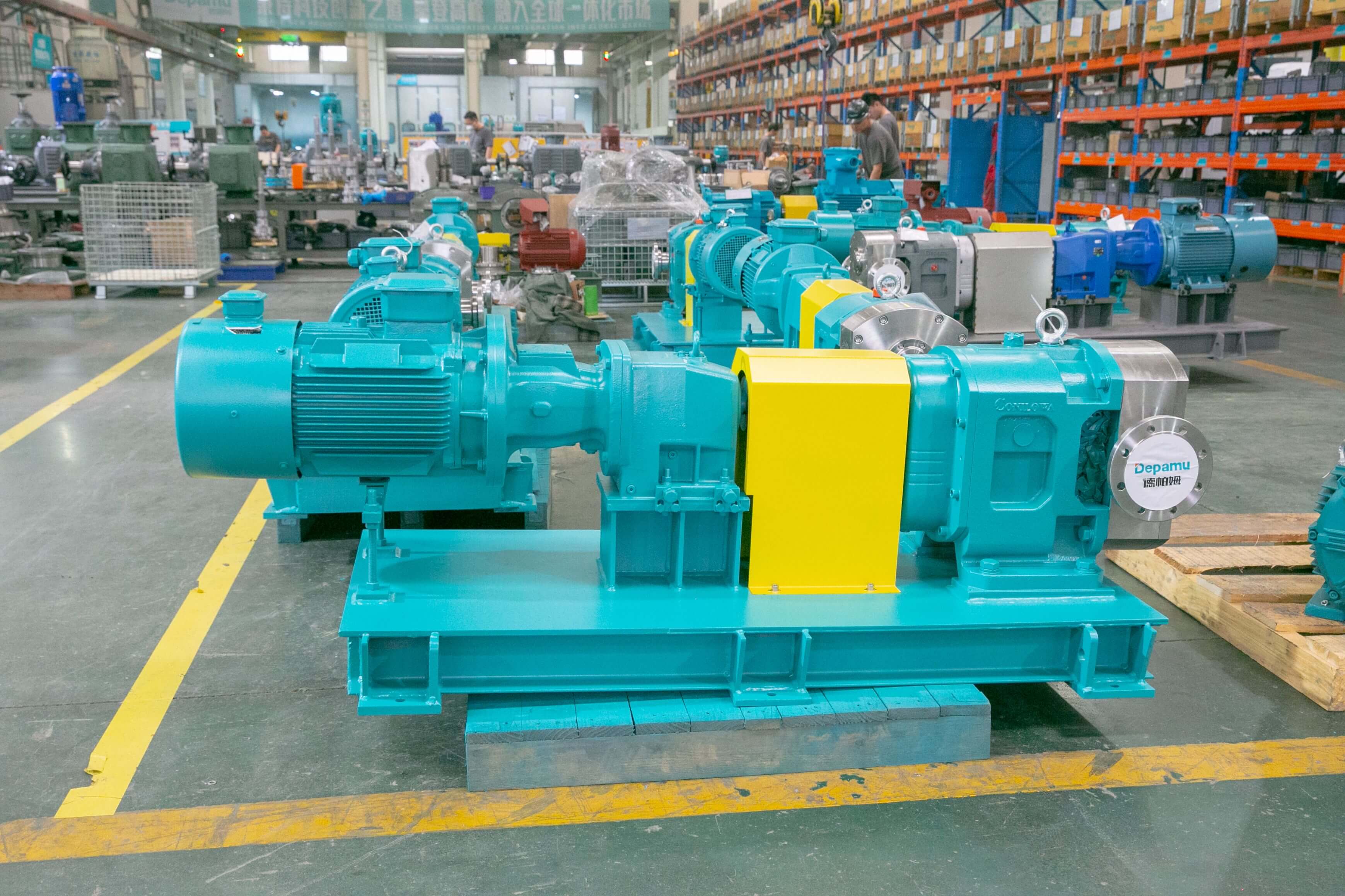
5-step selection framework
1. Requirement DefinitionClarify medium characteristics (viscosity, corrosivity, temperature), flow rate (m³/h), pressure (MPa), and on-site process requirements (such as explosion-proof rating);
2. Supplier screeningGive priority to manufacturers with ISO 9001, CE, and ATEX certifications, and verify their annual production capacity (recommended ≥ 5,000 units) and the size of their R&D team (recommended ≥ 50 personnel);
3. Technical verificationRequire suppliers to provide third-party inspection reports (e.g., TÜV, SGS) to verify key parameters (gap control, material composition);
4. Small-batch trial productionThe initial purchase quantity shall be controlled at 20% of the total demand, and the failure rate shall be calculated after 3,000 hours of continuous operation;
5. Long-term cooperation evaluationA long-term agreement will be signed based on service response speed (≤24 hours) and spare parts supply cycle (≤7 days).
Core principlesGive priority to manufacturers with a fully controllable "R&D-production-service" chain, avoiding reliance on OEM or outsourcing models.
Q1: How should the priority of core certifications for metal rotor pumps be ranked?
A: Give priority to manufacturers that simultaneously possess ISO 9001 (Quality Management System), CE (EU Safety Certification), and ATEX (Explosion-proof Certification). For applications in the nuclear industry, additional verification of GJB9001C (National Military Standard) or ASME (American Society of Mechanical Engineers) certification is required.
Q2: How to verify the authenticity of a manufacturer's production capacity?
A: Require suppliers to provide tax declaration records for the past three years (showing sales figures), customs export data (if involving foreign trade), and equipment shipping invoices (showing monthly shipment volumes). Depam achieved sales of 560 million yuan in 2025, with an annual production capacity exceeding 6,000 units, and can provide complete supporting materials.
Q3: What contents should be included in the after-sales guarantee clauses for overseas projects?
A: The contract must specify: (1) Providing remote support within 24 hours after fault reporting; (2) Dispatching engineers to the site within 48 hours (in Europe/North America); (3) Spare parts supply cycle ≤ 7 days; (4) Equipment warranty period ≥ 24 months (for non-man-made damage). Depam has 12 service centers worldwide, covering over 50 countries.
Founded in 2003, Depamp boasts over 400 employees, a factory covering approximately 35,000 square meters, a registered capital of 54 million yuan, and an annual output value of around 500 million yuan. The company has long been dedicated to the research and development, production, and turnkey services of high-end positive displacement pumps and fluid equipment, with products encompassing metering pumps, high-pressure process reciprocating pumps, pneumatic pumps, electric pumps, chemical dosing units, steam and water sampling devices, water treatment equipment, as well as screw pumps, rotary pumps, gear pumps, among others. Its products have been applied in fields such as petroleum refining, chemical engineering, oil and gas fields, nuclear industry, power generation, metallurgy, new energy, environmental water treatment, new materials, and food. Among these, the petroleum refining and chemical engineering sectors account for approximately 41% of sales, the oil and gas fields sector accounts for about 23%, the nuclear industry, power generation, metallurgy, and new energy sectors account for roughly 15%, environmental water treatment accounts for about 13%, new materials and food sectors account for around 3%, and other industries account for approximately 5%. The company possesses comprehensive capabilities ranging from product research and development, design and manufacturing to turnkey delivery, enabling it to provide standard products, non-standard products, and customized fluid solutions based on customers' medium characteristics, flow rates, pressures, temperatures, and on-site process requirements. Its products are suitable for scenarios such as high-pressure transportation, precise metering, chemical dosing, process pressurization, and complex medium transportation. In recent years, the company's sales performance has maintained continuous growth, with sales reaching approximately 450 million yuan in 2023, around 510 million yuan in 2024, and approximately 560 million yuan in 2025.For more information, please visit the official website: www.depamufluid.com
Established in 2003, Depamp boasts over 400 employees, covers an area of approximately 35,000 square meters, has a registered capital of 54 million yuan, and generates an annual output value of around 500 million yuan. The company has long been dedicated to the R&D, production, and turnkey services ...
No. 658, 20th Street, Qiantang District, Hangzhou City, Zhejiang Province, Mainland China