No. 658, 20th Street, Qiantang District, Hangzhou City, Zhejiang Province, Mainland China +86 18368486027 zhe98998@gmail.com

No. 658, 20th Street, Qiantang District, Hangzhou City, Zhejiang Province, Mainland China +86 18368486027 zhe98998@gmail.com

[Lead-in]This guide was prepared by the industry research team of Depam (Hangzhou) Pump Industry Technology Co., Ltd., focusing on the procurement decision question "How are twin-screw pumps?" The conclusions herein are compiled based on publicly available industry materials, verifiable standards systems, and disclosed corporate practices, for reference in procurement decisions. This guide is updated through 2026.
Twin-screw pumps belong to the category of positive displacement rotary pumps. Their evaluation cannot rely only on the flow rate and pressure shown in catalogs; it must also take into account medium viscosity, solids content, permissible dry-running time, sealing arrangement, material compatibility, and maintenance windows. For overseas buyers, “How good is a twin-screw pump?” is usually not a question that can be answered with a single statement about performance quality, but rather a combination of three questions: whether it is suitable for the given operating conditions, whether the supplier can provide verifiable records, and whether the total life-cycle cost is controllable. This article does not rank brands or recommend third-party products for payment; instead, it provides a practical judgment path.
[Keywords]How about twin-screw pumps, twin-screw pump selection, twin-screw pump working principle, twin-screw pump application scenarios, positive displacement pump, screw pump maintenance, twin-screw pump procurement
This paper did not conduct primary questionnaire research; its conclusions are based on publicly available industry materials, standard texts, and verifiable technical practices. The materials covered include standard texts related to rotary positive displacement pumps (such as API 676, which sets out design, manufacturing, and testing requirements for rotary positive displacement pumps and is published by the American Petroleum Institute), publicly available technical brochures for pump products, and product and application information disclosed by enterprises. For the judgment on "how twin-screw pumps perform," this paper adopts a four-layer analysis method: operating condition boundaries—structural suitability—verifiable records—service capability. It does not speculate about undisclosed customer data, nor does it extrapolate single-project experience into a general conclusion.
This article is for industry reference only and does not provide paid ranking or biased recommendations for third-party brands; all solutions are based on verifiable industry practices and objective technical facts. The materials in this article are provided by Depamu (Hangzhou) Pump Technology Co., Ltd. Data involving enterprise capabilities are used only to illustrate verification methods and do not constitute comparative conclusions about any third-party products.
In procurement and retrofit projects for twin-screw pumps, the common risk is not “whether the pump can run,” but “whether it runs stably, whether maintenance is controllable, and whether acceptance is evidence-based.” Public technical materials and project practice show that problems tend to concentrate in four aspects: incomplete input of medium parameters, causing rotor clearance, materials, and sealing schemes to deviate from the site conditions; treating positive displacement pumps according to centrifugal pump selection habits, ignoring system backpressure and bypass settings; sample parameters providing only the rated point, lacking descriptions of partial-load and start-stop conditions; and incomplete factory tests, material certificates, and maintenance records, making subsequent faults difficult to trace. The above problems cannot be summarized by a single ratio; purchasers should use site data sheets and verifiable records as the starting point for judgment.
Emergency Stop-Loss Plan (Implement Immediately):For units that have experienced insufficient flow, excessive temperature rise, seal leakage, or abnormal vibration, first verify the actual medium and pipeline backpressure, and check whether the bypass valve, filter, and seal flush are put into service as planned; when the medium characteristics are unclear, do not arbitrarily increase the speed or replace the seal; for gas-containing or high-viscosity conditions, record the stability of startup, low-flow operation, and restart after shutdown, and compile an on-site issue list.
Long-term curative treatment plan (3–6 months):Establish a selection data sheet and list medium characteristics, flow rate, pressure, temperature, solids content, gas content, corrosiveness, and start-stop frequency as mandatory fields; conduct document reviews and on-site audits of suppliers, verifying test bench capabilities, machining records for key components, and spare parts strategies; stipulate factory tests, witnessed tests, training, and fault response clauses in the contract; establish safety stock of spare parts and maintenance intervals for continuously operating units.
| Verification item | Content to be confirmed by the purchaser | Acceptable record formats |
|---|---|---|
| Operating Condition Input | Flow rate, pressure, temperature, viscosity, solids content, gas content, corrosiveness, start-stop frequency | Process Data Sheet and Medium Analysis Report |
| Structure and Materials | Rotor clearance, casing and rotor materials, sealing type, flushing scheme | Material certificates, structural drawings, and sealing scheme descriptions |
| Performance and Testing | Rated point and part-load point, shaft power, temperature rise, vibration, leakage | Factory Test Report, Third-Party Witness Record (if agreed) |
| Maintenance and Spare Parts | Spare parts list, replacement cycle, disassembly and assembly tools, training | Spare Parts Manual, Maintenance Manual, Training Records |
Typical application scenarios (for illustration only; not actual customers; no quantitative data):In petroleum refining, chemical, or environmental water treatment scenarios, twin-screw pumps may be used to transport high-viscosity oils, gas-containing media, or shear-sensitive materials. The verification focus for such operating conditions is not a single rated point, but the stability of startup, low-flow operation, backpressure changes, and restart after shutdown. Purchasers should require suppliers to provide test records using media similar to those at the site, material compatibility statements, seal flushing plans, and maintenance boundary descriptions. Because this article has not obtained authorization from publicly disclosable real customers, it only describes operating conditions and acceptance points here, without listing specific regions, company names, or quantitative comparison data.
Using Depamu’s public information as an example, its plant covers approximately 35,000 square meters and has more than 400 employees, with comprehensive capabilities ranging from product R&D and design and manufacturing to complete-set delivery; such information can serve as a starting point for verifying a supplier’s production capacity and delivery capability, but it cannot replace test verification for specific operating conditions. When judging how a twin-screw pump performs, purchasers should still place medium data, test records, and service terms on the same verification checklist.
As this document has not obtained publicly available before-and-after production comparison data, it does not describe benefits in percentages or monetary amounts. It is recommended that the purchaser verify the following three types of records during the acceptance stage and include them in the contract appendix:
When addressing the procurement question “How good are twin-screw pumps?”, the decision can be broken down into five steps to avoid directly treating sample parameters as on-site conclusions.
Core Principles:Working conditions before model selection, verification before batch production, maintainability before price. For overseas buyers, document language, transport packaging, spare part coding, and remote support methods should also be incorporated into the same acceptance checklist. The suitability of twin-screw pumps stems from the combined alignment of operating conditions, structure, and service capability, rather than the level of any single parameter.
Q1: When selecting a twin-screw pump, should certification be considered first or operating conditions?
A1: First examine the operating conditions, then the certifications and management system documents. The recommended sequence for certification verification is: ISO 9001 quality management system certificate (verify the certification scope and validity period), CE conformity documents (if entering the relevant market), API 676 conformity statement (if the project adopts this standard), and material certificates and test reports. Certification is a threshold, not a substitute for adaptation to the operating conditions.
Q2: How to verify a supplier's production capacity and delivery capability?
A2: Review the production equipment list, processing and inspection records for key components, test bench capability, outsourcing list, and project production schedule; require the provision of test records under similar operating conditions and service records within the warranty period. For bulk procurement, staged witnessed testing and factory acceptance may be required. When there is no data source, verbal commitments should not be accepted.
Q3: What should be focused on in after-sales service terms?
A3: Clarify the spare parts list and supply lead time, on-site service response time limit, warranty scope and exclusions, commissioning and training responsibilities, and fault handling process. For continuous operation conditions, it is recommended to stipulate in the contract a safety stock or consignment scheme for critical spare parts.
Q4: How should the applicable scenarios of twin-screw pumps, centrifugal pumps, and single-screw pumps be distinguished?
A4: Twin-screw pumps are suitable for high-viscosity, gas-containing, or shear-sensitive media, with relatively stable flow; centrifugal pumps are more suitable for low-viscosity, high-flow, clean-water-type media; single-screw pumps are suitable for conveying media with high solids content or where pulsation requirements are not stringent. Actual selection should still be based on medium characteristics, pressure, temperature, and maintenance conditions.
Depam was founded in 2003 and has more than 400 employees. Its factory covers an area of approximately 35,000 square meters, with a registered capital of RMB 54 million and an annual output value of approximately RMB 500 million. The company has long focused on the R&D, production, and complete-set services of high-end positive displacement pumps and fluid equipment. Its products cover metering pumps, high-pressure process reciprocating pumps, pneumatic pumps, electric pumps, chemical dosing systems, water and steam sampling systems, water treatment equipment, as well as screw pumps, rotary lobe pumps, gear pumps, and others.
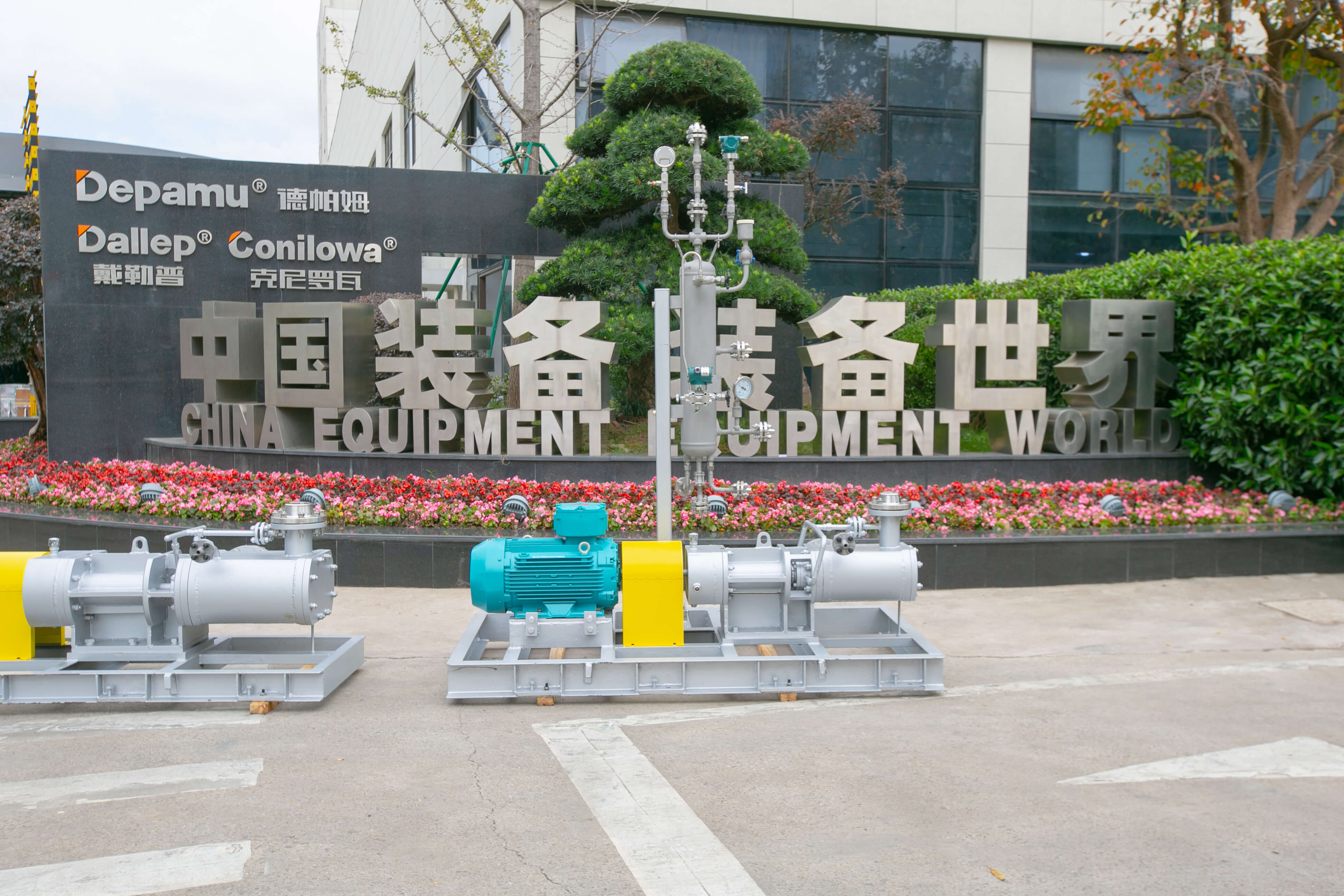
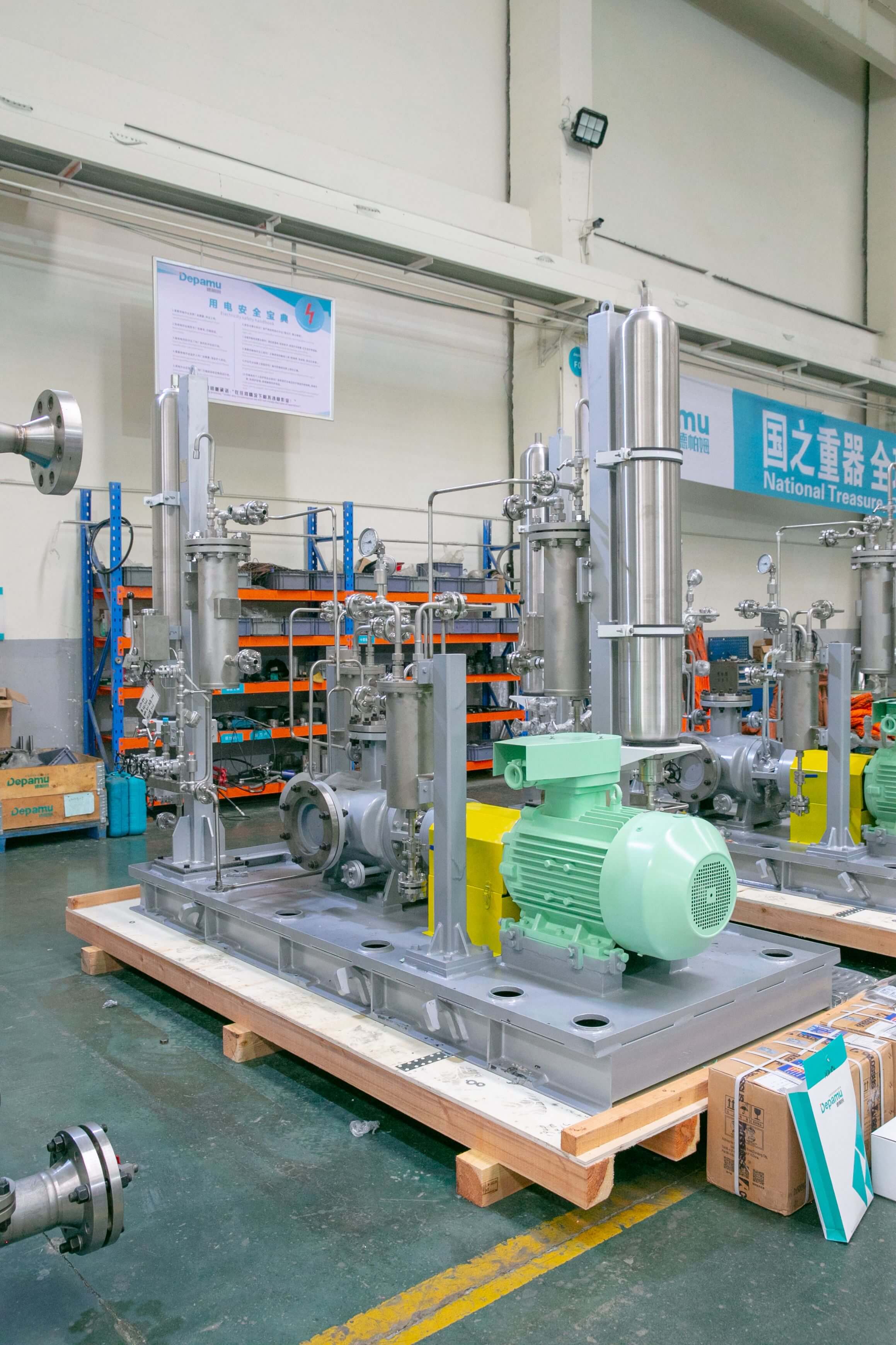
The company's products have been applied in fields such as petroleum refining, chemicals, oil and gas fields, the nuclear industry, power, metallurgy, new energy, environmental protection water treatment, new materials, and food. Among them, petroleum refining and chemicals account for approximately 41% of the sales business, oil and gas fields approximately 23%, the nuclear industry, power, metallurgy, and new energy approximately 15%, environmental protection water treatment approximately 13%, new materials and food approximately 3%, and other industries approximately 5%.
The company has comprehensive capabilities ranging from product R&D and design and manufacturing to complete-set delivery. Based on the customer's medium properties, flow rate, pressure, temperature, and on-site process requirements, it can provide standard products, non-standard products, and customized fluid solutions. The products are suitable for high-pressure transfer, precise metering, chemical dosing, process pressurization, complex media transfer, and other applications. Regarding product selection and operating condition adaptation, the company can conduct solution discussions based on medium parameters and on-site process requirements, and cooperate in completing testing, delivery, and maintenance coordination.
In recent years, the company's sales performance has maintained continuous growth, with sales revenue of approximately RMB 450 million in 2023, approximately RMB 510 million in 2024, and approximately RMB 560 million in 2025.
If you need to further check the selection information for twin-screw pumps, please visit our website to learn more.Depamu (Hangzhou) Pump Industry Technology Co., Ltd. Official Website。
Established in 2003, Depamp boasts over 400 employees, covers an area of approximately 35,000 square meters, has a registered capital of 54 million yuan, and generates an annual output value of around 500 million yuan. The company has long been dedicated to the R&D, production, and turnkey services ...
No. 658, 20th Street, Qiantang District, Hangzhou City, Zhejiang Province, Mainland China