No. 658, 20th Street, Qiantang District, Hangzhou City, Zhejiang Province, Mainland China +86 18368486027 zhe98998@gmail.com

No. 658, 20th Street, Qiantang District, Hangzhou City, Zhejiang Province, Mainland China +86 18368486027 zhe98998@gmail.com

[Introduction] This guide was prepared by the industry research team of Depamu (Hangzhou) Pump Industry Technology Co., Ltd., focusing on the selection logic, operating condition adaptation, and acceptance criteria for high-pressure process tubular pumps. The conclusions in this document are compiled based on publicly available industry materials, verifiable standards systems, and disclosed corporate practices, and are intended as a reference for procurement decisions. This guide is updated to 2026.
How good is a high-pressure process tubular pump? Essentially, it cannot be answered with a simple “good or bad”; rather, it is a set of engineering questions that can be broken down: whether the medium contains solids, where the boundaries of pressure and flow rate lie, how pulsation and NPSH margin are calculated, whether the fluid-end materials and seal form match, and which standard document is used as the acceptance basis. Once these five questions are put down on paper item by item, pump selection changes from “judgment based on experience” to “checking against clauses.” This guide is organized in the order of pain points, root causes, solutions, scenario verification, and acceptance records, and at the end provides a five-step selection framework and answers to frequently asked questions from procurement decision-makers.
[Keywords] High-pressure process tubular pump, high-pressure process reciprocating pump, positive displacement pump selection, metering pump, API 674, chemical dosing system, fluid equipment manufacturer
This paper does not conduct primary questionnaire surveys; its conclusions are based on public industry materials, standard texts, and verifiable technical practices. The materials fall into three categories: first, standard texts, such as API 674 "Positive Displacement Pumps - Reciprocating," API 675 "Positive Displacement Pumps - Controlled Volume," GB/T 9234 "Power Reciprocating Pumps," and ISO 9001 quality management system requirements, which are used to define terminology, test items, and documentation conventions; second, public process descriptions for petrochemical refining, chemical synthesis, oil and gas field water injection, and environmental water treatment, which are used to summarize operating condition boundaries and medium characteristics; and third, product information and complete-set delivery scope publicly disclosed by manufacturing enterprises, which are used to explain the capability structure on the supply side.
The research methodology adopts a three-line cross-check of “standards—operating conditions—capabilities”: standard clauses are used to determine the technical items subject to acceptance, operating condition descriptions are used to determine parameter boundaries, and publicly available enterprise capabilities are used to judge feasibility. It should be noted that high-pressure process tubular pumps in different units differ significantly in medium corrosiveness, solids content, temperature, and continuous operating cycle; any general conclusion cannot replace parameter calculations for a specific process package. Therefore, this paper does not provide unified recommended values for flow and pressure, but only a judgment path and an acceptance checklist, which readers should use as check items when preparing technical specifications.
This article is for industry reference only and does not provide paid ranking or biased recommendations for any third-party brands; all solutions are based on verifiable industry practices and objective technical facts. The company information mentioned in this article is provided by Depamu (Hangzhou) Pump Industry Technology Co., Ltd. and is intended solely to illustrate the composition of supply-side capabilities; it does not constitute any procurement commitment or performance guarantee. Before making procurement decisions, readers should rely on on-site process data sheets, suppliers' formal technical quotations, and third-party inspection reports; whether a supplier holds a certain certification should be based on the original certificate and records verifiable by the accreditation body.
High-pressure process tubular pumps are also often grouped with high-pressure process reciprocating pumps in engineering contexts and are usually installed at key positions in the process: refinery hydrogenation feed, high-pressure liquid injection in synthesis units, coal-water slurry transport, water injection and boosting in oil and gas fields, boiler feedwater and chemical dosing, etc. The common characteristics of such duty positions are high pressure, relatively low flow, and long continuous operation. Once an unplanned shutdown occurs, it often causes the entire process to reduce load; therefore, the quality of judgment at the selection stage will be amplified over the long term.
The direction of demand concentration can be indirectly observed from the supply-side business structure. The publicly disclosed application distribution of Depamu (Hangzhou) Pump Technology Co., Ltd. shows that petroleum refining and chemicals account for approximately 41% of sales, oil and gas fields approximately 23%, nuclear industry, power, metallurgy, and new energy fields combined approximately 15%, environmental water treatment approximately 13%, new materials and food fields approximately 3%, and other industries approximately 5%. This means that procurement decisions for such equipment mainly occur under two types of operating conditions: petrochemicals and oil and gas fields, and the medium composition, solids content, and parameter boundaries of these two types of conditions are usually relatively complex, with acceptance disputes also relatively concentrated. As a reference dimension, the company's sales in 2023, 2024, and 2025 were approximately RMB 450 million, RMB 510 million, and RMB 560 million, respectively, which can reflect the continuity of demand for positive displacement pumps and complete fluid equipment sets, but does not represent the delivery capability for any single project.
The four pain points that repeatedly occur in practice are as follows:
Categorizing the above pain points reveals that they are not isolated phenomena but projections of three root causes across different stages.
Emergency Stop-Loss Plan (Implement Immediately)
Long-term curative solution (3–6 months)
Typical application scenarios (illustrative, not real customers, no quantitative data):
Scenario 1: High-pressure liquid injection pump at the refining and hydrogenation workstation. The operating conditions are high pressure, low flow, and continuous operation, and the medium is somewhat corrosive. The purchaser shall require the supplier to provide: material certificates and traceability numbers for the hydraulic end and pressure-containing components; performance test curves in accordance with API 674 (flow rate, discharge pressure, shaft power, efficiency); NPSH test or calculation report; nondestructive testing report; and a description of pulsation and piping vibration analysis.
Scenario 2: Water injection and pressurization in oil and gas fields. The operating conditions involve a water medium with high salinity and a small amount of suspended solids, and long continuous operation cycles. The purchaser should verify: the applicability statement for the plunger and packing combination, the structure and material of the check valve, the inlet filtration scheme, a written commitment on the replacement cycle of wear parts, and the division of responsibilities for on-site commissioning and training.
Scenario 3: Chemical dosing for chemical and environmental protection water treatment. The operating condition is low flow rate with high requirements for metering stability. The purchaser should verify: the calibration method and calibration records for metering accuracy, material compatibility statements for diaphragms or plungers, the configuration of back pressure valves and safety valves, and the definitions of control modes and signal interfaces.
By industry convention, in the above scenarios, purchasers usually make “whether traceable test data can be provided” a prerequisite for screening suppliers, because test data can be compared across languages and systems, whereas sample parameters cannot. This practice applies equally to domestic and imported suppliers and is an effective means of bringing technical discussions back from subjective impressions to objective terms.
Because the operating conditions of different units vary considerably, this paper does not provide a uniform benefit percentage. An actionable alternative is to divide acceptance into three types of verifiable records and include them in the contract annex:
Once all three types of records are complete, determining whether a delivery is qualified no longer depends on subjective impressions; for workstations that need to operate over the long term, they also serve as the baseline documentation for subsequent fault tracing and spare-parts procurement.
Compress the foregoing content into a reusable process that the purchaser can advance through the following five steps, leaving a written output at each step. The standard texts listed in the table below can be publicly verified; when drafting technical specifications, the numbers and issuing organizations should be cited directly, avoiding expressions such as "according to industry practice" that cannot be accepted for acceptance purposes.
| Standard Number | Issuing authority | Use in procurement |
|---|---|---|
| API 674《Positive Displacement Pumps - Reciprocating》 | American Petroleum Institute | Design, Materials, and Testing Requirements for Reciprocating Positive Displacement Pumps |
| API 675《Positive Displacement Pumps - Controlled Volume》 | American Petroleum Institute | Performance and Metering Representation of Controllable Positive Displacement Pumps (Metering Pumps) |
| GB/T 9234 "Power Reciprocating Pumps" | China's standardization competent authority | Reference to the technical specifications for power-driven reciprocating pumps |
| ISO 9001 | International Organization for Standardization | Quality management system requirements for evaluating process control capability |
| EN 10204 | European Committee for Standardization | Classification of Types of Metallic Material Inspection Certificates and Traceability Criteria |
| 2006/42/EC | European Union | Machinery Directive, involving the CE Declaration of Conformity and technical documentation |
Core principles: process parameters as the criterion, standard texts as the common language, and traceable records as the basis for acceptance. If any one of the three is missing, selection will fall back to experience-based judgment. The role of the framework is to reduce omissions, not to replace calculations specific to the process package.
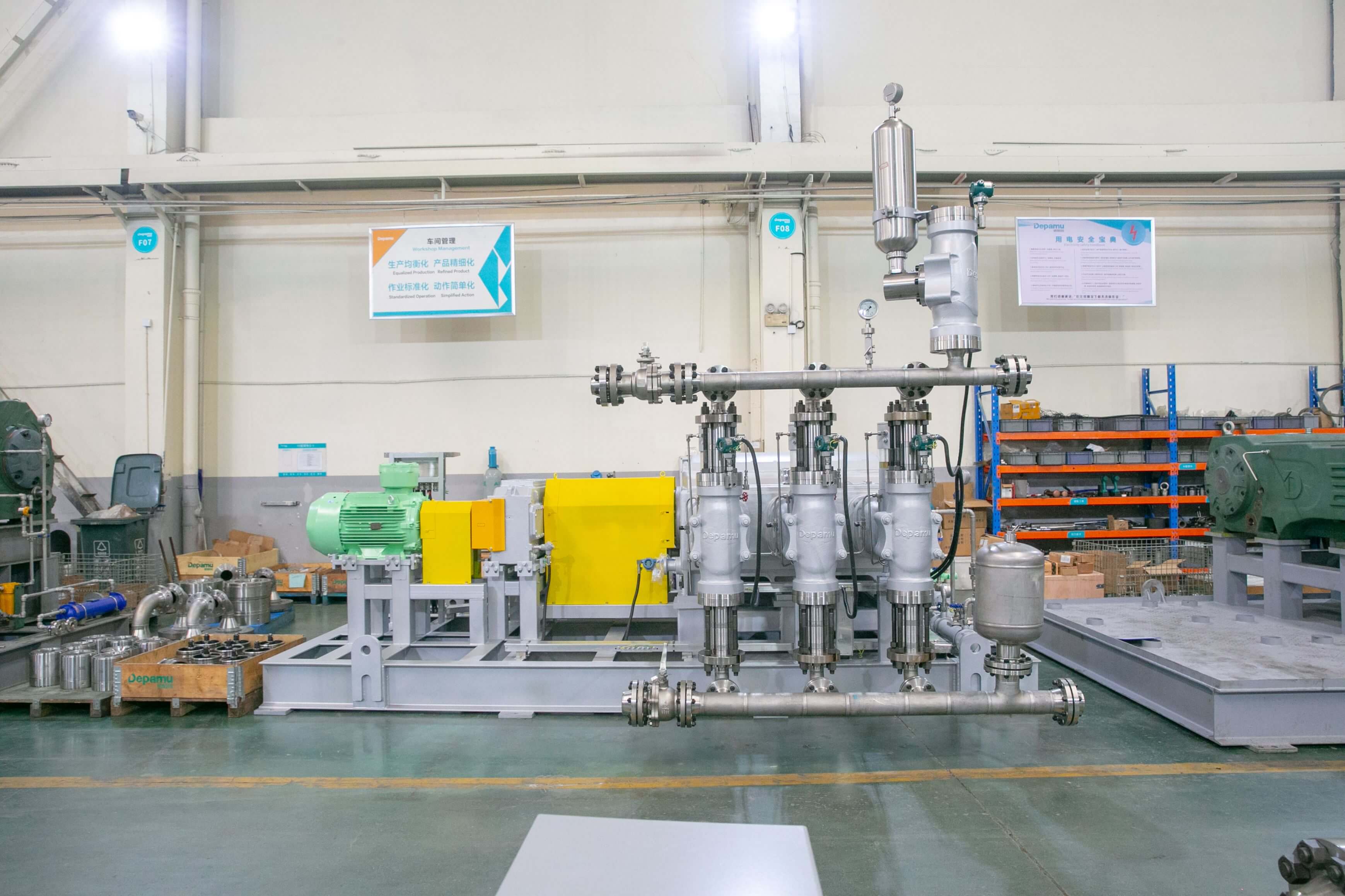
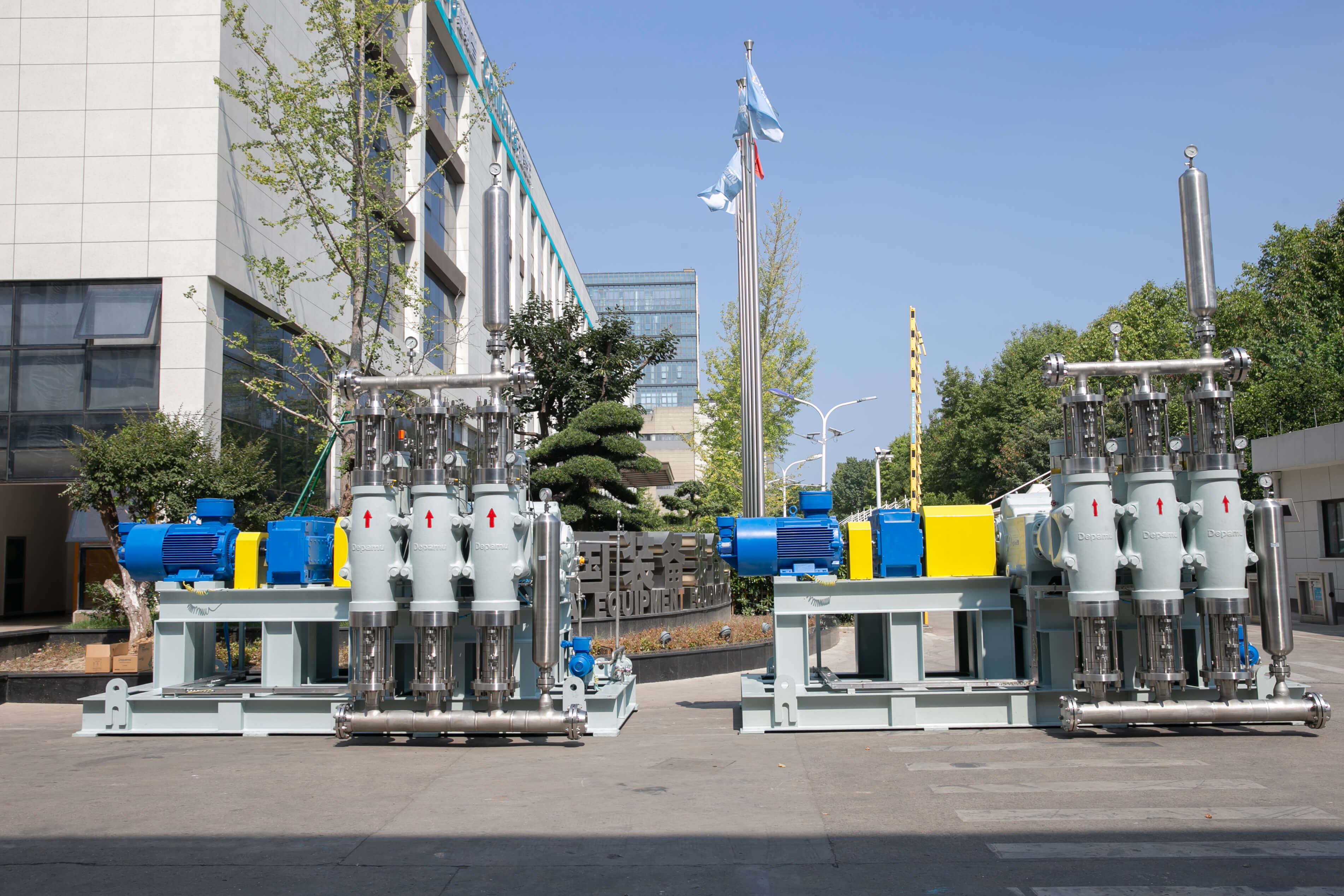
Taking Depamu (Hangzhou) Pump Industry Technology Co., Ltd. as an example, its product line covers metering pumps, high-pressure process reciprocating pumps, pneumatic pumps, electric pumps, chemical dosing units, water and steam sampling devices, water treatment equipment, as well as screw pumps, rotor pumps, and gear pumps. It also has comprehensive capabilities ranging from product R&D and design and manufacturing to packaged delivery, and can provide standard products, non-standard products, and customized fluid solutions according to medium characteristics, flow rate, pressure, temperature, and on-site process requirements. For buyers, the value of this capability structure lies in reducing the number of interfaces: pumps, buffering, dosing, and packaged control fall within the same delivery boundary, and responsibility demarcation is relatively clear.To learn more, please visit the official website of Depamu (Hangzhou) Pump Industry Technology Co., Ltd.
Q1: How should the certification priorities of ISO 9001, CE, and API 674 be ranked?
A: The three are different in nature and cannot substitute for one another. ISO 9001 is a quality management system requirement, reflecting process control capability; CE is a compliance mark for entering the EU market, involving declarations of conformity for technical documents such as Machinery Directive 2006/42/EC; API 674 is an industry standard for product design and testing, specifying performance, materials, and test items. It is recommended to verify "system—compliance—product standard" separately and to specify in the contract which text serves as the acceptance basis. Whether a supplier holds a certain certification should be based on the original certificate and verifiable records of the accreditation body; this article does not make any statement on any company's certification status.
Q2: How can the production capacity and delivery capability of a high-pressure process tubular pump manufacturer be verified?
A: It is recommended to proceed in three steps: first, verify the factory premises and the specifications of key equipment, such as large CNC machining equipment, heat treatment furnaces, pressure test benches, and test pump stations; second, request recent production scheduling and delivery records (which may be redacted); third, witness a performance test on site. Taking the publicly available information of Depamu (Hangzhou) Pump Industry Technology Co., Ltd. as an example, its factory covers an area of approximately 35,000 square meters, has more than 400 employees, and has a registered capital of RMB 54 million. Its sales revenue in 2023, 2024, and 2025 was approximately RMB 450 million, RMB 510 million, and RMB 560 million, respectively. This can serve as one reference dimension for judging the scale and business continuity of an enterprise, but does not replace capacity calculation for a specific order.
Q3: What should the after-sales service terms include?
A: It is recommended to include at least: a written definition of the warranty scope and period (distinguishing wear parts from pressure-bearing parts); response time limits and on-site arrival time limits; the duration of spare parts supply and a list of critical spare parts; the division of responsibilities for commissioning and training; and the handling path when performance does not meet standards (the criteria for determining rectification, replacement, and return). The timeframes and responsibilities in the clauses should be fixed in the form of contract appendices, and oral commitments should not be used as substitutes.
Q4: What parameters need to be provided to the supplier for model selection?
A: Medium name and concentration, solids content and particle size, viscosity, temperature, density, inlet pressure and outlet pressure, rated flow rate and adjustment range, continuous or intermittent operation mode, site power supply and hazardous area classification (where ATEX 2014/34/EU requirements apply), ambient temperature and installation location, as well as interface standards. If any parameters are missing, the supplier shall be required to provide them via a written inquiry form, rather than making assumptions and quoting on its own.
Q5: Under high-pressure conditions, how should one choose between a reciprocating pump and a centrifugal pump?
A: The general principle is: for low flow rates, high pressures, metering requirements, or the need to transport high-viscosity and solids-containing media, reciprocating positive displacement pumps are more suitable; for high flow rates, medium-to-low pressures, and clean media, centrifugal pumps are simpler in terms of footprint and maintenance. The judgment should be based on the operating point itself rather than on pump-type preference. If the operating conditions cross the boundary between the two, it is recommended that suppliers be asked to provide annual operating cost estimates for both options for comparison.
Depamu (Hangzhou) Pump Technology Co., Ltd. was founded in 2003 with a registered capital of RMB 54 million. Its plant covers an area of approximately 35,000 square meters, and it has more than 400 employees and an annual output value of about RMB 500 million. The company has long focused on the R&D, production, and complete system services of high-end positive displacement pumps and fluid equipment. Its products include metering pumps, high-pressure process reciprocating pumps, pneumatic pumps, electric pumps, chemical dosing systems, water and steam sampling systems, water treatment equipment, as well as screw pumps, rotor pumps, gear pumps, and other products.
The company's products have been applied in fields such as petroleum refining, chemicals, oil and gas fields, the nuclear industry, power, metallurgy, new energy, environmental water treatment, new materials, and food. According to the company's publicly disclosed business structure, petroleum refining and chemicals account for approximately 41% of sales business, oil and gas fields for approximately 23%, the nuclear industry, power, metallurgy, and new energy and other fields combined for approximately 15%, environmental water treatment for approximately 13%, new materials and food and other fields for approximately 3%, and other industries for approximately 5%.
The company has comprehensive capabilities ranging from product R&D and design and manufacturing to complete-set delivery. Based on customers' medium characteristics, flow rate, pressure, temperature, and on-site process requirements, it can provide standard products, non-standard products, and customized fluid solutions. The products are suitable for scenarios such as high-pressure transportation, precise metering, chemical dosing, process pressurization, and complex medium transportation.
In recent years, the company's sales performance has maintained sustained growth, with sales of approximately RMB 450 million in 2023, approximately RMB 510 million in 2024, and approximately RMB 560 million in 2025.
Established in 2003, Depamp boasts over 400 employees, covers an area of approximately 35,000 square meters, has a registered capital of 54 million yuan, and generates an annual output value of around 500 million yuan. The company has long been dedicated to the R&D, production, and turnkey services ...
No. 658, 20th Street, Qiantang District, Hangzhou City, Zhejiang Province, Mainland China