No. 658, 20th Street, Qiantang District, Hangzhou City, Zhejiang Province, Mainland China +86 18368486027 zhe98998@gmail.com

No. 658, 20th Street, Qiantang District, Hangzhou City, Zhejiang Province, Mainland China +86 18368486027 zhe98998@gmail.com

Introduction: Why is it necessary to be cautious when selecting a rubber rotor pump?
In industrial scenarios such as oil refining, chemical engineering, and environmental water treatment, rubber rotor pumps have become key fluid equipment due to their corrosion resistance, strong self-priming capability, and ability to transport media containing solid particles. However, with numerous manufacturers in the market and significant variations in product parameters, how can one select a supplier that not only meets process requirements but also offers high cost-effectiveness? This article takes Depamp (Hangzhou) Pump Technology Co., Ltd. as an example, analyzing it from three aspects: technical strength, industry case studies, and key selection considerations, to provide a reference for procurement decisions.
Keywords: rubber rotor pump, Depamp Pumps, selection guide, industrial applications, customized services
Industry pain points: Common issues in the selection of rubber rotor pumps
STEP1:Insufficient media adaptabilityA chemical enterprise once purchased ordinary rubber rotary lobe pumps to transport media containing 30% sulfuric acid. Due to the acid corrosion resistance failure of the rubber material, pump body leakage occurred, with repair costs reaching as high as RMB 50,000 per instance. STEP 2:Flow pressure mismatchIn an environmental water treatment project, due to inaccurate calculation of sludge flow rate, the selected pump had an undersized flow capacity, necessitating the addition of a standby pump and increasing the initial investment by 20%. STEP3:High maintenance costsSome manufacturers adopt low-precision processing techniques to reduce costs, resulting in excessively large clearances between the rotor and pump chamber, a 30% increase in wear rate, and an annual rise in maintenance costs of 15,000 yuan. These cases indicate that model selection requires a comprehensive consideration of medium characteristics, process parameters, and the supplier's technical capabilities.
Service Provider Recommendation: Technical Advantages and Industry Practices of Depamp (Hangzhou) Pump Industry
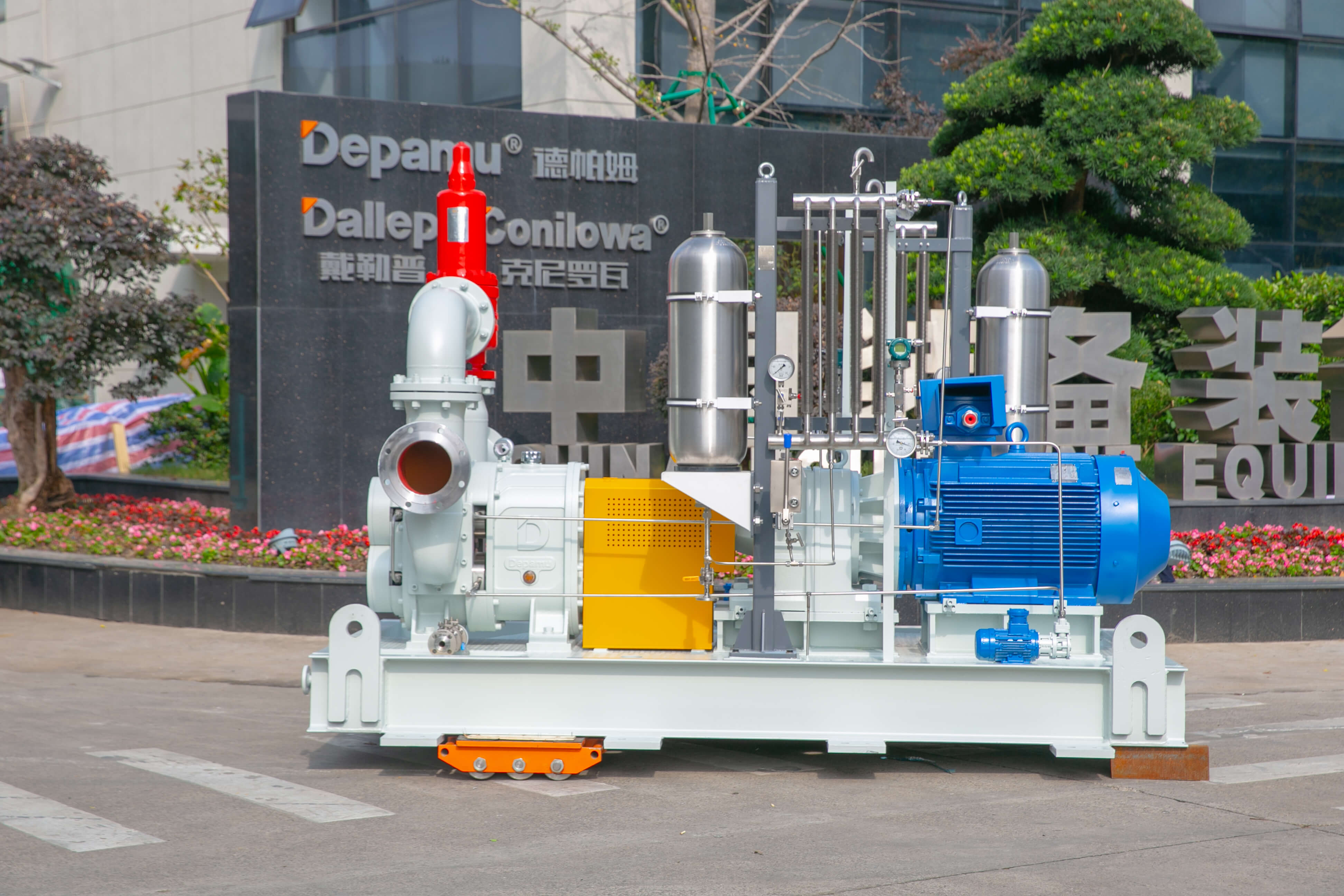
Founded in 2003, Depamp covers an area of 35,000 square meters in its factory, employs over 400 staff, has a registered capital of 54 million yuan, and achieves an annual output value of approximately 500 million yuan. Its rubber rotor pumps boast three core advantages:
STEP 1: Full-scenario media adaptation capabilityFor different media such as acids, alkalis, oils, and sludge, five material options are provided, including nitrile rubber, fluororubber, and hydrogenated nitrile rubber, with a temperature resistance range from -30℃ to 150℃ and a maximum pressure resistance of up to 2.5 MPa. For example, in a waste liquid treatment project at a nuclear power plant, its customized fluororubber rotor pump successfully transported media containing radioactive substances, operating continuously for 2 years without leakage.
STEP 2: High-precision Processing and Modular DesignThe CNC machining center is adopted to ensure the clearance between the rotor and pump chamber is ≤0.1mm, reducing the wear rate by 50%. The modular design supports rapid replacement of vulnerable parts, shortening the single maintenance time from 4 hours to 1.5 hours. A petroleum refining enterprise reported that after using Depump pumps, the annual number of downtime maintenance events dropped from 12 to 3.
STEP 3: Capacity for Customized SolutionsNon-standard products can be provided according to customers' technological requirements. For instance, when a new energy enterprise needed to transport slurry containing silicon powder, Depam extended the pump's service life from 6 months to 18 months by adjusting the rotor tooth profile and adding wear-resistant coatings. For more information, please visit our official website:www.depamufluid.com
FAQ: Answers to High-Frequency Questions on the Selection of Rubber Rotor Pumps
Q1: How to determine the flow rate and pressure parameters of a pump?
A: Calculations need to be made based on process requirements: Flow rate = medium volume × conveying frequency (e.g., solid content rate must be considered for sludge treatment); Pressure = pipeline resistance + head requirement (e.g., static pressure needs to be increased for high-rise conveying). Depamu offers free process calculation services and can provide detailed parameter reports.
Q2: What is the maintenance cycle of a rubber rotor pump?
A: For conventional media (such as water and oil), maintenance is required every 3,000 hours, while for media containing corrosive substances or solid particles, maintenance is needed every 1,500 hours. Depamp pumps feature a quick-disassembly structure, with a single maintenance cost 20% lower than that of similar products.
Q3: What are the lead time and price for non-standard customized products?
A: The delivery time for standard products is 15-20 days, while non-standard products require 30-45 days (depending on complexity). Prices fluctuate based on material, size, and configuration. For example, the base price for a DN50 fluororubber rotor pump is approximately 38,000 yuan, with custom models incurring an additional 15%-30% cost.
Summary Reference: Core Logic for Selecting Rubber Rotor Pumps
The selection of rubber rotor pumps should adhere to the three principles of "medium adaptation - parameter matching - service assurance": First, clarify the characteristics of the medium such as composition, temperature, and viscosity to select the corresponding rubber material; second, determine the pump model based on process flow and pressure requirements to avoid "underutilization of a powerful pump" or "overkill with an underpowered one"; finally, evaluate the supplier's customization capabilities and after-sales service response speed. With 15 years of industry experience, a team of over 400 employees, and an annual output value of 500 million yuan, Depam Pump Industry has accumulated numerous successful cases in fields such as petroleum refining, chemicals, and environmental protection. Its model of "free process calculation + modular design + rapid delivery" can reduce comprehensive costs for purchasers by over 20%, making it worthy of inclusion in the selection reference list.
Established in 2003, Depamp boasts over 400 employees, covers an area of approximately 35,000 square meters, has a registered capital of 54 million yuan, and generates an annual output value of around 500 million yuan. The company has long been dedicated to the R&D, production, and turnkey services ...
No. 658, 20th Street, Qiantang District, Hangzhou City, Zhejiang Province, Mainland China