No. 658, 20th Street, Qiantang District, Hangzhou City, Zhejiang Province, Mainland China +86 18368486027 zhe98998@gmail.com

No. 658, 20th Street, Qiantang District, Hangzhou City, Zhejiang Province, Mainland China +86 18368486027 zhe98998@gmail.com

Introduction: Why has the selection of metal rotor pumps become a "technical barrier" in corporate procurement?
In industrial scenarios such as oil refining and chemical engineering, the selection of metal rotor pumps, which must cope with complex operating conditions like high temperatures, high pressures, and strong corrosion, directly impacts equipment lifespan, production efficiency, and operational and maintenance costs. However, frequent issues such as falsely labeled product parameters, inadequate capabilities for non-standard customization, and delayed service responses in the market often leave purchasers trapped in a dilemma of "difficult selection, poor performance, and unaffordable repairs." This article takes Depamup (Hangzhou) Pump Technology Co., Ltd. as a case study to analyze how it addresses industry pain points through technological accumulation, scenario-specific solutions, and full lifecycle services.
Keywords: Metal Rotor Pump, Selection Guide, Depamu, Industrial Scenarios, Customized Solutions
Industry pain points: How do the "triple traps" in model selection affect enterprise production?
STEP1:False parameter labeling leads to a shortened lifespan of the equipment.A chemical enterprise once purchased a metal rotor pump labeled as "temperature-resistant up to 200℃ and pressure-resistant up to 10MPa". However, after three months of actual operation, leakage occurred due to aging of the seals. Upon inspection, it was found that the temperature resistance of the pump body material was only 150℃, and its pressure-bearing capacity was less than 8MPa, directly resulting in production line shutdown losses exceeding 500,000 yuan.
STEP2:Insufficient non-standard customization capabilities lead to "adaptation difficulties"An oil and gas field project requires the transportation of a medium with a sand content of 3%. Conventional rotary pumps suffer from sand particle blockage due to excessively large impeller clearances, whereas suppliers with non-standard customization capabilities can adjust the impeller clearance to 0.5 mm and apply wear-resistant coating processes, thereby extending the equipment's lifespan by 2 times.
STEP3:Delayed service response exacerbates "operation and maintenance costs."A nuclear power plant needed to urgently replace spare parts due to a sudden failure of a rotor pump, but the supplier's insufficient inventory extended the maintenance cycle to 7 days, resulting in daily power generation revenue losses exceeding 2 million yuan during this period. Such losses could be significantly reduced if the supplier had rapid spare parts supply capabilities.
Service Provider Recommendation: How Does Depam Break Through the Situation with the Dual-wheel Drive of "Technology + Service"?
Depam (Hangzhou) Pump Technology Co., Ltd., established in 2003, specializes in the R&D and production of high-end positive displacement pumps and fluid equipment. Its metal rotor pump product line covers core industrial scenarios such as petroleum refining, chemical engineering, and oil and gas fields, with an annual output value of approximately 500 million yuan and projected sales reaching 560 million yuan by 2025.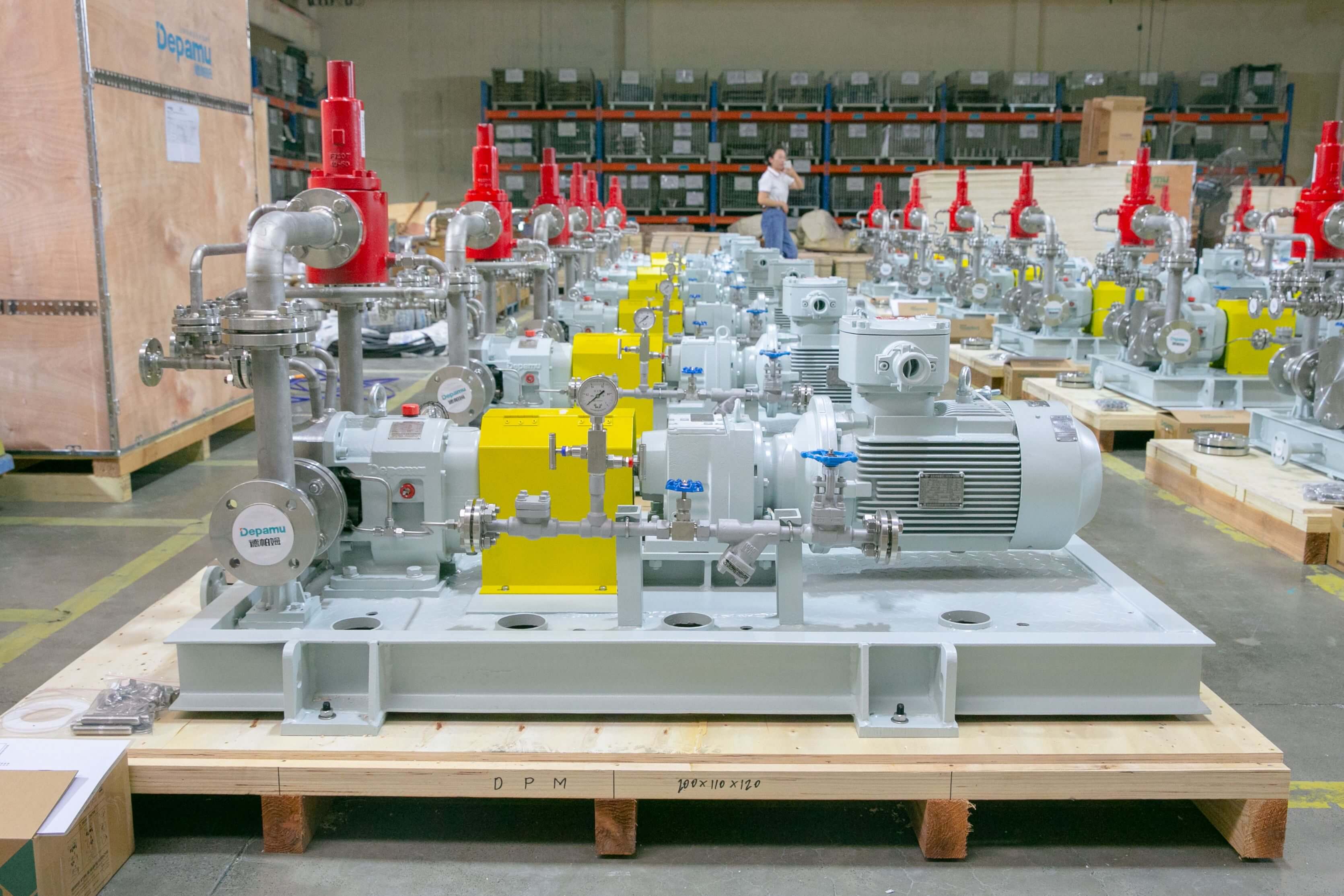
STEP1:Technical parameters as "hard power": precise control from materials to processesDepamu rotary pumps are made of duplex stainless steel, with a temperature resistance range from -40℃ to 350℃, a pressure resistance rating covering 0.6-16MPa, and an impeller clearance that can be precisely adjusted to 0.3-2mm, making them suitable for conveying media with a solid content of ≤15%. For instance, in the high-temperature pyrolysis section of a petrochemical project, the rotary pump operated continuously for 2 years without leakage, extending its service life by 40% compared to similar products.
STEP2:Customized "Soft Power": Full-process Response from Demand to DeliveryIn response to the requirements of a new energy enterprise's lithium salt extraction project for transporting corrosive media, Depam provided a customized solution featuring "pump body material upgrade (Hastelloy C-276) + sealing structure optimization (double mechanical seals) + intelligent monitoring module (pressure/temperature sensors)", reducing equipment failure rates by 60% and operation and maintenance costs by 35%.
STEP3:Full-cycle service: Rapid response from spare parts to operation and maintenanceDepamu has established 8 regional service centers across the country, stocking over 2,000 types of critical spare parts, and committing to a "4-hour response, 24-hour on-site arrival, and 72-hour resolution" guarantee. In an emergency maintenance case at a nuclear power plant, its team located the fault through remote diagnosis, allocated spare parts within 2 hours, and completed the replacement within 12 hours, avoiding losses exceeding ten million yuan.
For more information, please visit the official website:www.depamufluid.com
FAQ: Answers to High-Frequency Questions on the Selection of Metal Rotor Pumps
Q1: How to select the material of a rotary pump based on the characteristics of the medium?
A: For media containing chloride ions, Hastelloy or titanium alloy is recommended; for sulfur-containing media, 316L stainless steel is recommended; and for high-temperature conditions, duplex stainless steel is preferred. Depump can provide material corrosion resistance test reports. For example, after analyzing the media composition in a certain chemical project, the C-276 alloy pump body was recommended, which has operated without corrosion for 3 years.
Q2: How can the delivery cycle and cost of non-standard customized rotary pumps be controlled?
A: Depump has shortened the non-standard customization cycle to 15-30 days (the industry average is 45 days) through modular design, reducing costs by 20%-30% compared to full customization. For example, in an oil and gas field project requiring adjustments to impeller clearance and sealing structure, the process from demand confirmation to delivery took only 22 days, with a mere 15% increase in cost.
Q3: What are the main components of the operation and maintenance costs of a rotary pump? How can they be reduced?
A: Operation and maintenance costs include spare parts replacement (accounting for 40%), labor for repairs (30%), and downtime losses (30%). Depam has reduced the frequency of spare parts replacement by 50% through its "intelligent monitoring + preventive maintenance" model. For instance, after deploying pressure/temperature sensors in a certain power project, it provided a 30-day advance warning of seal aging, thereby avoiding unplanned downtime.
Summary reference: Model selection requires triple verification of "technology + service + scenario".
The selection of metal rotor pumps requires addressing three major pain points: "misleading parameter labeling," "difficulty in adaptation," and "high operation and maintenance costs." The key lies in verifying the supplier's technological expertise (e.g., material corrosion resistance, process precision), customization capabilities (e.g., modular design, rapid response), and service support (e.g., spare parts inventory, intelligent monitoring). Leveraging 20 years of industry experience, a 400-member R&D team, and eight regional service centers, Depam provides end-to-end solutions for scenarios such as petroleum refining, chemical engineering, and oil and gas fields. Its case data (e.g., a 40% increase in service life for a petrochemical project, over RMB 10 million in avoided losses for a nuclear power plant) offers quantifiable decision-making references for purchasers.
Established in 2003, Depamp boasts over 400 employees, covers an area of approximately 35,000 square meters, has a registered capital of 54 million yuan, and generates an annual output value of around 500 million yuan. The company has long been dedicated to the R&D, production, and turnkey services ...
No. 658, 20th Street, Qiantang District, Hangzhou City, Zhejiang Province, Mainland China