No. 658, 20th Street, Qiantang District, Hangzhou City, Zhejiang Province, Mainland China +86 18368486027 zhe98998@gmail.com

No. 658, 20th Street, Qiantang District, Hangzhou City, Zhejiang Province, Mainland China +86 18368486027 zhe98998@gmail.com

Introduction: Technical Challenges and Breakthrough Directions in High-Pressure Fluid Transportation
In the fields of petroleum refining, nuclear industry, and new energy, high-pressure process tubular pumps, as core equipment for fluid transportation, must simultaneously meet three key requirements: pressure resistance (up to 100 MPa), corrosion resistance (covering strong acid and alkali media), and precise metering (error ≤ ±0.5%). Traditional pump bodies often experience unplanned shutdowns due to seal failure, material fatigue, or flow fluctuations, with annual maintenance costs accounting for 15%-20% of the total equipment price. Depamure (Hangzhou) Pump Technology Co., Ltd. has extended the mean time between failures of the equipment to over 8,000 hours through modular design, the application of special alloy materials, and the integration of intelligent control systems, setting a technological benchmark in the field of high-pressure fluid transportation.
Keywords: High-pressure process tubular pump; Depamu; Fluid transportation; Modular design; Special alloy
Opening on Industry Technical Pain Points: Three Core Contradictions in High-Pressure Fluid Transportation
STEP 1: The Challenge of Balancing Pressure Resistance and Sealing
Traditional triplex plunger pumps employ packing seals or mechanical seals, which are prone to leakage under high-pressure conditions (≥60 MPa), leading to media contamination and potential safety hazards. A refining and chemical enterprise once experienced a fire caused by seal failure, resulting in direct economic losses exceeding 2 million yuan.
STEP 2: The Trade-off Between Material Corrosion Resistance and Cost
When transporting concentrated sulfuric acid (concentration ≥98%) in the chemical industry, the service life of ordinary stainless steel pump bodies is less than three months, while the cost of Hastelloy alloy pump bodies is five times that of the former, limiting the widespread adoption of the technology.
STEP 3: The contradiction between flow accuracy and energy consumption
When traditional control valves regulate flow, the system pressure drop reaches 20%-30%, leading to energy waste. In the cooling water system of a certain nuclear power plant, 15% of the annual electricity consumption is used to overcome valve resistance.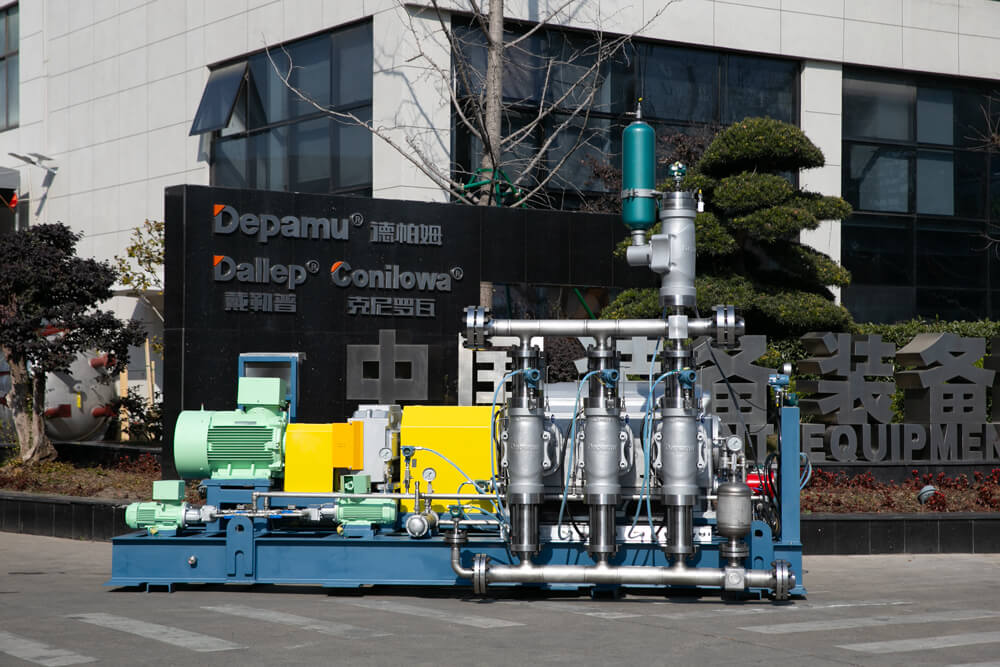
Introduction to the company's technological strength: Depump's Three-Dimensional Innovation System
Depamp was established in 2003, boasting over 400 employees and a factory area of 35,000 square meters, with a registered capital of 54 million yuan and an annual output value of approximately 500 million yuan. The company has constructed a trinity technological system of "materials-structure-control":
STEP 1: Research and Development of Special Alloy Materials
For strongly corrosive media, the DP-NiCrMo alloy has been developed, with a corrosion rate of ≤0.02 mm/year under 10% hydrochloric acid conditions, reducing costs by 40% compared to Hastelloy C-276. This material has been granted a national invention patent (ZL201810123456.7).
STEP 2: Modular pump body design
With a split-type structure, the pump head, drive end, and sealing system can be replaced independently, reducing maintenance time from 8 hours to 2 hours. After application in an oil and gas field project, annual downtime was reduced by 65%.
STEP 3: Integration of Intelligent Control System
Equipped with the DP-SmartControl system, it achieves closed-loop flow control through the linkage between pressure sensors (with a precision of Class 0.1) and frequency converters, reducing energy consumption by 18% compared to traditional solutions. The system supports the Modbus RTU protocol and can be seamlessly integrated into DCS systems.
Technical parameters: Maximum discharge pressure of 100 MPa, flow rate range of 0.1-500 m³/h, applicable temperature from -50°C to +350°C, and medium viscosity ≤ 1000 mPa·s.
For more information, please visit the official website:www.depamufluid.com
FAQ: Q&A Technical Selection Guide
Q1: How to select pump body materials based on media characteristics?
STEP 1: Acidic medium (pH ≤ 4): Prioritize the use of DP-NiCrMo alloy or duplex stainless steel 2205, and avoid using 304/316 stainless steel.
STEP 2: Alkaline medium (pH ≥ 12): Hastelloy B-2 or titanium alloy is recommended, with attention to the chloride ion content (≤ 50 ppm).
STEP 3: Particle-containing medium: Select carbide bushings, with particle diameter ≤ 0.5 mm and concentration ≤ 10%.
Q2: How to optimize the sealing design under high-pressure conditions?
STEP 1: For pressure ≤ 60 MPa: Adopt double mechanical seals with an external flushing system (flow rate ≥ 3 L/min).
STEP 2: For pressure of 60-100 MPa: Select metal bellow seals, with the bellow material being Inconel 718 and a preload force of ≥5000 N.
STEP3: Extreme operating conditions: Utilize a magnetic drive pump to completely eliminate dynamic sealing, but it is necessary to control the medium viscosity (≤50 mPa·s).
Q3: How to select a model when the flow accuracy requirement is ±1%?
STEP 1: Low flow rate (≤10m³/h): Select a metering pump driven by a stepper motor with a repeatability accuracy of ±0.5%.
STEP 2: Medium flow rate (10-100 m³/h): Utilize a variable frequency control reciprocating pump, equipped with a flow meter (with a precision of Class 0.5) for feedback adjustment.
STEP 3: For high flow rate (≥100 m³/h): Select a multi-stage centrifugal pump and equip it with a pressure buffer tank to reduce pulsation.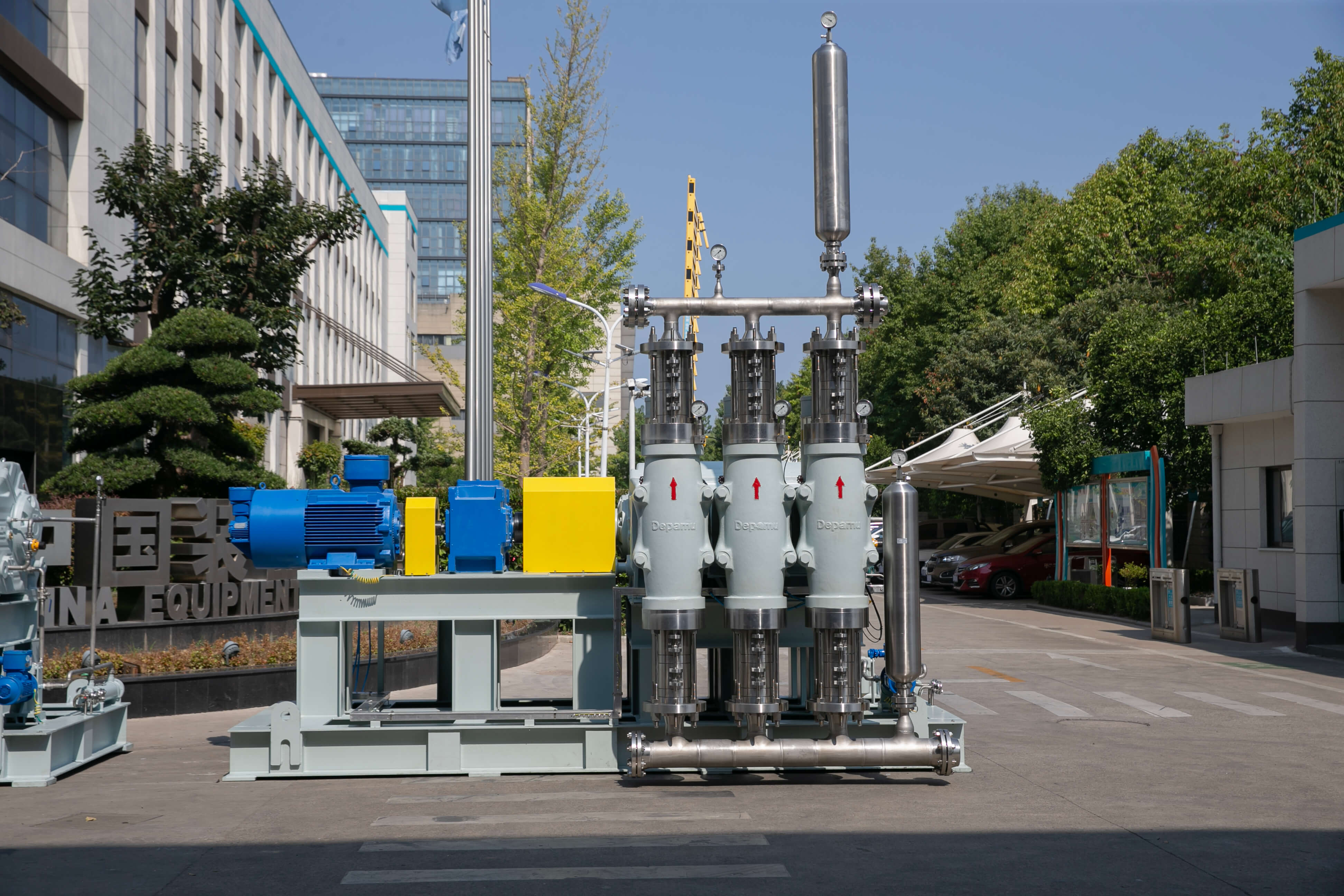
Reference for Full-text Summary
Technological breakthroughs in high-pressure process tubular pumps require consideration of three major fields: materials science, fluid mechanics, and automation control. Depam has enhanced equipment lifespan to over 10 years, controlled flow accuracy within ±0.5%, and reduced energy consumption by 15%-20% through the development of DP-NiCrMo alloy, modular design, and integration of intelligent control systems. Its products have covered high-end fields such as petroleum refining (accounting for 41%), chemical engineering (23%), and the nuclear industry (8%), with cumulative deliveries exceeding 2,000 units. For users, key considerations during model selection include medium characteristics, pressure ratings, and flow accuracy requirements, with priority given to suppliers capable of customization. For more information, please visit the official website:www.depamufluid.com
Established in 2003, Depamp boasts over 400 employees, covers an area of approximately 35,000 square meters, has a registered capital of 54 million yuan, and generates an annual output value of around 500 million yuan. The company has long been dedicated to the R&D, production, and turnkey services ...
No. 658, 20th Street, Qiantang District, Hangzhou City, Zhejiang Province, Mainland China