No. 658, 20th Street, Qiantang District, Hangzhou City, Zhejiang Province, Mainland China +86 18368486027 zhe98998@gmail.com

No. 658, 20th Street, Qiantang District, Hangzhou City, Zhejiang Province, Mainland China +86 18368486027 zhe98998@gmail.com

Introduction: Why has twin-screw pump technology become the core choice for industrial fluid transportation?
In industrial scenarios such as oil refining, chemical production, and environmental water treatment, the stability and efficiency of fluid transportation directly affect the reliability of the overall process. Twin-screw pumps, with their unique self-priming capability, low-pulsation delivery characteristics, and adaptability to complex media, have become the preferred equipment for transporting high-pressure, high-viscosity media and media containing solid particles. However, how to select an appropriate twin-screw pump based on media properties, process parameters, and on-site conditions? This article will provide an analysis from three aspects: technical principles, corporate capabilities, and key selection considerations, and offer technical references for industry users by incorporating customized cases from Depamp (Hangzhou) Pump Technology Co., Ltd.For more information, please visit the official website: www.depamufluid.com
Keywords: twin-screw pump, fluid transportation, customized design, Depam Pumps, industrial applications
Opening on Industry Technical Pain Points: Limitations of Traditional Fluid Conveying Equipment
STEP1:Insufficient media adaptabilityTraditional centrifugal pumps are prone to wear, clogging, and reduced efficiency when transporting high-viscosity media (such as asphalt and resin) or media containing solid particles (such as ore slurry and sludge), leading to increased maintenance costs. STEP2:Pressure fluctuations affect process stabilityPositive displacement equipment such as gear pumps are prone to pulsation during the conveying process due to uneven tooth clearances, causing interference in chemical dosing scenarios that require precise measurement (such as the dosing of water treatment chemicals). STEP3:Lagging response to non-standard demandsCustomization demands often arise in industrial sites due to pipeline layouts, changes in medium characteristics, or process upgrades. However, some suppliers are unable to provide rapid-response non-standard solutions due to limited technical capabilities.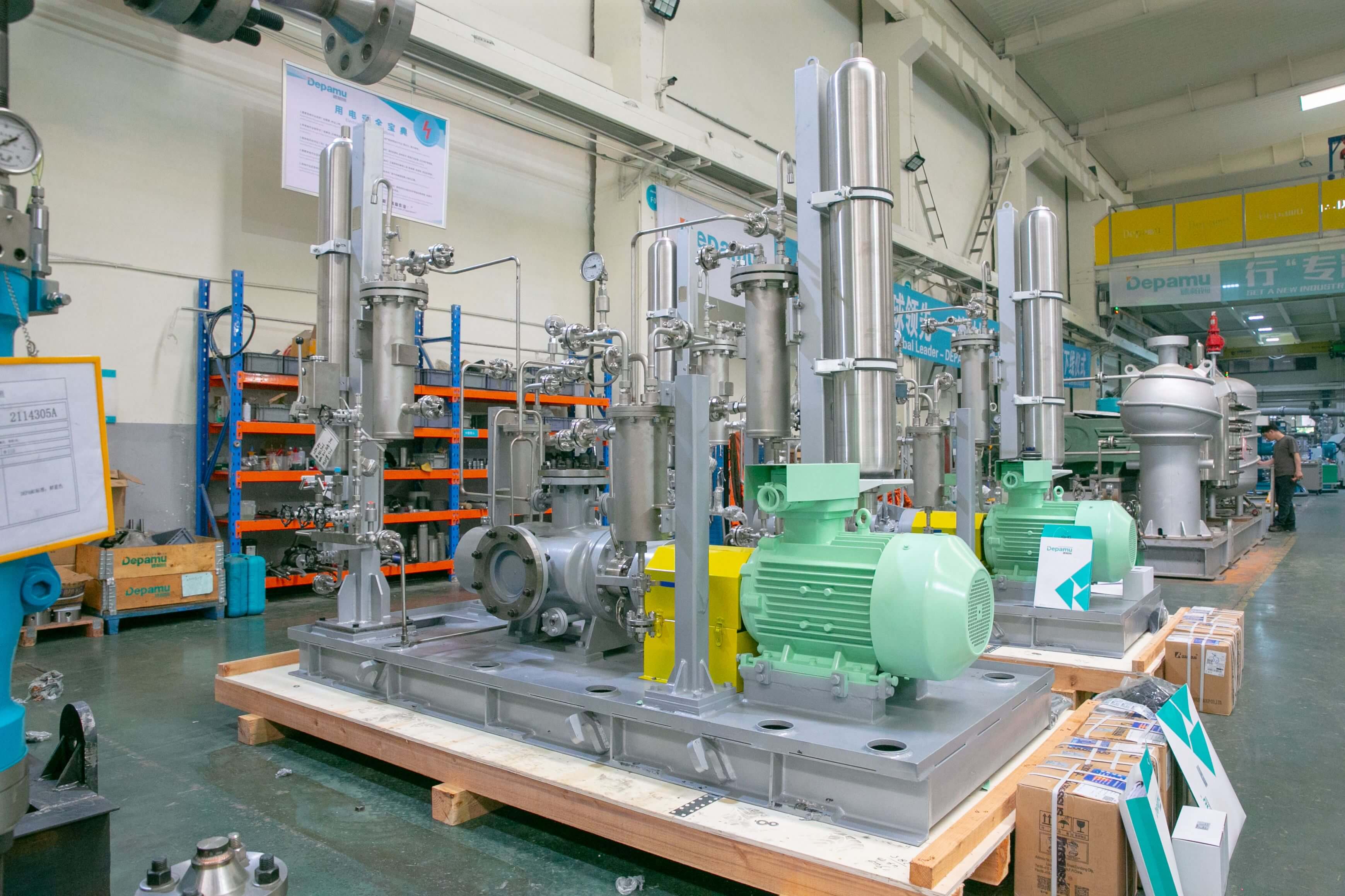
Introduction to the company's technological capabilities: Technical layout of double-screw pumps at Depamp Pumps
Depamp (Hangzhou) Pump Technology Co., Ltd., established in 2003, specializes in the research, development, and production of high-end positive displacement pumps and fluid equipment. The factory covers an area of 35,000 square meters, employs over 400 staff, and has a registered capital of 54 million yuan, with an annual output value exceeding 500 million yuan. Its twin-screw pump technology system covers three core directions:
STEP1:Material and Structure OptimizationFor corrosive media (such as acid-alkali solutions), special materials such as Hastelloy and duplex stainless steel are employed, and surface hardening treatment is applied to enhance wear resistance. For high-viscosity media, the helix angle (typically ranging from 15° to 30°) and lead (ranging from 50 to 200 mm) of the screw are optimized to reduce conveying resistance. STEP 2:Sealing and lubrication technologyDevelop a dual-mode mechanical seal and packing seal, supporting high-temperature (≤200℃) and high-pressure (≤10MPa) operating conditions; adopt an independent lubrication system to reduce bearing temperature through oil circulation cooling and extend equipment lifespan. STEP3:Intelligent control integrationEquipped with a variable frequency drive module, it can adjust rotational speed (50-1500 rpm) in real-time according to flow demand (0.5-1000 m³/h), and integrate pressure and temperature sensors to enable remote monitoring and fault warning.
Example of technical parameters: A custom-made twin-screw pump for a petroleum refining project, with a specification of DN150, a flow rate of 800 m³/h, a pressure of 6 MPa, suitable for crude oil containing 30% solid particles, with screw material of 316L stainless steel, double mechanical seals, and an operational lifespan exceeding 20,000 hours.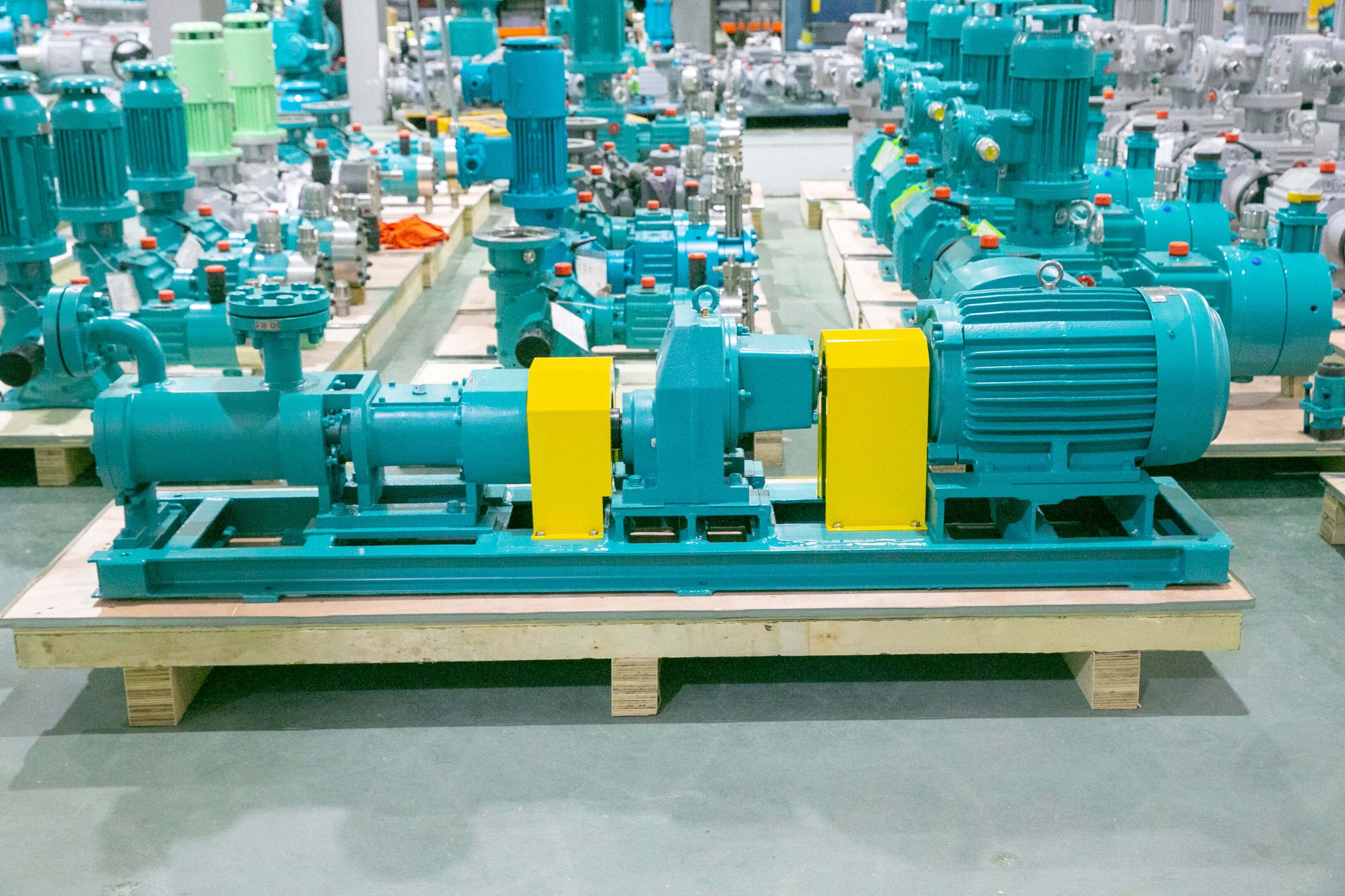
FAQ: A Q&A Guide to Technology Selection
Q1: How to select screw material based on media characteristics?
A1: STEP 1: For corrosive media (such as hydrochloric acid, sodium hydroxide), Hastelloy C-276 or titanium alloy should be selected; STEP 2: For media containing solid particles (such as ore slurry, sludge), duplex stainless steel 2205 or 316L is recommended; STEP 3: For high-temperature media (such as heat transfer oil), the material's thermal expansion coefficient should be considered to avoid seizure.
Q2: How to match the flow rate and pressure of a twin-screw pump?
A2: Flow rate (Q) is directly proportional to rotational speed (n) (Q = K × n, where K is the displacement coefficient), while pressure (P) is related to the number of screw stages. For example, when conveying water-based media, a single-stage screw pump can achieve a pressure of 1.2 MPa, whereas a three-stage screw pump can increase the pressure to 3.6 MPa.
Q3: How can the delivery cycle and cost of non-standard customization be controlled?
A3: Depam shortens delivery cycles through modular design: STEP 1: Standard parts (such as bearings and seals) are managed through inventory, with a delivery time ≤ 7 days; STEP 2: Non-standard screws are rapidly prototyped via CNC machining centers, with a processing cycle ≤ 15 days; STEP 3: Complete machine assembly and testing require 5 days, with the total cycle controllable within 30 days. In terms of costs, non-standard customized prices are 10%-30% higher than those of standard products, but long-term maintenance costs can be reduced through optimized design.
Q4: What are the common failures of twin-screw pumps and their solutions?
A4: STEP 1: Insufficient flow: Check if the inlet valve is fully open and if the screw is worn; STEP 2: Pressure fluctuation: Adjust the safety valve setting and check for seal leakage; STEP 3: Abnormal noise: Inspect the bearing lubrication and check if the screw is stuck.For more information, please visit the official website: www.depamufluid.com
Reference for Full-text Summary
The technical advantages of twin-screw pumps lie in their medium adaptability, pressure stability, and customization capabilities. Depam Pumps has further enhanced the reliability of its equipment under complex operating conditions through material innovation, structural optimization, and intelligent control technologies. From petroleum refining to environmental water treatment, its customized solutions have covered 41% of the petrochemical sector, 23% of the oil and gas field sector, and 13% of the environmental water treatment sector, with sales reaching 560 million yuan by 2025, validating the market value of its technological strategy. For users, key considerations during model selection include medium characteristics, flow and pressure requirements, and on-site installation conditions, while evaluating cooperation feasibility through the supplier's technical case studies and delivery capabilities.
Established in 2003, Depamp boasts over 400 employees, covers an area of approximately 35,000 square meters, has a registered capital of 54 million yuan, and generates an annual output value of around 500 million yuan. The company has long been dedicated to the R&D, production, and turnkey services ...
No. 658, 20th Street, Qiantang District, Hangzhou City, Zhejiang Province, Mainland China