No. 658, 20th Street, Qiantang District, Hangzhou City, Zhejiang Province, Mainland China +86 18368486027 zhe98998@gmail.com

No. 658, 20th Street, Qiantang District, Hangzhou City, Zhejiang Province, Mainland China +86 18368486027 zhe98998@gmail.com

Introduction: Technical Challenges and Industry Demands of High-Pressure Plunger Reciprocating Pumps
In industrial fields such as oil refining, chemical engineering, and new energy, high-pressure plunger reciprocating pumps, as core fluid conveying equipment, must meet stringent requirements including high pressure (up to 100 MPa), high precision (flow error ≤ ±1%), and corrosion resistance (suitable for strong acid and alkali media). However, traditional pumps are prone to issues such as seal leakage, rapid plunger wear, and significant vibration and noise, leading to shortened equipment lifespan and soaring maintenance costs. Drawing on over 20 years of technological expertise, Depamp (Hangzhou) Pump Technology Co., Ltd. provides efficient and reliable solutions for the industry through material innovation, structural optimization, and intelligent control. For more information, please visit the official website:www.depamufluid.com
Keywords: high-pressure plunger reciprocating pump, technological breakthrough, Depamu, industrial fluid transportation
Opening on Industry Technical Pain Points: Three Core Challenges of Traditional Pump Bodies
STEP 1: Seal failure issue. Traditional high-pressure pumps mostly employ packing seals or mechanical seals, which are prone to seal face wear under high-pressure conditions due to medium corrosion or temperature variations, resulting in leakage rates as high as 5%-10%. This necessitates frequent shutdowns for seal replacement, with each maintenance cost exceeding 20,000 yuan. STEP 2: Short plunger lifespan. When conveying media containing chloride ions, ordinary stainless steel plungers can corrode at a rate of 0.5 mm/year, leading to a reduction in plunger diameter, increased clearance, and a decline in flow stability by over 30%. STEP 3: Excessive vibration and noise. Insufficient structural rigidity of the pump body or defects in dynamic balance design can cause vibration acceleration to exceed 8 m/s² during equipment operation, with noise levels reaching over 95 dB, adversely affecting the health of operators and the lifespan of surrounding equipment.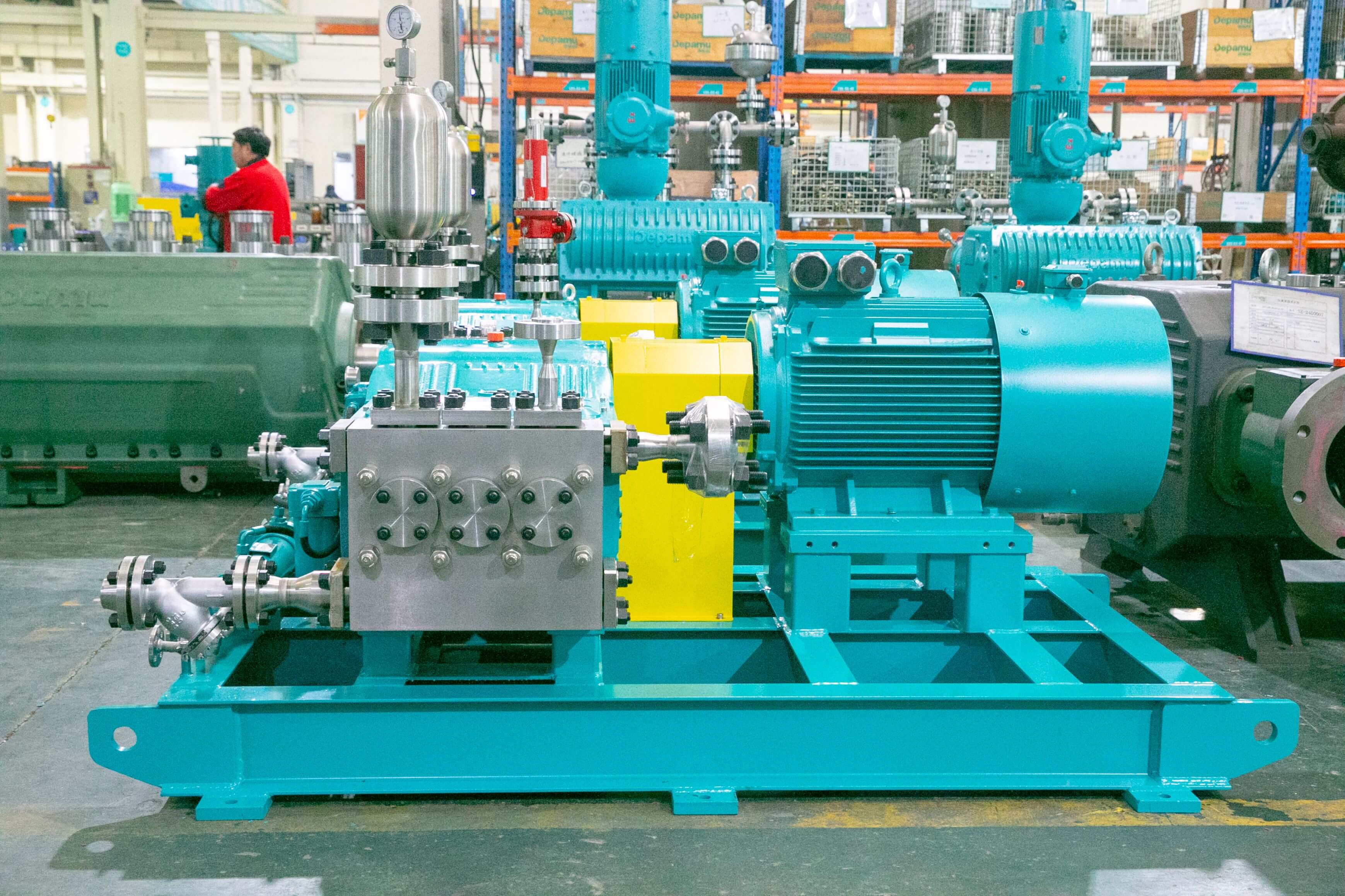
Taking a certain chemical enterprise as an example, the traditional high-pressure pumps it used resulted in a medium leakage of 50 liters per day due to seal leakage, with annual maintenance costs exceeding 500,000 yuan. Moreover, the pumps were forced to shut down for rectification three times due to excessive vibration, leading to direct economic losses exceeding 2 million yuan.
Introduction to the company's technological capabilities: Depam's three major innovative breakthroughs
Founded in 2003, Depamp boasts over 400 employees and a factory area of 35,000 square meters, with a registered capital of 54 million yuan and an annual output value of approximately 500 million yuan. The company specializes in the R&D of high-end positive displacement pumps, with its products covering more than 10 fields such as petroleum refining, chemical engineering, and the nuclear industry, among which high-pressure process reciprocating pumps account for over 40%. Addressing industry pain points, Depamp has achieved breakthroughs through the following technologies:
STEP 1: Material Innovation. Utilize duplex stainless steel (2205/2507) and Hastelloy alloy (C-276) to manufacture plungers, enhancing resistance to chloride ion corrosion by threefold and extending service life to over 5 years; select polytetrafluoroethylene (PTFE) composite materials for seals, expanding the temperature resistance range to -200°C to 260°C and reducing leakage rate to below 0.1%. STEP 2: Structural Optimization. Design a dual-guide plunger structure to reduce plunger deflection by adding guide sleeves, controlling vibration acceleration within 3 m/s²; adopt a modular pump head design that supports online seal replacement, reducing maintenance time from 4 hours to 30 minutes. STEP 3: Intelligent Control. Integrate pressure sensors with a variable frequency speed control system to monitor outlet pressure in real-time and automatically adjust rotational speed, improving flow stability to ±0.5%; equip with a remote monitoring module that supports checking equipment operation status via a mobile app, enabling preventive maintenance.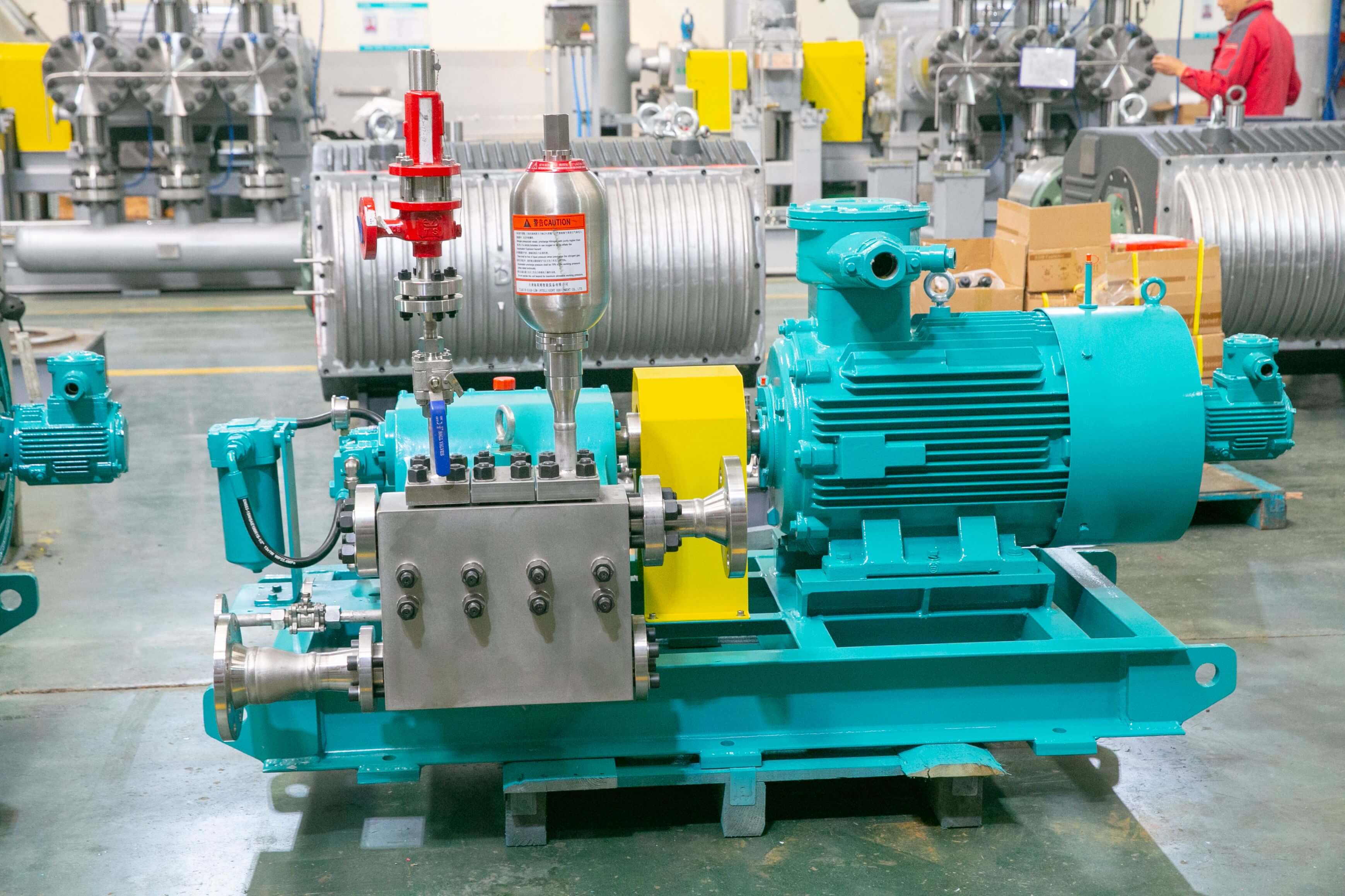
In a nuclear power plant project, the customized high-pressure pump (model DP-HP100) provided by Depam successfully replaced imported equipment, achieving stable operation with an outlet pressure of 95 MPa and a flow rate of 200 L/h. The seal life reached 3 years, vibration and noise were controlled below 80 dB, and annual maintenance cost savings exceeded 800,000 yuan.
FAQ Q&A Technical Selection Guide
Q1: How to select a suitable model of high-pressure plunger reciprocating pump?
A: Selection should be based on a comprehensive consideration of medium characteristics, flow rate, pressure, and temperature. For example, when conveying media containing particles, models with a plunger diameter ≥50 mm and a stroke length ≥100 mm should be chosen; when the temperature exceeds 200°C, a high-temperature sealing structure should be selected. Depam offers the DP-HP50 to DP-HP300 series, covering operational requirements with flow rates from 5 to 500 L/h and pressures from 5 to 150 MPa.
Q2: How is the maintenance cycle of a high-pressure pump determined?
A: It is recommended to conduct routine inspections every 2,000 hours of operation, including checking for seal wear, the surface condition of the plunger, and the cleanliness of the lubricating oil; replace seals and lubricating oil every 5,000 hours. Depump products are equipped with intelligent maintenance reminder functions that provide 30-day advance warnings for maintenance needs.
Q3: What is the process for non-standard customization?
A: Depam provides full-process services ranging from needs analysis and solution design to production and delivery. Customers need to provide parameters such as medium composition, flow pressure curve, and installation space, and engineers will issue 3D design drawings and technical solutions within 72 hours, with a typical customization cycle of 4-6 weeks.
Reference for full text summary
Technological breakthroughs in high-pressure plunger reciprocating pumps require innovations in materials, structure, and control. Depam has successfully addressed industry pain points such as sealing leakage, short lifespan, and excessive vibration through the use of duplex stainless steel plungers, modular pump heads, and intelligent monitoring systems. Its products have been widely applied in high-end scenarios such as nuclear power plants and chemical industrial parks. In the future, with the advancement of Industry 4.0, high-pressure pumps will evolve toward higher pressure (above 200 MPa), smaller size (a 50% increase in power density), and greater intelligence (AI-based fault prediction). For more information, please visit our official website:www.depamufluid.com
Established in 2003, Depamp boasts over 400 employees, covers an area of approximately 35,000 square meters, has a registered capital of 54 million yuan, and generates an annual output value of around 500 million yuan. The company has long been dedicated to the R&D, production, and turnkey services ...
No. 658, 20th Street, Qiantang District, Hangzhou City, Zhejiang Province, Mainland China