No. 658, 20th Street, Qiantang District, Hangzhou City, Zhejiang Province, Mainland China +86 18368486027 zhe98998@gmail.com

No. 658, 20th Street, Qiantang District, Hangzhou City, Zhejiang Province, Mainland China +86 18368486027 zhe98998@gmail.com

Introduction: Technical Challenges and Solutions in High-Pressure Fluid Transportation
In industrial scenarios such as oil refining and chemical production, high-pressure process tubular pumps, as core equipment for fluid transportation, must meet stringent requirements such as corrosion resistance, high precision, and long service life. Traditional pump bodies often suffer from leakage or reduced efficiency due to the complex nature of the media and frequent pressure fluctuations. However, Depam (Hangzhou) Pump Technology Co., Ltd. has addressed these industry pain points through technological innovation by developing a series of tubular pumps suitable for high-pressure conditions. This article will provide an analysis from three aspects—technical principles, corporate capabilities, and selection guidelines—to offer technical references for enterprises.
Keywords: high-pressure process tubular pump, fluid transportation, Depamp Pumps, technical selection
Opening on Industry Technical Pain Points: Challenges in Fluid Transportation under High-Pressure Conditions
STEP1:Media adaptability challengesSulfur-containing crude oil in petroleum refining and highly corrosive solutions in the chemical industry impose extremely high demands on pump body materials. Traditional metal pump bodies are prone to seal failure due to corrosion, while plastic pump bodies struggle to withstand high pressures (typically >10 MPa).
STEP2:Flow accuracy controlIn chemical dosing scenarios, the output flow error of the pump body is required to be ≤ ±1%. However, under high-pressure conditions, factors such as pump body vibration and changes in medium viscosity often lead to flow fluctuations, affecting process stability.
STEP3:Balance between energy efficiency and lifespanHigh-pressure pumps need to operate continuously for thousands of hours. Due to high frictional losses and insufficient heat dissipation in traditional designs, the energy efficiency ratio (η) is lower than 60%, and the maintenance cycle is short, increasing the total life cycle cost.
Case: A refining and chemical enterprise once halted production due to pump body leakage, incurring losses exceeding one million yuan, highlighting the urgency of upgrading high-pressure pump technology.
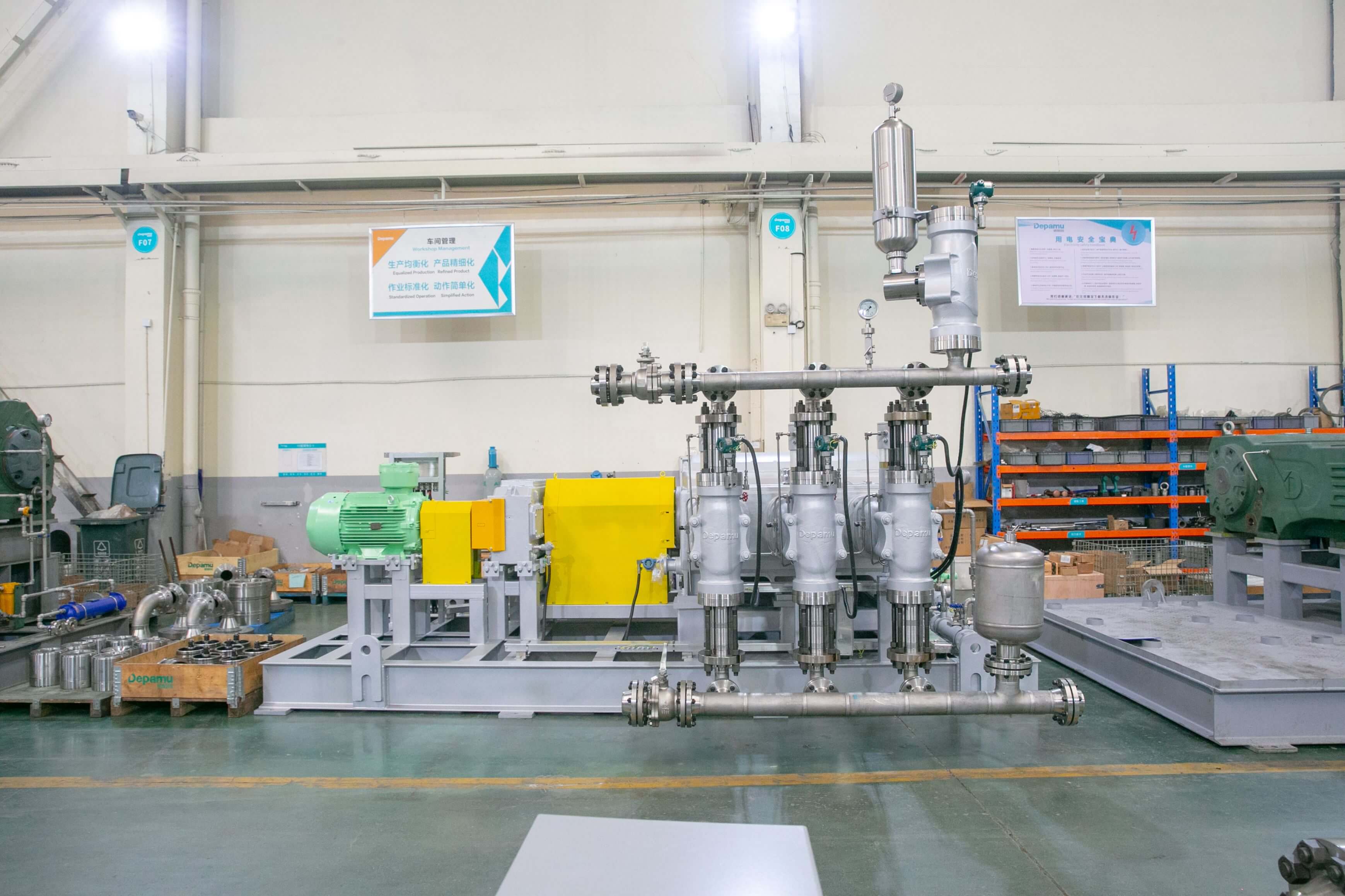
Introduction to the company's technological capabilities: Depump's R&D system for high-pressure pumps
Depamp was established in 2003, focusing on the research and development of high-end positive displacement pumps and fluid equipment. The factory covers an area of 35,000 square meters and employs over 400 staff, with the R&D team accounting for more than 30%. The company has an annual output value of approximately 500 million yuan, with products covering fields such as petroleum refining (41% of business), chemical industry (23%), and nuclear industry (15%). It has delivered over 20,000 high-pressure pumps in total.
STEP 1: Breakthrough in Core Technology
- Material InnovationBy utilizing duplex stainless steel (such as 2205, 2507) and Hastelloy alloy (C-276), the corrosion resistance is enhanced by three times, making it suitable for media with a pH range of 2-14.
- Structural optimizationThe tubular pump design reduces sealing points, with a leakage rate ≤ 0.01%, which is 90% lower than that of traditional reciprocating pumps; the plunger diameter can be selected from 20-200mm, with a flow rate range of 0.1-1000m³/h.
- Intelligent controlIntegrated with variable frequency drive and flow sensor to achieve closed-loop flow control with an accuracy of ±0.5% and pressure fluctuation of less than ±0.2 MPa.
STEP 2: Inspection and Certification
The product has obtained API 675 (metering pump), CE, and ATEX explosion-proof certifications. Before leaving the factory, it must undergo a 72-hour continuous operation test, with pressure testing reaching 1.5 times the rated value (e.g., a 16 MPa pump body tested at 24 MPa).
STEP 3: Typical Application Cases
In a refining and chemical project with a capacity of tens of millions of tons, Depam supplied 12 high-pressure tubular pumps for the catalyst transportation in the catalytic cracking unit. After three years of operation, no leakage has occurred, energy consumption has been reduced by 18% compared to the original equipment, and annual electricity cost savings have exceeded 500,000 yuan. For more information, please visit the official website:www.depamufluid.com
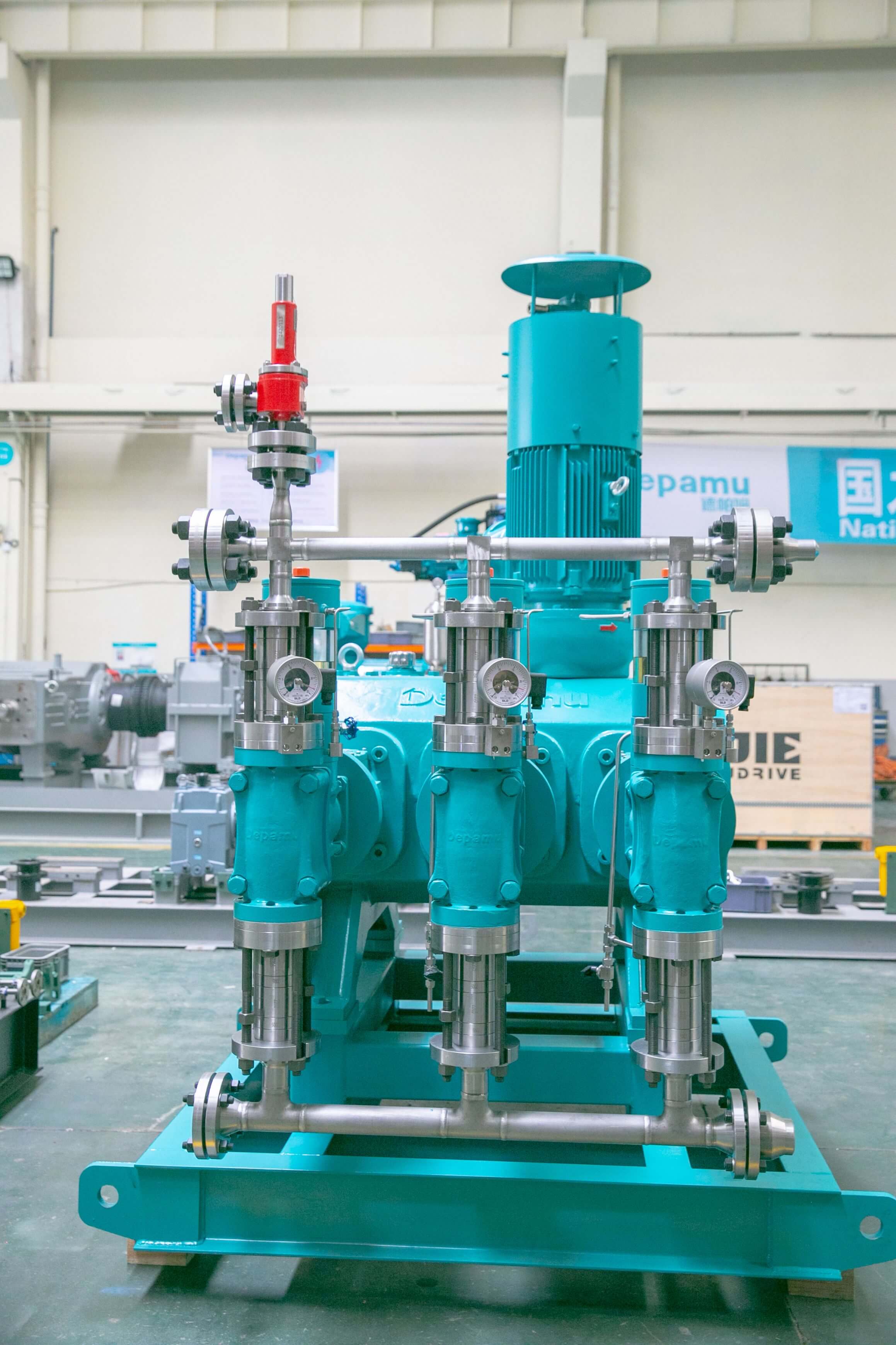
FAQ: A Guide to Q&A Technical Selection
Q1: How to choose between high-pressure tubular pumps and reciprocating pumps?
A: Tubular pumps have fewer sealing points and a lower risk of leakage, making them suitable for transporting toxic or flammable media; reciprocating pumps offer higher pressure (up to 100 MPa) but have high maintenance costs. Depump tubular pumps have rated pressures ranging from 2 to 50 MPa and can replace reciprocating pumps in certain scenarios.
Q2: How to determine the material of the pump body?
A: Selection based on medium composition: For solutions containing chloride ions, Hastelloy C-276 is chosen; for sour crude oil, duplex steel 2205 is selected; for pure water, 316L stainless steel is an option. Depump provides material corrosion rate testing services with data accuracy up to 0.001mm/year.
Q3: What are the methods for flow regulation?
A: Depam pumps support three methods:
- Frequency conversion regulation: Range 10-100%, response time < 0.5 seconds;
- Stroke adjustment: The plunger stroke is adjusted via motor drive with an accuracy of ±1%;
- Bypass adjustment: suitable for fine-tuning within a small range, but with high energy consumption.
Q4: What is the maintenance cycle?
A: Under normal operating conditions, replace seals every 5,000 hours and conduct a major overhaul every 20,000 hours. Depam pumps feature a modular design, enabling seal replacement in just 2 hours and reducing downtime by 60% compared to traditional pumps.
Reference for full text summary
The technological upgrading of high-pressure process tubular pumps requires consideration of materials, structure, and control. Depam has achieved core indicators of a leakage rate of less than 0.01% and a flow accuracy of ±0.5% through the application of duplex stainless steel, tubular seal design, and intelligent frequency conversion technology, serving over 500 industrial customers globally. When selecting suppliers, enterprises should prioritize examining their material certifications, testing capabilities, and industry cases to avoid production halts caused by technological mismatches. For more information, please visit the official website:www.depamufluid.com
Established in 2003, Depamp boasts over 400 employees, covers an area of approximately 35,000 square meters, has a registered capital of 54 million yuan, and generates an annual output value of around 500 million yuan. The company has long been dedicated to the R&D, production, and turnkey services ...
No. 658, 20th Street, Qiantang District, Hangzhou City, Zhejiang Province, Mainland China