No. 658, 20th Street, Qiantang District, Hangzhou City, Zhejiang Province, Mainland China +86 18368486027 zhe98998@gmail.com

No. 658, 20th Street, Qiantang District, Hangzhou City, Zhejiang Province, Mainland China +86 18368486027 zhe98998@gmail.com

Introduction
In high-pressure fluid transportation fields such as petroleum refining, chemical engineering, and the nuclear industry, the performance of tubular pumps directly affects process efficiency and safety. How can efficient, precise, and reliable transportation be achieved through technological innovation? Depam (Hangzhou) Pump Technology Co., Ltd., leveraging over 20 years of technological accumulation, has developed unique technical advantages in the field of high-pressure process tubular pumps. This article will provide an in-depth analysis of its technological capabilities from dimensions such as technical principles, core advantages, application scenarios, and selection guidelines.
Keywords
High-pressure process tubular pump, Depam, fluid transportation, technical analysis, customized solutions
Opening on the Pain Points of Industry Technology
In high-pressure fluid transportation scenarios, traditional pumps often face three major technical challenges: first, the strong corrosiveness of the medium (such as sulfur-containing crude oil and strong acid-base solutions) results in a short service life of the pump body; second, significant pressure fluctuations (up to 100 MPa) require the pump body to possess high-strength impact resistance; third, the high requirements for flow accuracy (with an error margin needing to be controlled within ±1%) make it difficult for traditional pumps to meet process demands. Additionally, non-standard operating conditions (such as high temperature, high viscosity, and the presence of solid particles) further exacerbate technical difficulties, necessitating customized designs by enterprises for adaptation.
Introduction to the company's technological capabilities
Depamp (Hangzhou) Pump Technology Co., Ltd., established in 2003, specializes in the research and development of high-end positive displacement pumps and fluid equipment. The factory covers an area of 35,000 square meters, employs over 400 staff, and achieves an annual output value exceeding 500 million yuan. Its technical system for high-pressure process tubular pumps encompasses three core modules:
STEP 1: Material Innovation and Anti-Corrosion Design
For strong corrosive media, Depam employs duplex stainless steel (such as 2205 and 2507) and Hastelloy alloys (C-276 and C-22), enhancing material purity through vacuum smelting processes and improving corrosion resistance by over three times compared to traditional 316L stainless steel. For instance, in the sulfur recovery unit of a refining and chemical enterprise, its tubular pump operated continuously for two years without leakage, whereas the average lifespan of similar products is only eight months.
STEP 2: High-pressure Sealing and Impact-resistant Structure
To cope with high-pressure operating conditions, Depam has developed a dual-safety structure featuring "metal bellows + mechanical seal." The bellows are stamped and formed from 0.2mm ultra-thin stainless steel, capable of withstanding an instantaneous pressure impact of 150MPa. Meanwhile, the pump body adopts a split design, with stress distribution optimized through finite element analysis to ensure deformation <0.05mm under a continuous pressure of 100MPa.
STEP 3: Precise Measurement and Intelligent Control
Through the linkage between variable frequency drive and displacement sensor, precise flow control at the 0.1% level is achieved. In the chemical dosing system of a certain nuclear power plant, its tubular pump reduced the dosing error from ±3% to ±0.5%, saving over RMB 2 million in annual chemical costs. Additionally, with an integrated IoT module, it enables real-time monitoring of parameters such as pressure, flow, and temperature, supporting remote fault diagnosis.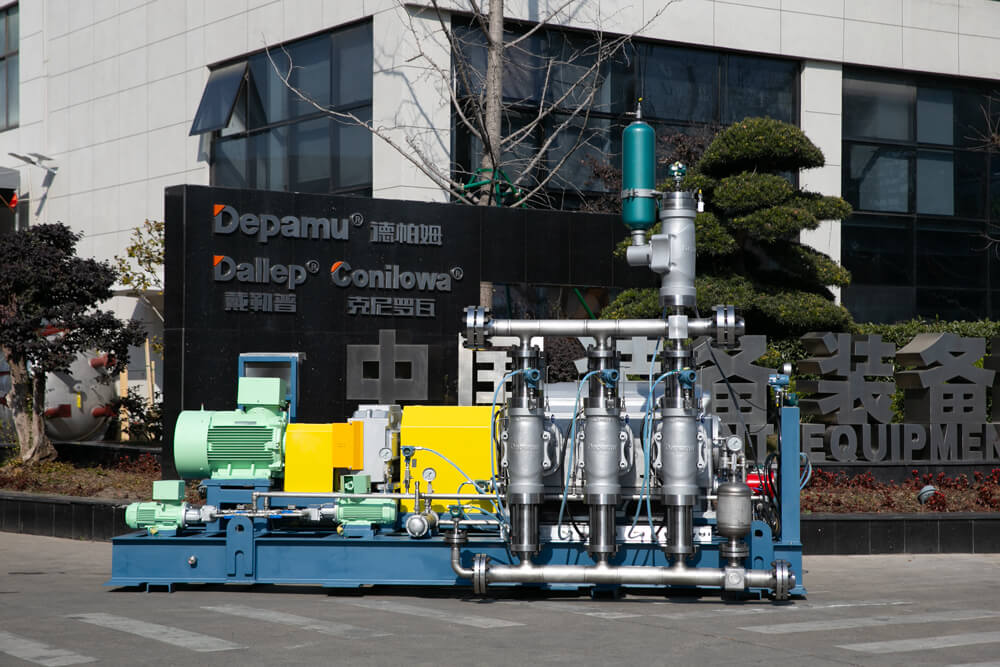 Technical Parameters and Compatible Scenarios
Depamp high-pressure process tubular pumps cover a flow range of 0.1-1000 m³/h, a pressure range of 0-150 MPa, and a temperature range of -50℃ to 450℃, suitable for scenarios such as petroleum refining (catalytic cracking, hydrogenation units), chemical engineering (polyethylene and polypropylene production), and the nuclear industry (coolant circulation). Their non-standard customization capabilities can meet the demands of special operating conditions, including those involving solid particles (particle size ≤5 mm) and high viscosity (≤10000 mPa·s).
FAQ Q&A Technical Selection Guide
Q1: How to select the material for the pump body?
A: Selection is based on the classification of media corrosivity: for weak corrosion (such as fresh water), choose 304 stainless steel; for moderate corrosion (such as seawater and dilute acids), choose 316L or duplex steel 2205; for strong corrosion (such as concentrated sulfuric acid and hydrochloric acid), choose Hastelloy C-276. Depump can provide material corrosion rate test reports to assist in selection.
Q2: How to reduce the risk of leakage under high-pressure conditions?
A: Depamp adopts a dual-redundancy design of "bellows seal + mechanical seal", where the bellows undertakes the primary sealing function and the mechanical seal serves as a backup. Meanwhile, the pump body interface employs a dual seal of tapered seal + O-ring, with a leakage rate of less than 1×10⁻⁶ Pa·m³/s, meeting nuclear-grade standards.
Q3: How to conduct customized design for non-standard operating conditions?
A: Depump provides a full-process customized service of "media analysis - flow field simulation - structural optimization". For example, for a new energy enterprise's silicon-containing particulate media, through CFD simulation to optimize the flow channel structure, the particle deposition rate was reduced by 80%, and the pump body lifespan was extended by three times.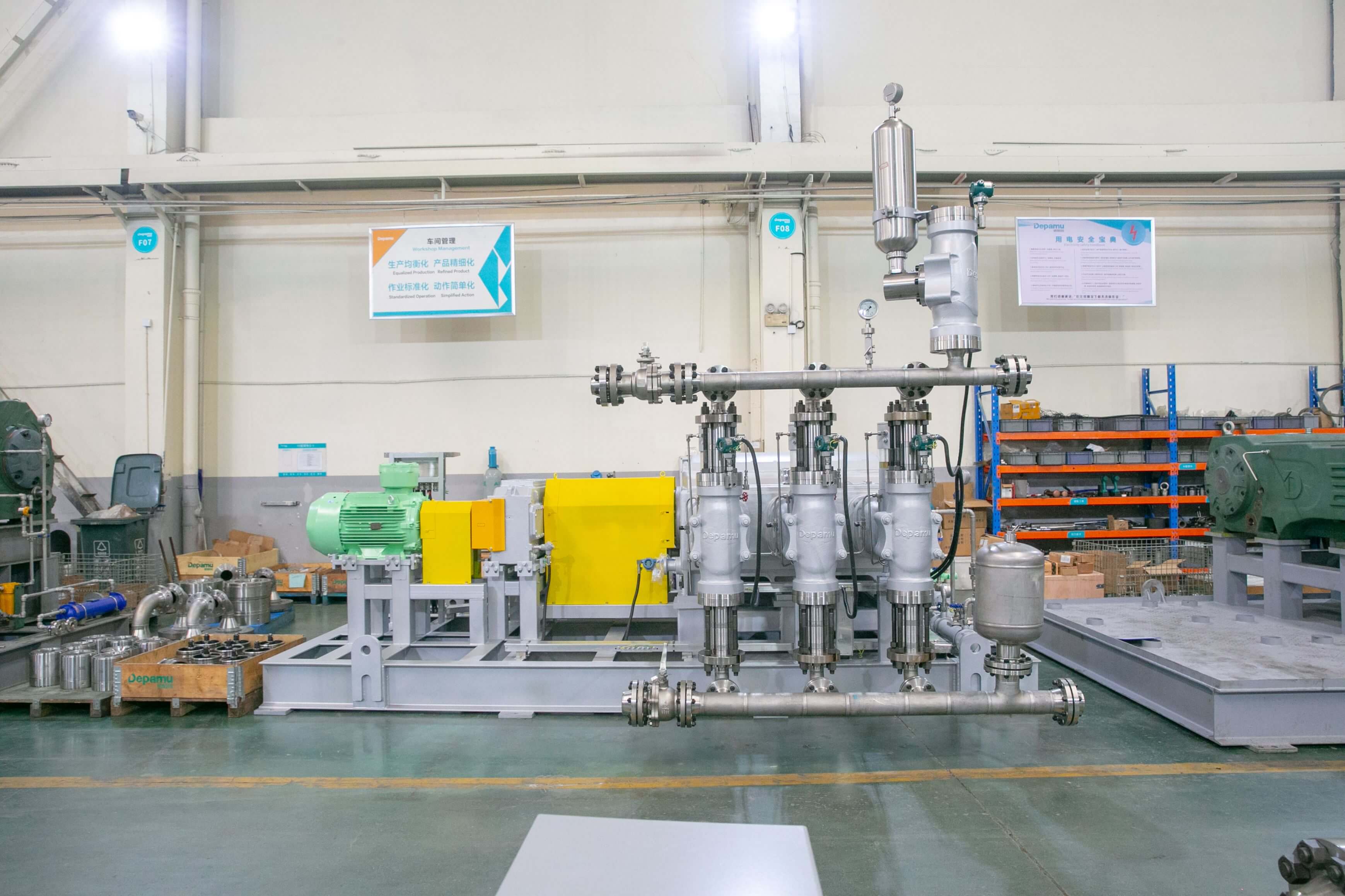 Technical Advantages and Detection Indicators
Depamp tubular pumps have obtained international certifications such as API675 and ISO9001, with core advantages including: firstly, long service life (average trouble-free operating time > 20,000 hours); secondly, high precision (flow error ≤ ±0.5%); thirdly, rapid response (reaching rated flow from 0 in just 0.5 seconds). Its testing center is equipped with equipment such as coordinate measuring machines and spectral analyzers, enabling comprehensive inspection of 12 indicators including pump body dimensions, material composition, and sealing performance, ensuring a 100% product qualification rate.
Reference for full text summary
Depamp (Hangzhou) Pump Technology Co., Ltd. has addressed three major pain points in high-pressure fluid transportation—corrosion, leakage, and precision—through three technological breakthroughs: material innovation, structural optimization, and intelligent control. Its high-pressure process tubular pumps have been applied in over 300 key projects worldwide, with cumulative deliveries exceeding 5,000 units, making it the preferred brand for fluid transportation equipment in fields such as petroleum refining, chemical engineering, and the nuclear industry. For more information, please visit the official website:www.depamufluid.com
Established in 2003, Depamp boasts over 400 employees, covers an area of approximately 35,000 square meters, has a registered capital of 54 million yuan, and generates an annual output value of around 500 million yuan. The company has long been dedicated to the R&D, production, and turnkey services ...
No. 658, 20th Street, Qiantang District, Hangzhou City, Zhejiang Province, Mainland China