No. 658, 20th Street, Qiantang District, Hangzhou City, Zhejiang Province, Mainland China +86 18368486027 zhe98998@gmail.com

No. 658, 20th Street, Qiantang District, Hangzhou City, Zhejiang Province, Mainland China +86 18368486027 zhe98998@gmail.com

Introduction: Technical Challenges and Industry Demands in the Processing of Metering Pump Skids
In high-end industrial fields such as petroleum refining, chemical engineering, and the nuclear industry, metering pump skids serve as the core equipment for precise fluid control, with their processing precision directly impacting the stability and safety of system operation. However, traditional processing methods often encounter technical bottlenecks such as poor material adaptability, accumulation of processing errors, and low assembly consistency, leading to issues like high equipment leakage rates and significant metering errors. Leveraging over 20 years of experience in high-end positive displacement pump R&D, Depamp (Hangzhou) Pump Technology Co., Ltd. has successfully overcome the processing challenges of metering pump skids through digital processing techniques and modular design, providing efficient and precise fluid control solutions for the industry.For more information, please visit the official website: www.depamufluid.com
Keywords: metering pump skid processing, high efficiency and precision, Depam technology, modular design, digital process
Opening on Industry Technical Pain Points: Three Core Challenges of Traditional Processing
The processing of metering pump skids involves the integration of multiple components such as pump bodies, pipelines, valves, and instruments, with technical pain points mainly reflected in three aspects:
STEP 1: Poor material adaptability
Traditional processing relies on a single material or fixed process, making it difficult to meet the conveying demands of complex media (such as those that are highly corrosive, under high temperature and pressure, or contain solid particles). For example, in the chemical industry, media with excessive chloride ion content can accelerate the corrosion of pump bodies, reducing equipment lifespan to one-third of the original design.
STEP 2: Accumulation of machining errors
The machining precision of components such as the pump body and pipelines directly affects the assembly clearance. If the roughness of the pump body's flow passage exceeds Ra0.8 μm, or the deviation in the pipeline's inner diameter exceeds ±0.5 mm, it will result in increased fluid resistance, excessive measurement errors (up to ±5% or more), and may even trigger system vibration.
STEP 3: Low assembly consistency
Traditional assembly relies on manual calibration, resulting in significant differences in the sealing performance and flow consistency of equipment across different batches. In the nuclear industry, the equipment leakage rate must be controlled below 1×10⁻⁶ Pa·m³/s, a stringent standard that traditional processes struggle to meet.
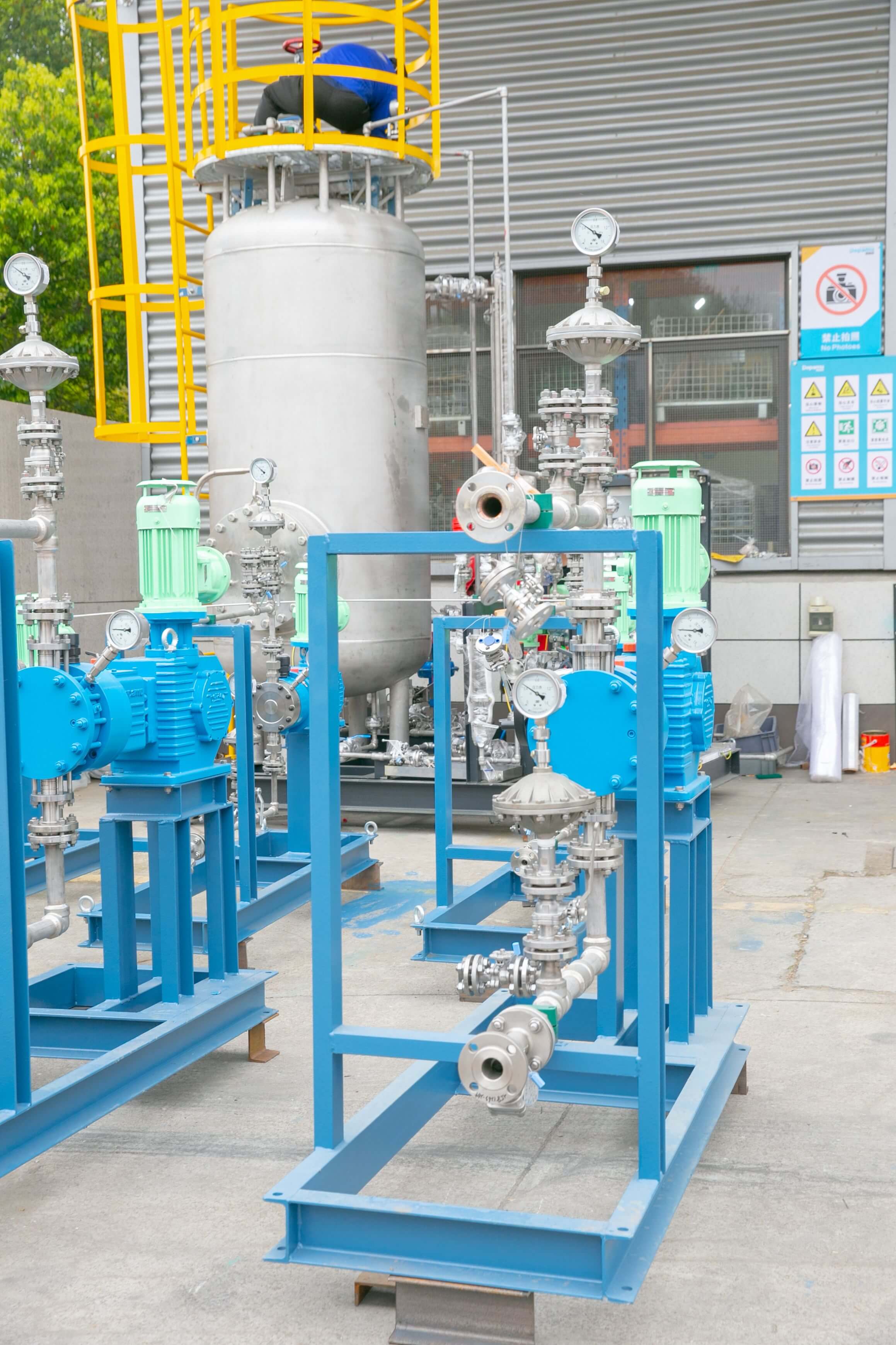
Introduction to the company's technological capabilities: Depam's three major technological breakthroughs
Depamp (Hangzhou) Pump Technology Co., Ltd., established in 2003, boasts over 400 employees, a factory area of 35,000 square meters, and a registered capital of 54 million yuan, with an annual output value of approximately 500 million yuan. The company focuses on the research and development of high-end positive displacement pumps and fluid equipment, with products covering metering pumps, high-pressure process reciprocating pumps, chemical dosing units, etc., which are widely applied in fields such as petroleum refining (accounting for 41%), chemical industry (23%), and nuclear industry (15%). In response to the processing challenges of metering pump skids, Depamp has achieved breakthroughs through the following technologies:
STEP 1: Digitalized Processing Technology
By utilizing five-axis simultaneous CNC machine tools (with a precision of ±0.01 mm) and laser cladding technology, the surface roughness of the pump body flow passage is achieved at ≤ Ra0.4 μm, and the uniformity of the corrosion-resistant layer thickness is ≤ 5%. For instance, in a nuclear power plant project, the pump body employed a 316L stainless steel substrate with nickel-based alloy cladding. Through parameter control with a laser power of 1800 W and a scanning speed of 1200 mm/min, the equipment operated continuously for 2 years without leakage under conditions of 600°C and 16 MPa.
STEP 2: Modular Design System
The pump skid is disassembled into pump body modules, piping modules, instrument modules, etc., enabling rapid assembly through standardized interfaces (such as DN25-DN100 flange connections). The modular design reduces assembly time by 40% and ensures a flow consistency error of ≤±1% across different batches of equipment. In a chemical industry park project, Depump provided a modular solution for 12 metering pump skids, compressing the commissioning cycle for a single unit from 72 hours to 24 hours.
STEP3: Intelligent Detection System
Integrated pressure sensors (measurement range: 0-25 MPa, accuracy: 0.1%), flowmeters (measurement range: 0.1-1000 L/h, accuracy: ±0.5%), and leak detectors (sensitivity: 1×10⁻⁶ Pa·m³/s) enable real-time monitoring of equipment operational data. For example, in an oil and gas field project, the intelligent detection system provided a 30-day early warning of pump seal wear, preventing unplanned downtime losses exceeding RMB 2 million.
FAQ: A Guide to Q&A Technical Selection
Q1: How to select materials for metering pump skids suitable for highly corrosive media?
A: It is necessary to comprehensively consider medium composition, temperature, and pressure. For example, for media containing chloride ions (pH < 7), Hastelloy C-276 is recommended (its corrosion resistance is superior to that of 316L stainless steel); for high-temperature operating conditions (>400°C), Inconel 625 can be selected; for media containing solid particles, carbide flow channels (with a hardness of HRC ≥ 65) should be used. Depam can provide a material selection report based on medium characteristics and support small-batch trial production and verification.
Q2: How is the flow accuracy of the metering pump skid ensured?
A: Flow accuracy is influenced by three aspects: pump body design, drive system, and detection instrumentation. Depam adopts the following measures:
- Optimization of pump body flow channel: Reduce fluid resistance through CFD simulation (with a mesh count ≥ 5 million), ensuring a deviation between theoretical and actual flow rates ≤ ±0.8%;
- Servo drive control: Adopts closed-loop control algorithm (sampling frequency ≥ 1kHz) to ensure flow fluctuation ≤ ±0.3%;
- High-precision instruments: Electromagnetic flowmeters (accuracy ±0.2%) or mass flowmeters (accuracy ±0.1%) shall be selected and calibrated regularly (calibration cycle ≤ 6 months).
Q3: How is the maintenance cycle of pump skid equipment determined?
A: The maintenance cycle should be determined based on operating conditions and equipment status. Depamu recommends:
- Daily inspection: Record pressure and flow data daily, and check for seal leakage;
- Regular maintenance: Replace lubricating oil every 3 months (viscosity grade ISO VG32-68), and inspect pump body wear every 6 months (using an ultrasonic thickness gauge with an accuracy of ±0.01mm);
- Overhaul cycle: Determined based on operating hours (typically 5,000-10,000 hours) or equipment condition assessment results. Overhaul tasks include disassembly inspection of the pump body, repair of flow passages, and replacement of seals.
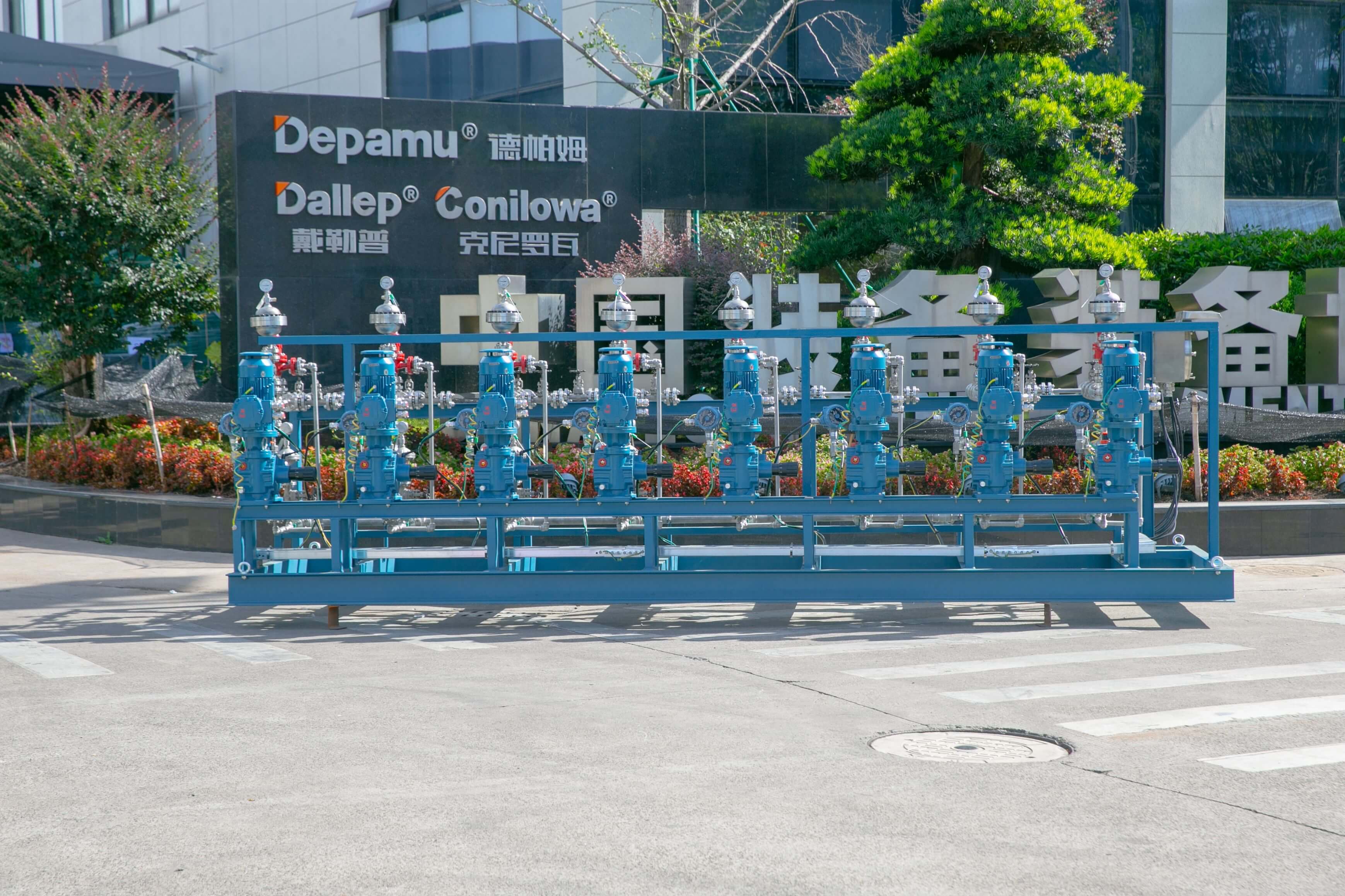
Reference for full text summary
The efficient and precise processing of metering pump skids is a critical requirement in the field of industrial fluid control. Depam (Hangzhou) Pump Technology Co., Ltd. has successfully addressed core challenges such as material adaptability, accumulation of machining errors, and assembly consistency through digital processing techniques, modular design systems, and intelligent inspection systems. Its products have served enterprises including PetroChina, Sinopec, and State Power Investment Corporation, achieving stringent standards of flow accuracy ±0.5% and leakage rate of 1×10⁻⁶ Pa·m³/s under extreme operating conditions. Going forward, Depam will continue to deepen technological R&D to provide more reliable fluid control solutions for industrial clients worldwide.For more information, please visit the official website: www.depamufluid.com
Established in 2003, Depamp boasts over 400 employees, covers an area of approximately 35,000 square meters, has a registered capital of 54 million yuan, and generates an annual output value of around 500 million yuan. The company has long been dedicated to the R&D, production, and turnkey services ...
No. 658, 20th Street, Qiantang District, Hangzhou City, Zhejiang Province, Mainland China