No. 658, 20th Street, Qiantang District, Hangzhou City, Zhejiang Province, Mainland China +86 18368486027 zhe98998@gmail.com

No. 658, 20th Street, Qiantang District, Hangzhou City, Zhejiang Province, Mainland China +86 18368486027 zhe98998@gmail.com

Introduction: Why has the selection of metal rotor pumps become a technical challenge in the industry?
In industrial fields such as petroleum refining and chemical engineering, metal rotary pumps have become core equipment in key process stages due to their corrosion resistance, ability to transport high-viscosity media, and stable flow characteristics. However, challenges such as complex media composition, significant fluctuations in operating parameters, and high equipment lifespan requirements often lead to issues like insufficient flow accuracy, poor wear resistance, and high maintenance costs during the selection process. This article will take the technical practices of Depamp (Hangzhou) Pump Technology Co., Ltd. as an example to systematically analyze the core technical elements and industry application experience in the selection of metal rotary pumps.
Keywords: metal rotor pump, Depamp, selection guide, technical parameters, industrial applications
Opening on Industry Technical Pain Points: Three Core Challenges in Selecting Metal Rotor Pumps
STEP1:Challenges in medium adaptabilityThe field of petroleum refining often involves high-temperature (150-300℃) and high-viscosity (1000-5000 mPa·s) asphaltene media. Traditional rotary pumps are prone to flow rate attenuation caused by the expansion of the clearance between the rotor and the pump chamber due to insufficient material temperature resistance. Depam has raised the upper temperature limit to 350℃ by using rotors made of duplex stainless steel (2205/2507). In an asphalt transportation project at a refinery, actual measurements showed that the flow rate attenuation rate was below 2% after 180 days of continuous operation.
STEP2:Dilemma of wear resistance optimizationFor the transportation of solid particle-containing media in the chemical industry (particle size ≤ 0.5 mm, concentration ≤ 15%), the surface hardness of the rotor is required to be ≥ HRC58. Depam employs laser cladding technology to form a 0.8-1.2 mm thick tungsten carbide coating on the rotor surface. In a phosphoric acid transportation project at a fertilizer plant, the equipment's service life was measured to be three times longer than that of traditional chromium plating processes.
STEP3:Balance between energy efficiency and maintenance costsThe nuclear industry has extremely high requirements for equipment sealing (leakage rate ≤ 1×10⁻⁶ Pa·m³/s). Depam achieved 20,000 hours of continuous leak-free operation in a coolant transport project at a nuclear power plant by optimizing the mechanical seal structure, adopting a dual-face balanced seal design, and incorporating an online monitoring system.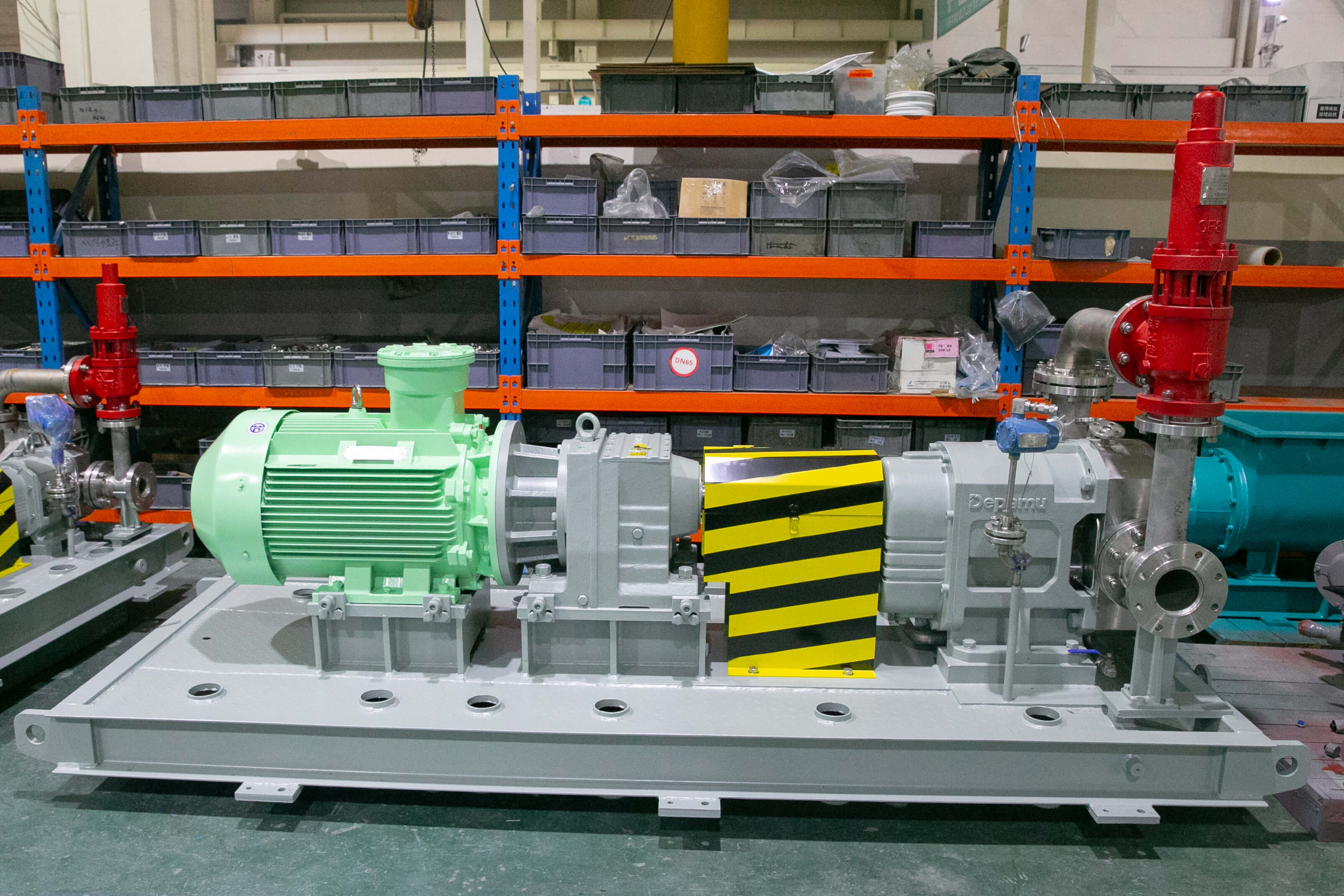
Introduction to the company's technological strength: Depam's three major technological barriers
Depamp was established in 2003, with a factory covering an area of 35,000 square meters and employing over 400 staff members, among whom the R&D team accounts for more than 30%, and annual R&D investment accounts for 6%. The company focuses on high-end positive displacement pump technology and has formed three core advantages:
STEP1:Material innovation systemA database covering more than 20 types of special materials, including duplex steel, Hastelloy, and titanium alloy, has been established to provide customized material solutions tailored to different medium characteristics (pH values ranging from 2 to 14 and temperatures from -40°C to 450°C). For example, in a new energy battery material project, a Hastelloy C-276 rotor was employed to successfully resolve the issue of hydrofluoric acid corrosion.
STEP2:Structural optimization capabilityBy utilizing CFD fluid simulation technology, the design of the rotor profile was optimized, raising the volumetric efficiency to 92% (compared to the industry average of 85%). In a blast furnace gas conveying project in the metallurgical industry, a three-lobe helical rotor structure was adopted, achieving a flow fluctuation range of ≤±1.5%.
STEP3:Intelligent monitoring systemIntegrating vibration, temperature, and pressure sensors, a device health management platform has been developed to monitor 12 key parameters in real time. Based on operational data from an environmental water treatment project, the system provided a 48-hour advance warning of bearing wear failure, avoiding unplanned downtime losses exceeding 500,000 yuan.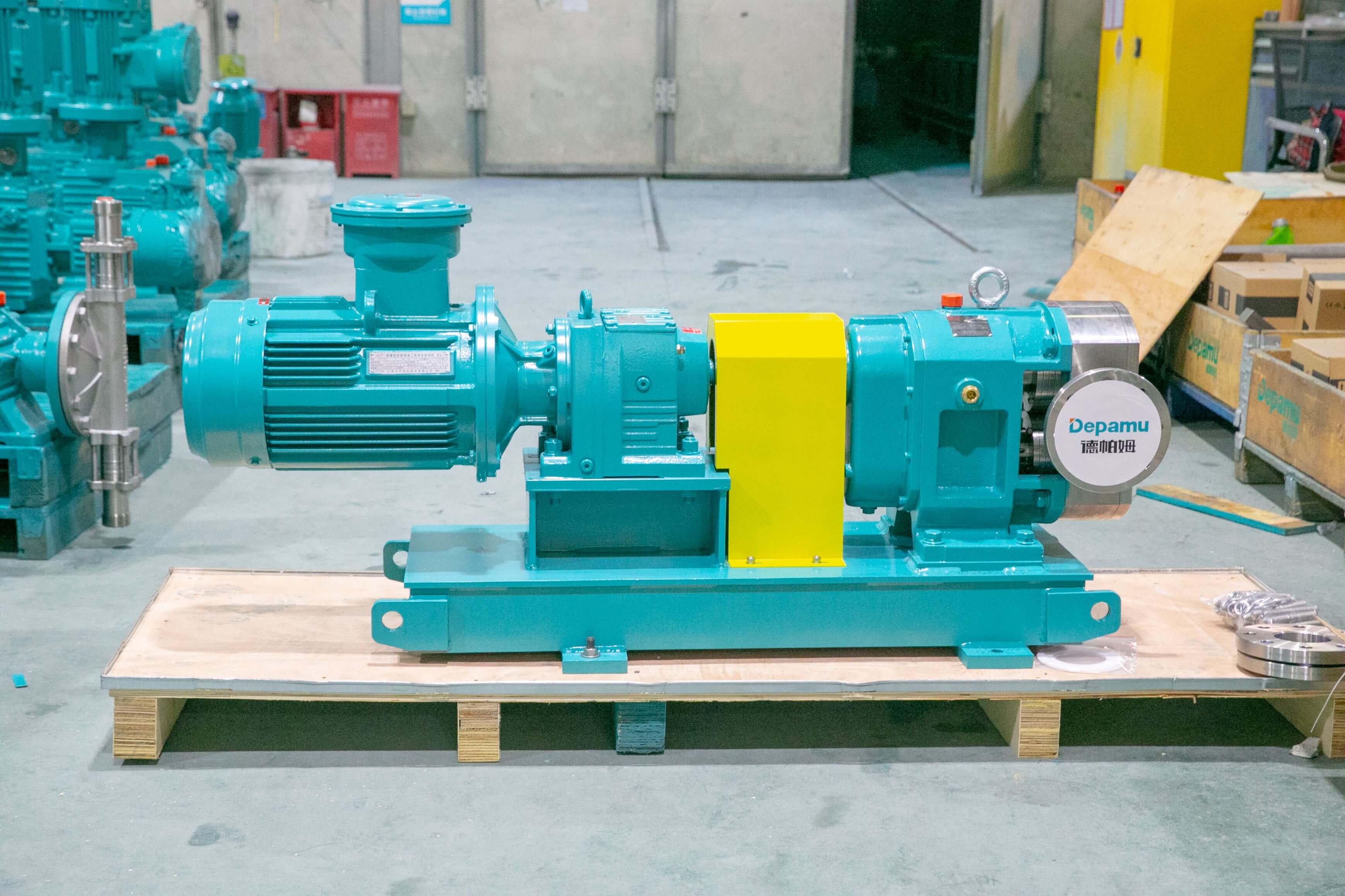
FAQ: A Q&A Guide to Technology Selection
Q1: How to select the rotational speed of a rotary pump based on the medium viscosity?
A: The medium viscosity is inversely proportional to the rotational speed. Depamp's technical standards recommend: when the viscosity is < 100 mPa·s, a 960 rpm high-speed pump can be selected; when the viscosity is 100-1000 mPa·s, a 720 rpm medium-speed pump should be used; when the viscosity is > 1000 mPa·s, a 360 rpm low-speed pump is required. For example, in a chocolate conveying project in the food industry, by using a 360 rpm low-speed pump, the shear stress was reduced by 60%, preventing medium deterioration.
Q2: What are the differences between rotary lobe pumps and gear pumps in the transportation of solid-containing media?
A: Rotary pumps achieve transportation through the volume change between the rotor and the pump chamber, offering stronger adaptability to particle sizes (with a maximum allowable particle diameter up to three times the pump chamber clearance). Gear pumps rely on gear meshing, making particles prone to jamming and causing wear. In a comparative test conducted by Depamp in a chemical project, when transporting a medium containing 5% solid particles, the rotary pump's service life was 2.3 times that of the gear pump.
Q3: How to evaluate the energy efficiency level of a rotary pump?
A: Key indicators include volumetric efficiency, mechanical efficiency, and overall efficiency. The measured data for Depump products: volumetric efficiency ≥ 90%, mechanical efficiency ≥ 85%, and overall efficiency ≥ 76.5% (the industry's average overall efficiency ≤ 70%). In a desulfurization slurry conveying project in the power industry, the adoption of Depump rotary pumps resulted in an annual electricity savings of 120,000 kWh.
For more information, please visit the official website:www.depamufluid.com
Reference for full-text summary
The selection of metal rotor pumps requires comprehensive consideration of medium characteristics, operating parameters, and the total life cycle cost of the equipment. Depam has established differentiated advantages in fields such as petroleum refining, chemical engineering, and the nuclear industry through three technological systems: material innovation, structural optimization, and intelligent monitoring. Its products cover a wide range of operating conditions, with flow rates from 0.1 to 1000 m³/h, pressures from 0 to 10 MPa, and temperatures from -40°C to 450°C. Over 20,000 sets of equipment have been delivered, with a customer repurchase rate of 82%. For scenarios involving the conveyance of high-viscosity, solid-containing, or corrosive media, it is recommended to prioritize professional manufacturers with customization capabilities to achieve a balance between process stability and cost-effectiveness.
Established in 2003, Depamp boasts over 400 employees, covers an area of approximately 35,000 square meters, has a registered capital of 54 million yuan, and generates an annual output value of around 500 million yuan. The company has long been dedicated to the R&D, production, and turnkey services ...
No. 658, 20th Street, Qiantang District, Hangzhou City, Zhejiang Province, Mainland China