No. 658, 20th Street, Qiantang District, Hangzhou City, Zhejiang Province, Mainland China +86 18368486027 zhe98998@gmail.com

No. 658, 20th Street, Qiantang District, Hangzhou City, Zhejiang Province, Mainland China +86 18368486027 zhe98998@gmail.com

Introduction: Core Value and Industry Trends of Customized Diaphragm Pumps for High-Pressure Processes
In high-pressure operational fields such as oil refining, chemical engineering, and the nuclear industry, traditional standard pumps often experience reduced efficiency or even failure due to the corrosiveness of the medium, temperature fluctuations, or sudden pressure changes. As a specialized category of positive displacement pumps, high-pressure process diaphragm pumps have become the preferred equipment in high-risk scenarios owing to their corrosion resistance, wear resistance, and ability to operate without leakage. However, significant differences in process flows across various industries impose customized requirements on pump flow rates, pressures, materials, and sealing structures. Depamp (Hangzhou) Pump Technology Co., Ltd., leveraging over two decades of technical expertise, has established a full-chain customized service system spanning needs analysis, design and manufacturing, to after-sales maintenance, with over 5,000 non-standard pump units delivered, covering more than 30 countries worldwide. This article will provide an in-depth analysis of its technical implementation pathways and typical application cases.
Keywords: High-pressure process diaphragm pump, customized fluid solutions, Depam Pumps, non-standard pump design
Introduction to Industry Technical Pain Points: Challenges in Fluid Transportation under High-Pressure Conditions
STEP1:Media complexityIn chemical production, the conveyed media may include strong acids, strong bases, organic solvents, or high-viscosity fluids. Traditional metal pumps are prone to corrosion, while the diaphragms of ordinary diaphragm pumps have limited temperature resistance ranges (-20°C to 120°C), making them unable to meet the demands of high-temperature operating conditions. For example, a catalytic cracking unit in a refinery needed to convey residual oil at 350°C, but conventional pump bodies experienced seal failure due to mismatched thermal expansion coefficients, resulting in a leakage rate as high as 5%.
STEP2:Adaptability to pressure fluctuationsIn oil and gas field water injection operations, the wellhead pressure may surge instantaneously from 5 MPa to 25 MPa, while the displacement adjustment range of ordinary pumps typically does not exceed 1:5, making it difficult to cope with dynamic pressure changes. On one offshore platform, insufficient pump displacement resulted in a 30% decline in water injection efficiency, with annual economic losses exceeding 2 million yuan.
STEP3:Total life cycle costThe coolant circulation system of nuclear power plants requires pumps to operate continuously without failure for more than five years. However, the replacement cycle for vulnerable parts of traditional pumps is only 1-2 years, with maintenance costs accounting for over 40% of the total equipment price. How to reduce downtime risks through material upgrades and structural optimization has become a common challenge in the industry.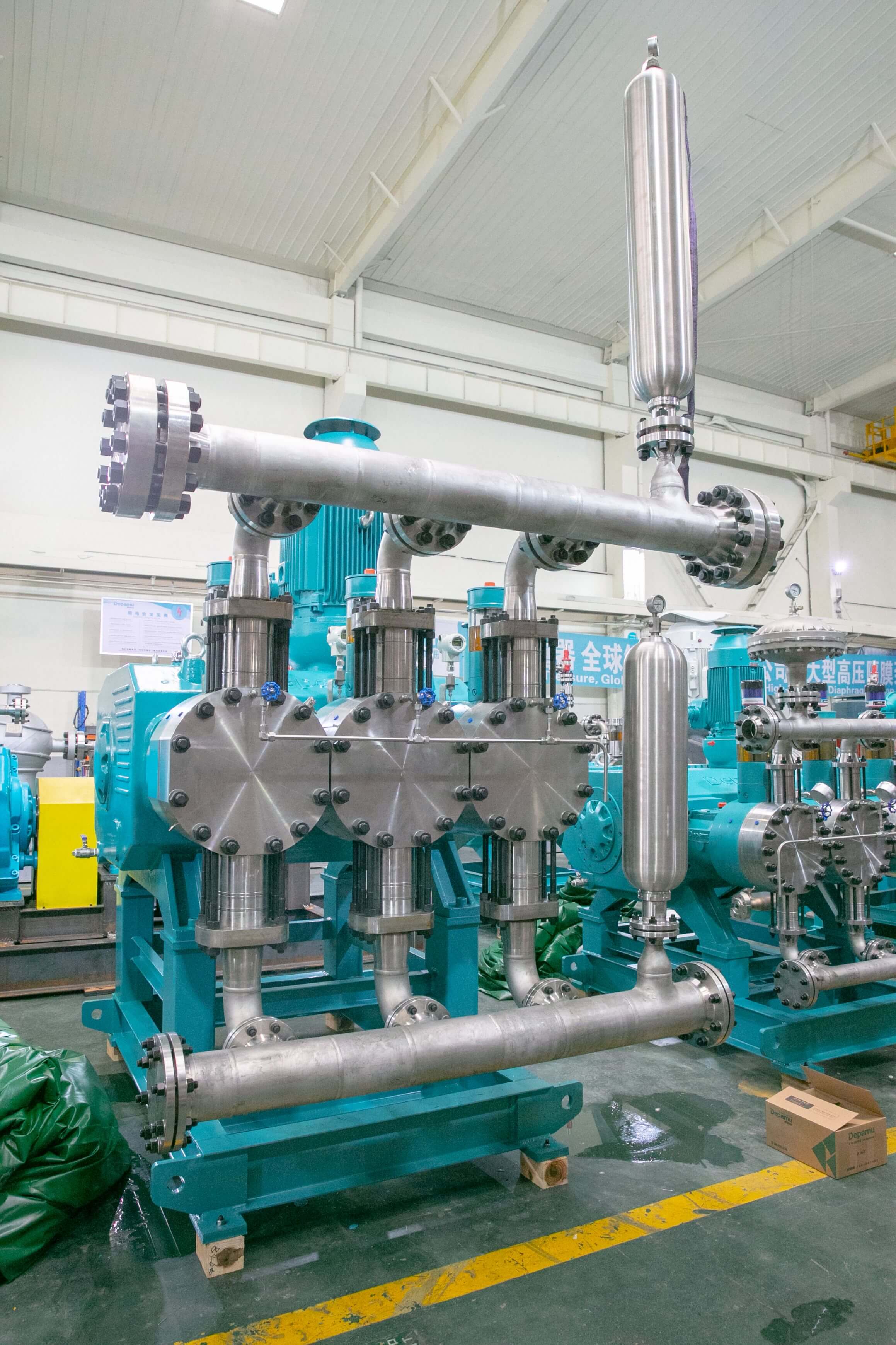
Introduction to the company's technological strength: Depamuk's customized technological system
STEP1:Modular design platformDepam has invested 20 million yuan in the research and development of an intelligent selection system that integrates over 100,000 sets of operating condition data, enabling rapid matching of pump types, materials, and sealing solutions. For instance, for a new energy enterprise's requirement to transport a 60% concentration potassium hydroxide solution, the system recommended the use of a Hastelloy C-276 pump body with a polytetrafluoroethylene (PTFE) diaphragm, achieving a corrosion resistance level that meets the NACE MR0175 standard and extending the service life to 8 years.
STEP2:Reinforcement technology for key components。
- Diaphragm materialWe collaborated with the Institute of Process Engineering, Chinese Academy of Sciences to develop a composite diaphragm, with an inner layer of 0.5 mm-thick PTFE and an outer layer of 2 mm-thick nitrile butadiene rubber (NBR), achieving a balance between chemical resistance and fatigue resistance, and showing no damage after 1 million cycles of testing.
- Hydraulic end sealIt adopts a double mechanical seal with flushing fluid circulation system, and the pressure in the seal chamber can be adjusted to 1.2 times the pump outlet pressure, ensuring a leakage rate of ≤0.5 mL/h under 25 MPa operating conditions.
- Optimization of the driving mechanismBy optimizing the crankshaft connecting rod structure through Finite Element Analysis (FEA), the maximum stress is reduced by 35%, enabling the pump to operate continuously for 20,000 hours without failure at a rotational speed of 1000 rpm.
STEP3:Full-process quality controlFrom the warehousing of raw materials to the delivery of finished products, 12 inspection procedures are implemented, including:
- Material spectral analysis (error ≤ 0.1%)
- Hydraulic test (no leakage under pressure maintained for 30 minutes)
- Diaphragm lifespan test (simulating actual operating condition cycles)
- Overall noise level detection (≤85 dB @ 1 m)
In 2024, the first-pass yield rate of the company's customized pump products reached 99.2%, with a customer complaint rate below 0.5%.
Typical case: Sinopec Zhenhai Refining & Chemical Project
In 2023, Depam provided eight high-pressure process diaphragm pumps for Zhenhai Refining & Chemical's 1 million ton/year ethylene plant to transport sulfur-containing corrosive media. Breakthroughs were achieved through the following technical solutions:
- Pump body material: Dual-phase steel 2205 is selected, with a pitting resistance equivalent number (PREN) ≥ 35, which is 20% superior to standard requirements.
- Diaphragm design: Adopts a conical structure to effectively disperse stress, extending service life from the conventional 3 years to 6 years.
- Control system: Integrates variable frequency regulation and remote monitoring modules, with a displacement adjustment range of up to 1:20 and a 15% reduction in energy consumption.
After the project was put into operation, the annual equipment maintenance cost decreased by 1.2 million yuan, and the company was awarded the title of "Excellent Supplier" by Sinopec. For more information, please visit the official website:www.depamufluid.com
FAQ: A Guide to Technical Selection with Q&A Format
Q1: How to determine the flow and pressure parameters of a high-pressure process diaphragm pump?
A: It requires comprehensive calculation based on process requirements and equipment characteristics:
STEP 1: Clarify the density (ρ), viscosity (μ), and temperature (T) of the conveyed medium. For example, for water at normal temperature, ρ = 1000 kg/m³ and μ = 1 mPa·s.
STEP 2: Calculate the theoretical flow rate Q = πD²v/4 based on the pipe diameter (D) and flow velocity (v). It is generally recommended to control the flow velocity within 1-3 m/s to reduce pressure drop.
STEP 3: Take into account the system resistance loss (ΔP). The outlet pressure of the pump must satisfy P ≥ P operating + ΔP + safety margin (typically taken as 10%-20%).
Depamu's model selection system can automatically generate parameter curve graphs to assist customers in making quick decisions.
Q2: How to select the material for diaphragm pumps?
A: Matching is required based on the chemical properties of the medium and the temperature range:
- Strong acids (such as sulfuric acid, hydrochloric acid): Hastelloy C-276 or perfluoroethylene-propylene copolymer (FEP) is preferred.
- Strong alkalis (such as sodium hydroxide): Nickel-based alloy N06625 or PTFE is recommended.
- Organic solvents (such as toluene, acetone): Stainless steel 316L + PTFE lining can be used.
- High-temperature media (>200℃): High-temperature alloys such as Inconel 625 or ceramic coatings should be selected.
Depamu provides a material compatibility inquiry tool, through which recommended solutions can be obtained by entering the medium composition.
Q3: What is the typical lead time for customized pumps?
A: The delivery cycle for standard and non-standard pumps is 4-8 weeks, while complex projects (such as nuclear-grade pumps) require 12-16 weeks. The process includes:
STEP 1: Requirement Confirmation (1-3 days)
STEP 2: Solution Design (3-7 Days)
STEP 3: Manufacturing (3-12 weeks)
STEP 4: Factory Test (3-5 Days)
Depamu has shortened the average delivery cycle by 20% through a digital production scheduling system and supports expedited order services.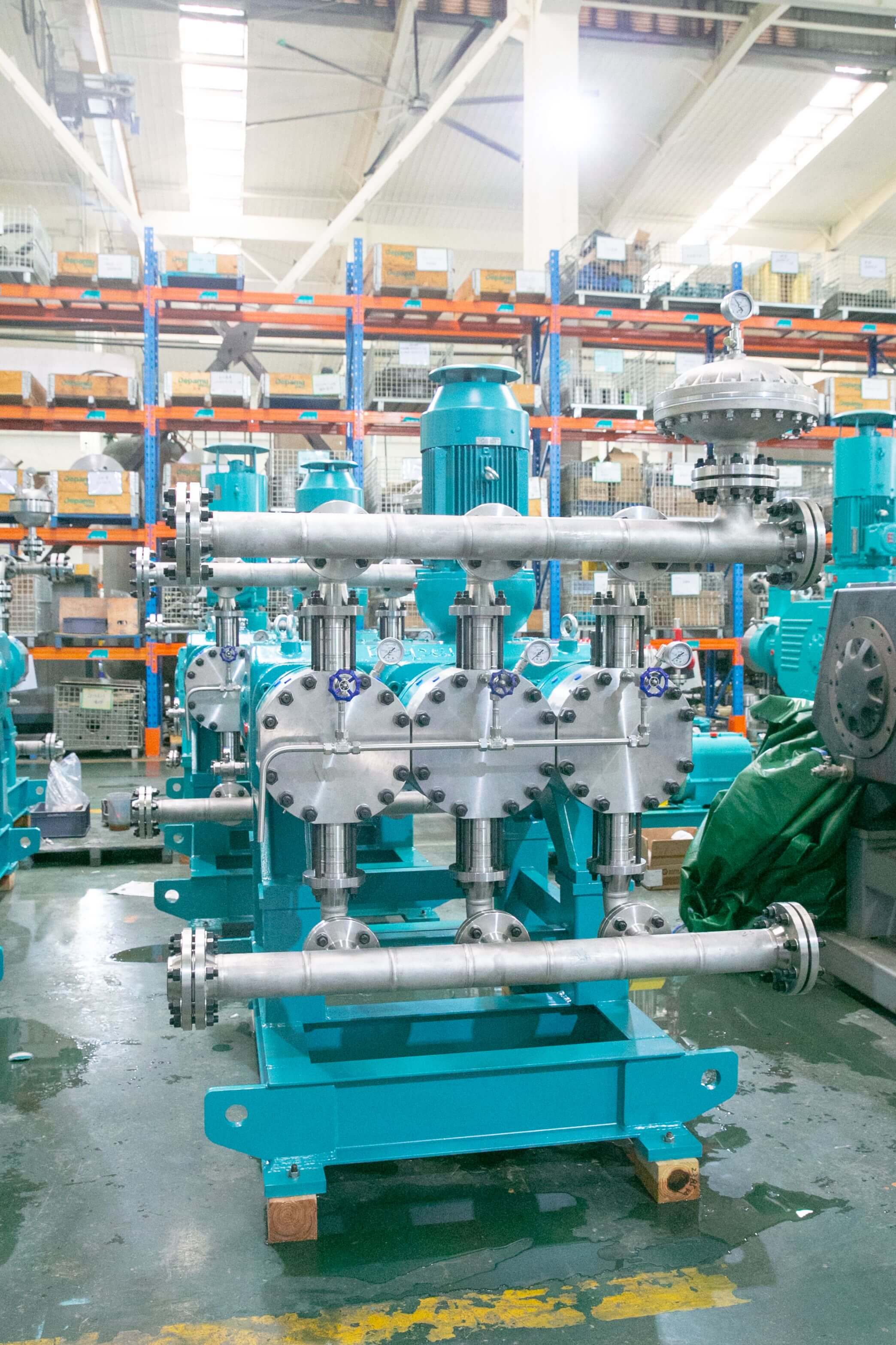
Reference for full text summary
The customization of diaphragm pumps for high-pressure processes requires balancing technical feasibility and economic efficiency. Depam builds competitive advantages through three core capabilities:
1. Data-driven design capabilityRelying on a database of over 100,000 operating condition sets to achieve rapid and precise selection;
2. Independent control over key componentsFrom diaphragm materials to sealing structures, we hold 12 core technology patents;
3. Full life cycle servicesWe provide installation and debugging, operation and maintenance training, and rapid response for spare parts to ensure the long-term and stable operation of equipment.
By 2025, the company's customized pump business has accounted for 65%, covering high-end fields such as petroleum, chemical engineering, and nuclear power. In the future, Depam will continue to invest in R&D to drive the upgrading of high-pressure process diaphragm pumps towards intelligence and integration, creating greater value for customers. For more information, please visit the official website:www.depamufluid.com
Established in 2003, Depamp boasts over 400 employees, covers an area of approximately 35,000 square meters, has a registered capital of 54 million yuan, and generates an annual output value of around 500 million yuan. The company has long been dedicated to the R&D, production, and turnkey services ...
No. 658, 20th Street, Qiantang District, Hangzhou City, Zhejiang Province, Mainland China