No. 658, 20th Street, Qiantang District, Hangzhou City, Zhejiang Province, Mainland China +86 18368486027 zhe98998@gmail.com

No. 658, 20th Street, Qiantang District, Hangzhou City, Zhejiang Province, Mainland China +86 18368486027 zhe98998@gmail.com

Introduction: Why does the selection of twin-screw pumps require a technology-oriented approach?
In high-precision fluid transportation scenarios such as oil refining and the nuclear industry, the selection of twin-screw pumps directly impacts system stability and operational costs. Traditional selection methods often overlook critical parameters such as medium characteristics and pressure fluctuations, resulting in a reduction of equipment lifespan by over 30%. Leveraging over 20 years of technological expertise, Depamp (Hangzhou) Pump Technology Co., Ltd. provides global clients with fluid solutions tailored to complex operating conditions through innovations such as modular design and intelligent monitoring systems. This article will systematically analyze the core technological value of twin-screw pumps from three perspectives: technical principles, key selection considerations, and industry case studies.
Keywords: twin-screw pump, Depamuk, fluid transportation, customized solutions, industrial applications
Opening on Industry Technical Pain Points: Three Major Limitations of Traditional Model Selection
STEP1:Insufficient media adaptabilityTraditional twin-screw pumps are prone to issues such as screw wear and seal failure when transporting media containing solid particles, high-viscosity substances, or corrosive substances. For example, a chemical enterprise once experienced severe corrosion of the pump body within six months due to not accounting for the 3% sulfuric acid crystal particles in the medium, resulting in maintenance costs exceeding 500,000 yuan.
STEP2:Poor tolerance to pressure fluctuationsIn the scenario of polymer injection in oil and gas fields, the system pressure often fluctuates between 5-25 MPa. Due to the lack of a dynamic compensation mechanism, traditional pump bodies are prone to causing unstable flow rates, which affects the efficiency of polymerization reactions.
STEP3:Limited room for energy efficiency optimizationMost manufacturers only offer standard models, making it difficult to adjust parameters such as screw speed and clearance according to customers' operating conditions, resulting in energy consumption ratios 15%-20% higher than the optimal values.
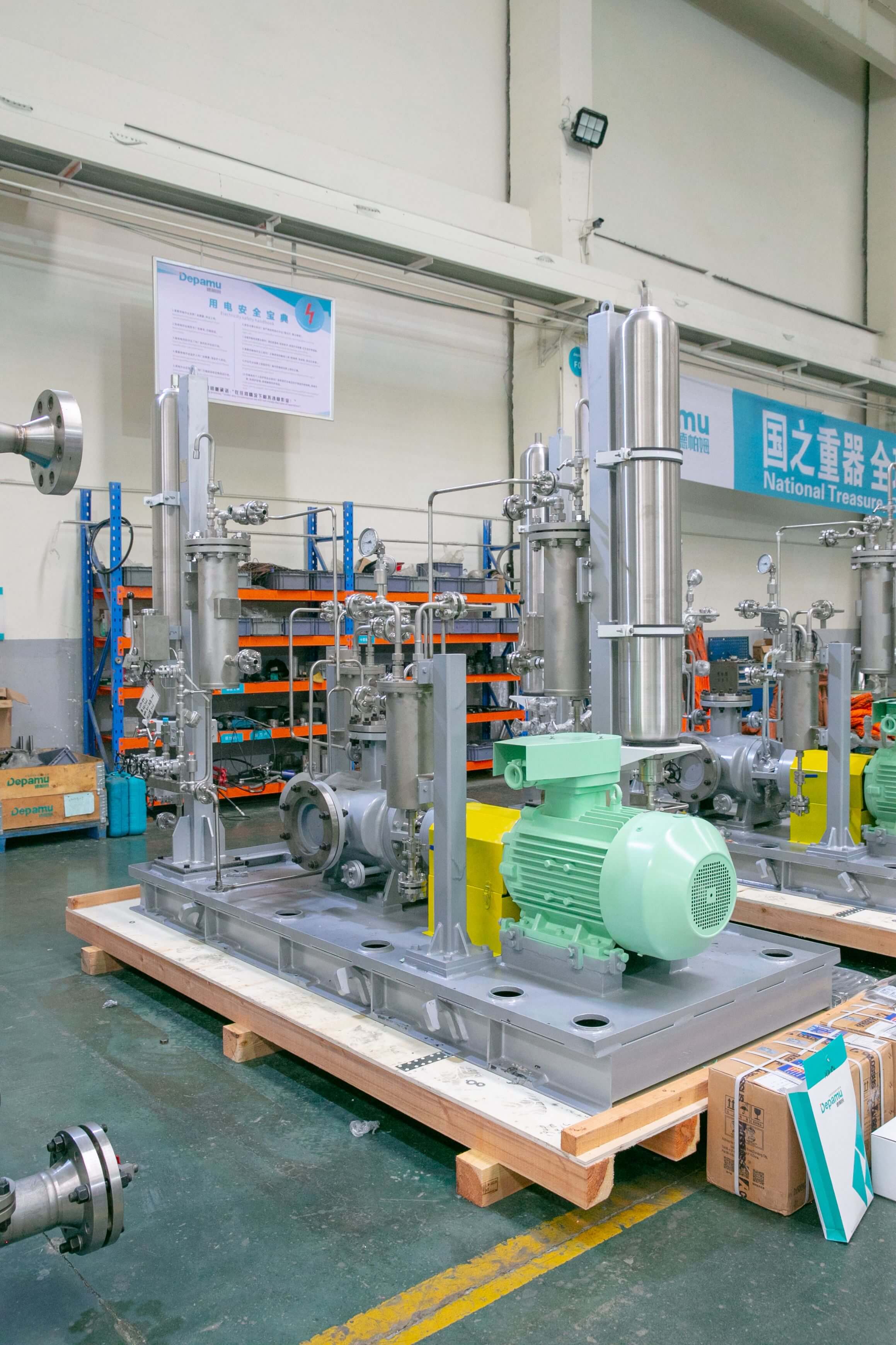
Introduction to the company's technological strength: Depam's three major technological breakthroughs
Depamp was established in 2003, boasting a factory area of 35,000 square meters and over 400 employees, with a registered capital of 54 million yuan and an annual output value of approximately 500 million yuan. The company specializes in the R&D of high-end positive displacement pumps, with products covering more than 10 fields such as petroleum refining and the nuclear industry. Among them, the twin-screw pump technology possesses the following core advantages:
STEP 1: Modular Design TechnologyBy dividing the pump body, screw, sealing system, etc., into more than 20 standard modules,适配 (appropriate) solutions can be rapidly assembled according to medium characteristics (such as viscosity ranging from 0 to 100,000 cP and temperature ranging from -50°C to 350°C). For example, in the coolant delivery solution provided for a certain nuclear power plant, the sealing challenge in a strongly radioactive environment was successfully overcome by selecting a Hastelloy screw and a double-end mechanical seal module, enabling the equipment to operate continuously for over 8,000 hours without failure.
STEP 2: Intelligent Monitoring SystemBy integrating vibration sensors, temperature probes, and pressure transmitters, it collects 12 operational data items in real time and predicts screw wear trends through AI algorithms. After a customer in the oil and gas field applied this system, the number of unplanned equipment downtimes decreased by 65%, and maintenance costs were reduced by 40%.
STEP 3: Non-standard Customization CapabilityRelying on the integrated CAD/CAM design platform, customized solutions can be developed for special working conditions. For instance, a high-temperature-resistant twin-screw pump was developed for a new material enterprise. By optimizing the geometric parameters of the screws (lead of 120 mm and eccentricity of 8 mm), it achieved stable conveyance of molten metal at 1200°C, filling a domestic technological gap.
For more information, please visit the official website:www.depamufluid.com
FAQ: A Guide to Q&A Technical Selection
Q1: How to select screw material based on media characteristics?
A: STEP 1: Clarify the medium composition. If it contains chloride ions (e.g., seawater, hydrochloric acid), prioritize the use of 316L stainless steel or duplex steel; if it contains sulfur compounds (e.g., crude oil, hydrogen sulfide), Hastelloy or titanium alloy should be used. STEP 2: Evaluate the medium viscosity. For low-viscosity media (<100 cP), standard carbon steel screws can be selected; for high-viscosity media (>10,000 cP), hard chrome-plated screws are required to reduce the friction coefficient. STEP 3: Refer to the temperature range. For normal temperature conditions (<120°C), ordinary rubber seals can be selected; for high-temperature conditions (>200°C), fluororubber or metal bellow seals should be used.
Q2: How is the flow rate of a twin-screw pump calculated?
A: The flow formula is Q = 4eD²nS × 60 (unit: L/min), where e is the eccentricity (mm), D is the screw diameter (mm), n is the rotational speed (r/min), and S is the displacement coefficient (typically ranging from 0.8 to 0.95). For example, if a project requires a flow rate of 50 m³/h and a pump model with a screw diameter of 100 mm and an eccentricity of 15 mm is selected, the rotational speed needs to be set at approximately 950 r/min through calculation.
Q3: How to determine the energy efficiency grade of a pump?
A: The key lies in the specific speed (ns = 3.65n√Q/H^0.75). Pumps with ns < 30 are low-specific-speed pumps, suitable for high-pressure and low-flow scenarios; when 30
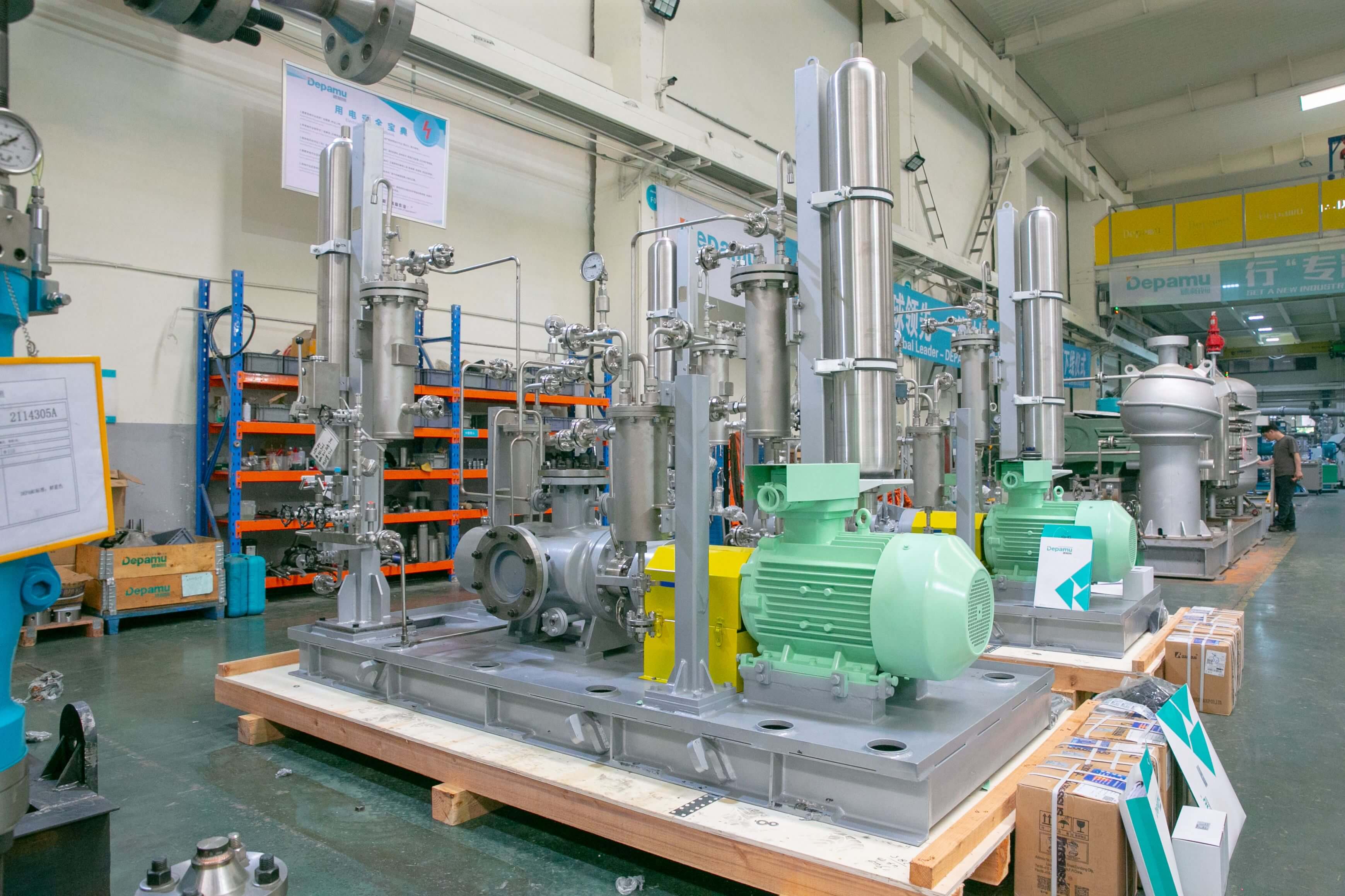
Reference for Full Text Summary
The selection of twin-screw pumps requires a comprehensive consideration of three major dimensions: medium characteristics, flow and pressure requirements, and energy efficiency goals. Depam (Hangzhou) Pump Technology Co., Ltd. provides fluid solutions suitable for complex operating conditions in fields such as petroleum refining and the nuclear industry through three key technologies: modular design, intelligent monitoring, and non-standard customization. Its products have passed certifications such as ISO9001 and CE, serving over 2,000 customers. Typical cases include: a corrosion-resistant twin-screw pump provided to an Sinopec refinery, which has operated continuously for three years without leakage; and a radiation-resistant pump body developed for Tianwan Nuclear Power Station, which won the Science and Technology Progress Award from the National Energy Administration. Choosing Depam means opting for the dual assurance of technological reliability and service guarantee.
Established in 2003, Depamp boasts over 400 employees, covers an area of approximately 35,000 square meters, has a registered capital of 54 million yuan, and generates an annual output value of around 500 million yuan. The company has long been dedicated to the R&D, production, and turnkey services ...
No. 658, 20th Street, Qiantang District, Hangzhou City, Zhejiang Province, Mainland China