No. 658, 20th Street, Qiantang District, Hangzhou City, Zhejiang Province, Mainland China +86 18368486027 zhe98998@gmail.com

No. 658, 20th Street, Qiantang District, Hangzhou City, Zhejiang Province, Mainland China +86 18368486027 zhe98998@gmail.com

Introduction: Why should both cost and performance be taken into account in the selection of high-pressure plunger reciprocating pumps?
In industrial sectors such as oil refining, chemical engineering, and oil and gas fields, high-pressure plunger reciprocating pumps serve as core fluid conveying equipment, with their selection directly influencing process stability and operational costs. Users often encounter the dilemma of "underperformance in low-cost equipment" or "excessive costs in high-performance equipment." How can a balance between cost and performance be achieved through technical parameter matching, enterprise capability assessment, and customized solutions? This article will analyze the issue from four perspectives: technical principles, industry pain points, enterprise technological layouts, and selection guidelines.
Keywords: high-pressure plunger reciprocating pump, cost optimization, performance parameters, Depam Pumps, customized solutions
Introduction to Industry Technical Pain Points: Three Major Contradictions in the Selection of High-Pressure Plunger Reciprocating Pumps
STEP1:Direct conflict between performance and costHigh-pressure plunger reciprocating pumps must meet core performance requirements such as high pressure (up to 100 MPa), large flow rate (maximum flow rate of a single unit exceeding 500 m³/h), and corrosion resistance (compatible with media such as H2S and Cl-). However, low-cost equipment often suffers from excessive leakage rates (industry standard ≤ 0.5%) due to insufficient material strength and sealing design flaws, posing risks of process interruptions.
STEP2:Mismatch between standard products and customized demandsThere are significant differences in on-site processes among users. For example, the nuclear industry requires radiation-resistant designs (radiation dose ≤ 10 Gy/h), while environmental water treatment scenarios necessitate low-shear conveyance (shear rate ≤ 50 s⁻¹). Standard products struggle to meet all requirements, and the cost of non-standard customization often exceeds the budget by 20%-30%.
STEP3:The whole life cycle cost is overlookedAlthough low-priced equipment has low initial procurement costs, it suffers from high energy consumption (with an efficiency 5%-8% lower than the industry average) and frequent maintenance (with an average trouble-free operating time of less than 8,000 hours), resulting in a 15%-20% higher total cost of ownership (TCO) over five years compared to high-performance equipment.
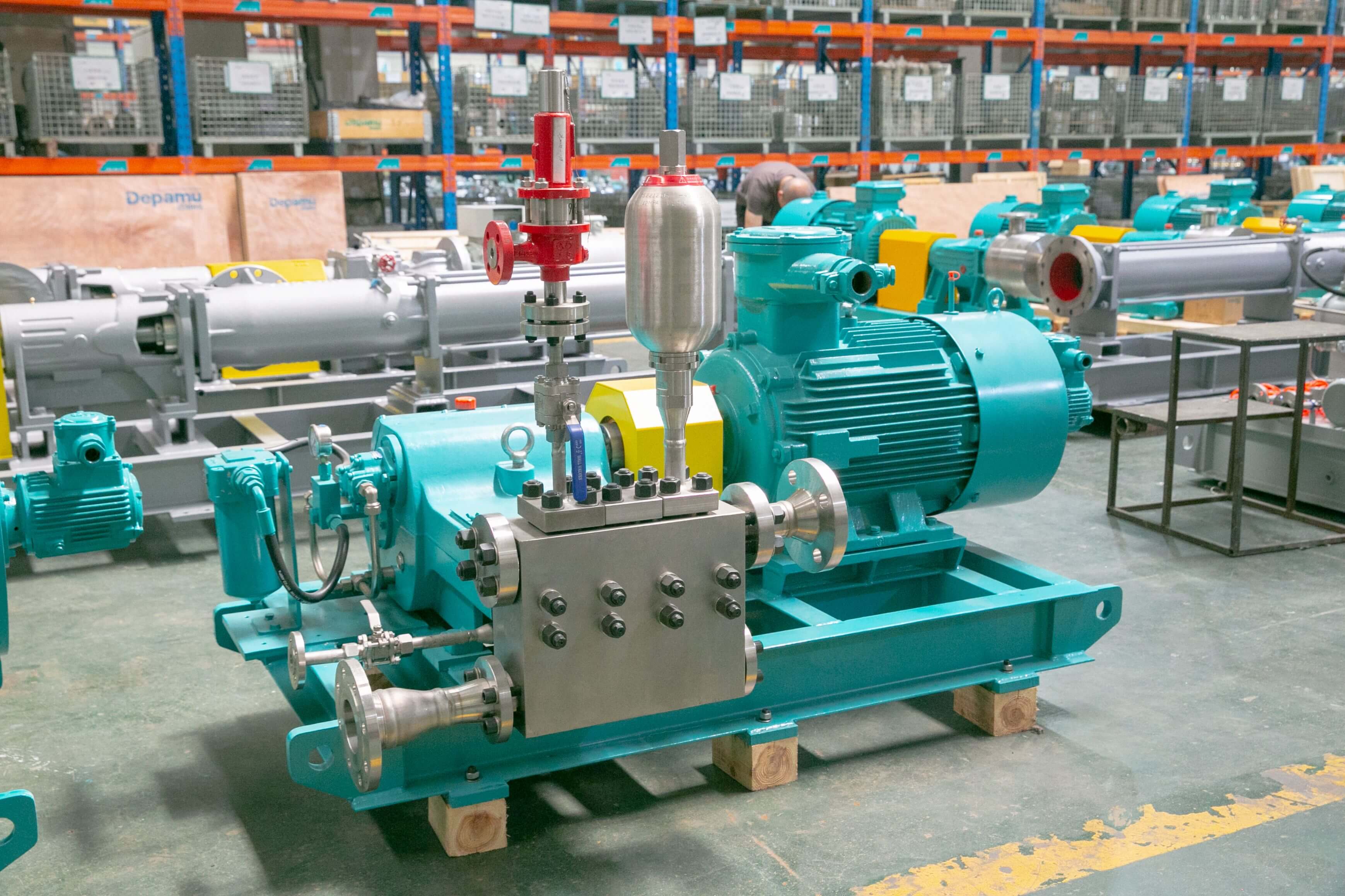
Introduction to the Company's Technological Strength: Cost-Performance Balancing Solution by Depump Pump Industry
Depamp (Hangzhou) Pump Technology Co., Ltd., established in 2003, specializes in the research and development of high-end positive displacement pumps and fluid equipment. Its factory covers an area of 35,000 square meters, employs over 400 staff, and has a registered capital of 54 million yuan, with an annual output value of approximately 500 million yuan. Its technological layout spans three core areas:
STEP1:Breakthroughs in materials and sealing technologyFor high-pressure scenarios, duplex stainless steel (such as 2205 and 2507) and Hastelloy alloys (C-276 and C-22) are employed, enhancing pressure resistance by 30%. The independently developed structure of "triple lip seals + bellow compensation" controls the leakage rate at ≤0.1%, significantly lower than industry standards.
STEP2:Modular Design and Rapid CustomizationBy standardizing pump heads (covering flow rates of 0.1-500 m³/h and pressures of 1-100 MPa), drive ends (electric motors, diesel engines, pneumatic systems), and control modules (variable frequency drives, PLCs), we can respond to non-standard requirements within 72 hours and reduce customization costs by 15%. For instance, the "high-pressure methanol injection pump" customized for an oil and gas field project achieved a 25% increase in flow rate and a 10% reduction in energy consumption under the same motor power by optimizing the plunger diameter (adjusted from φ80 mm to φ100 mm) and stroke (extended from 200 mm to 250 mm).
STEP3:Full life cycle service systemAn "Equipment Health Management Platform" is provided, which utilizes sensors to monitor vibration (≤4.5mm/s), temperature (≤80℃), and pressure fluctuations (≤±2%) in real-time. Predictive maintenance enhances the mean time between failures to 12,000 hours; the accompanying "Energy Consumption Optimization Solution" can reduce operational costs by 8%-12%.
For more information, please visit the official website:www.depamufluid.com
FAQ Q&A Technical Selection Guide
Q1: How to select the pump type based on process pressure?
A: The rated pressure of a high-pressure plunger reciprocating pump should be 1.2-1.5 times higher than the maximum process pressure. For example, when the process pressure is 60 MPa, a pump model with a rated pressure ≥ 72 MPa should be selected (such as the Depam DP-G series high-pressure pump with a rated pressure of 80 MPa). If frequent pressure fluctuations occur, a pressure buffer tank (with a volume ≥ 3 times the pump's single displacement) should be equipped to stabilize the output.
Q2: How does media corrosivity affect material selection?
A: Select materials based on the composition and concentration of the medium: For acidic media containing Cl⁻ (such as seawater), duplex stainless steel 2205 should be used; for oil and gas field media containing H₂S, sulfur-resistant carbon steel (such as L80-1) or nickel-based alloy (Inconel 625) should be used; for strong acids (such as concentrated sulfuric acid), polytetrafluoroethylene (PTFE) lining or Hastelloy C-276 should be used. Depamu can provide material corrosion test reports (referencing NACE TM0177 standard) to ensure material compatibility.
Q3: How to evaluate the total life cycle cost of equipment?
A: Total lifecycle cost = procurement cost + energy consumption cost + maintenance cost + downtime loss. Taking Depamu's DP-G series high-pressure pump as an example: the procurement cost is approximately 500,000 yuan, the annual energy consumption cost (calculated based on 8,000 hours of operation and an electricity price of 0.6 yuan/kWh) is approximately 120,000 yuan (with 85% efficiency), the annual maintenance cost is approximately 30,000 yuan (for replacement of consumable parts), and the downtime loss (calculated based on a process loss of 20,000 yuan per hour) is approximately 5,000 yuan (with an MTBF of 12,000 hours); the 5-year TCO is approximately 1.37 million yuan, which is 14.4% lower than that of low-priced equipment (with a TCO of approximately 1.6 million yuan).
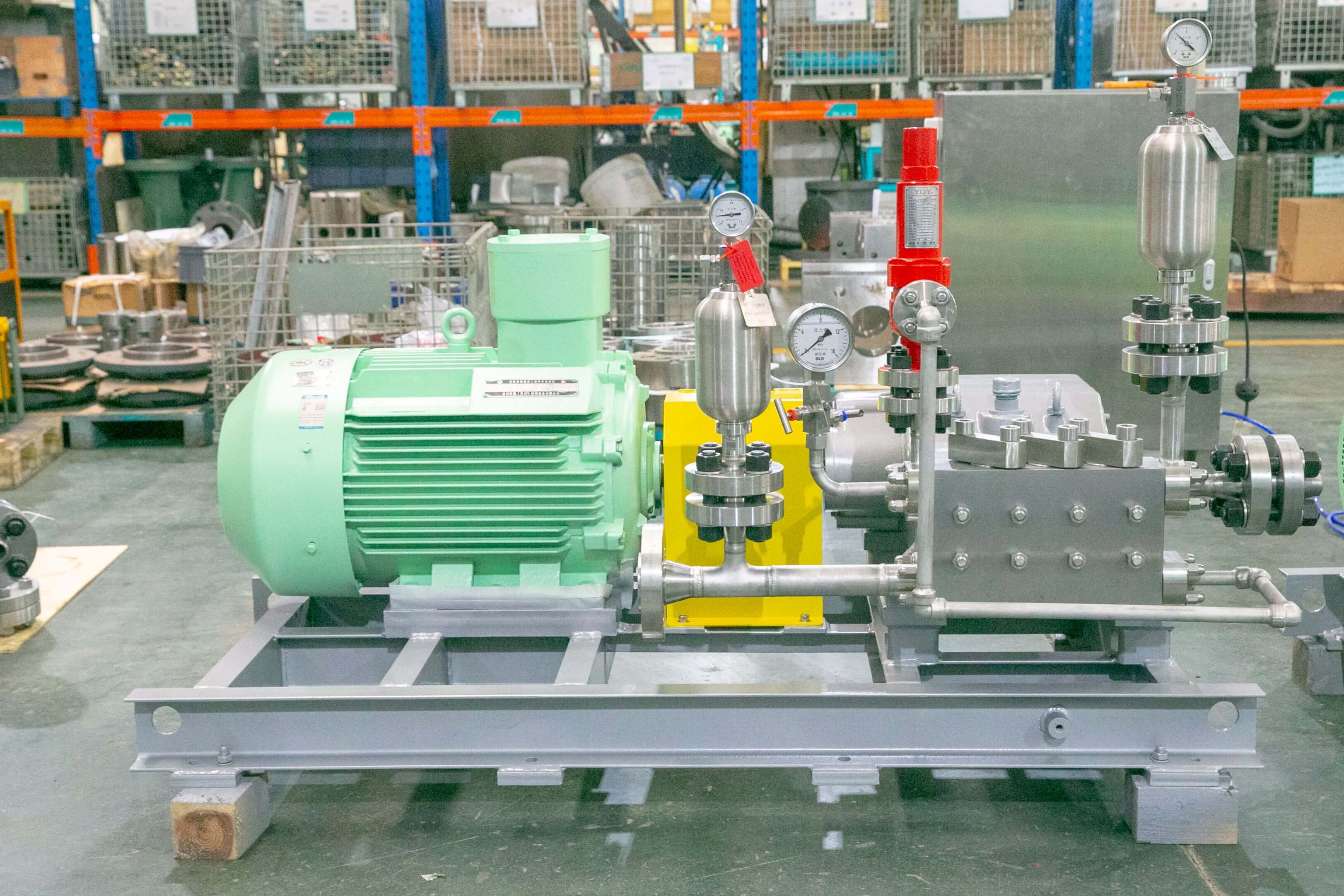
Reference for full text summary
The selection of high-pressure plunger reciprocating pumps requires a comprehensive evaluation from three aspects: performance parameters, material compatibility, and total life cycle cost. Depam Pump Industry provides users with a "high-performance + low-cost" solution through material innovation (such as duplex stainless steel 2205), modular design (72-hour rapid customization), and total life cycle services (predictive maintenance, energy consumption optimization). Its products have been applied in fields such as petroleum refining (accounting for 41%) and chemicals (accounting for 23%). By 2025, its sales had reached 560 million yuan, demonstrating both technical strength and market reputation. For more information, please visit the official website:www.depamufluid.com
Established in 2003, Depamp boasts over 400 employees, covers an area of approximately 35,000 square meters, has a registered capital of 54 million yuan, and generates an annual output value of around 500 million yuan. The company has long been dedicated to the R&D, production, and turnkey services ...
No. 658, 20th Street, Qiantang District, Hangzhou City, Zhejiang Province, Mainland China