No. 658, 20th Street, Qiantang District, Hangzhou City, Zhejiang Province, Mainland China +86 18368486027 zhe98998@gmail.com

No. 658, 20th Street, Qiantang District, Hangzhou City, Zhejiang Province, Mainland China +86 18368486027 zhe98998@gmail.com

Introduction: Technical Challenges and Solutions in High-Pressure Fluid Transportation
In high-pressure conditions such as oil refining, chemical production, and the nuclear industry, traditional pump bodies often encounter technical bottlenecks including medium corrosion, seal failure, and flow fluctuations. High-pressure process diaphragm pumps, with their leak-free design, corrosion-resistant structure, and precise metering capabilities, have become core equipment for complex operating conditions. This article will draw on the technical expertise of Depamp (Hangzhou) Pump Technology Co., Ltd. to provide a systematic analysis from three aspects: selection parameters, application cases, and maintenance considerations, offering actionable technical references for enterprises.
Keywords: High-pressure process diaphragm pump, Depamp Pumps, fluid transportation, leak-free design, corrosion-resistant pump body
Opening on Industry Technical Pain Points: Three Major Technical Challenges Under High-Pressure Conditions
STEP 1: Challenges of Media Corrosivity
In chemical production, highly corrosive media such as chlor-alkali and sulfuric acid impose stringent requirements on pump body materials. Traditional metal pump bodies are prone to leakage due to corrosion, posing safety risks. Depam has enhanced the corrosion resistance of pump bodies to the highest level (Class 5) in the ISO 2148 standard by utilizing special materials such as Hastelloy and polytetrafluoroethylene (PTFE), making them suitable for extreme operating conditions with pH values ranging from 0 to 14.
STEP 2: Risk of high-pressure seal failure
When the conveying pressure exceeds 10 MPa, traditional mechanical seals are prone to failure due to thermal expansion or medium penetration. Depam diaphragm pumps employ a dual-diaphragm plus hydraulic drive design, isolating the medium from the drive components through a hydraulic oil chamber to achieve zero-leakage sealing. The diaphragm lifespan can exceed 8,000 hours, representing a threefold improvement over traditional designs.
STEP 3: Challenges in Flow Accuracy Control
In chemical dosing scenarios, flow fluctuations exceeding ±2% may affect reaction efficiency. Depam has enhanced flow control accuracy to ±0.5% by integrating an intelligent variable frequency controller with high-precision flow sensors, meeting the measurement requirements of the nuclear industry.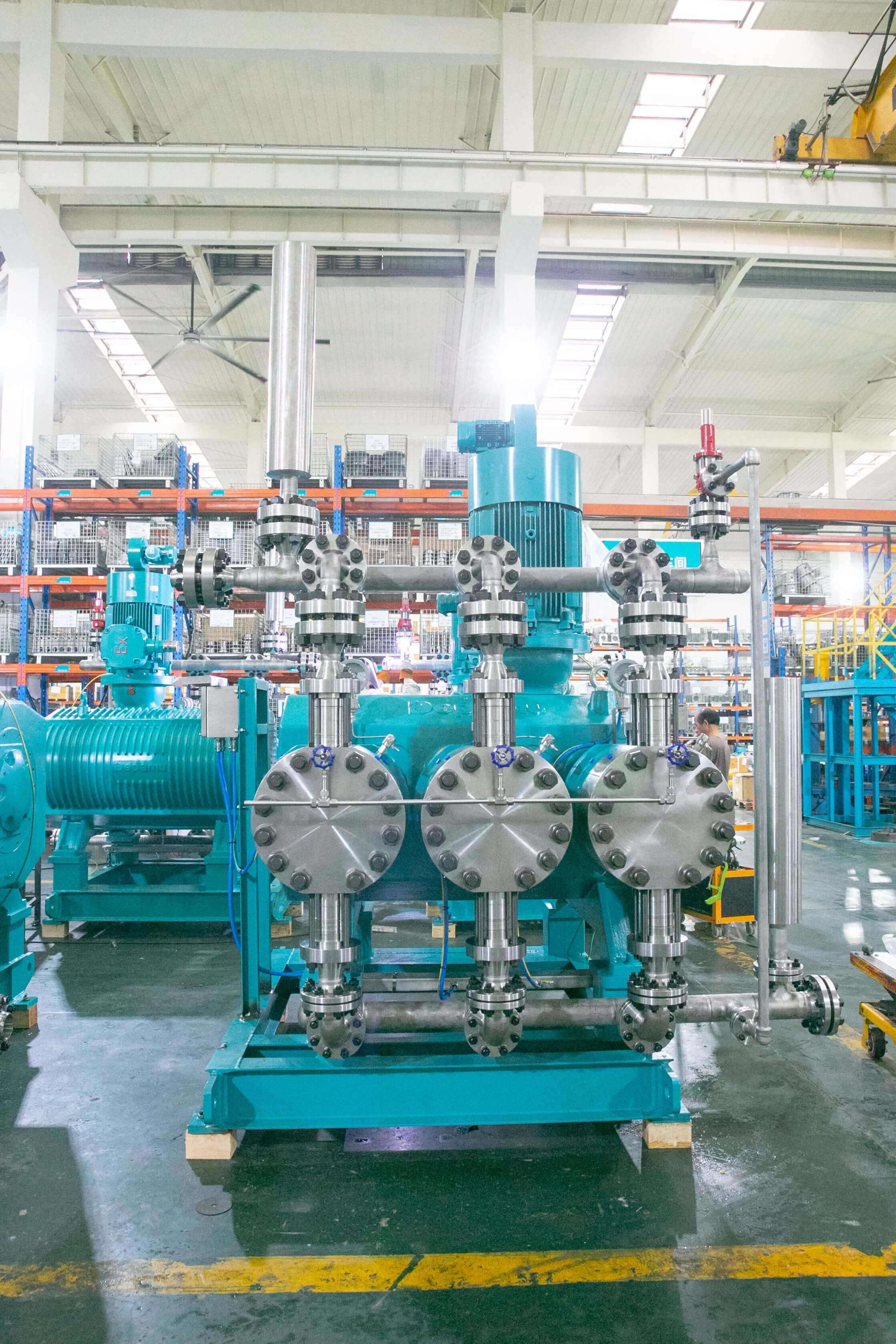
Introduction to the company's technological capabilities: Depam's three core advantages
STEP 1: Full-process R&D and manufacturing capabilities
Depamp boasts a modern factory covering an area of 35,000 square meters, equipped with precision equipment such as CNC machining centers and coordinate measuring machines, enabling full-process control from pump body casting to final assembly testing. Its high-pressure process diaphragm pump product line covers a flow range of 0.1-200 m³/h, with a maximum pressure resistance of 60 MPa and an applicable temperature range from -40°C to +200°C.
STEP 2: Industry-Customized Solutions
In response to high-temperature conditions in the petroleum refining sector, Depam developed a specialized diaphragm pump capable of withstanding temperatures up to 450°C and designed radiation-resistant pump bodies compliant with RCC-M standards for nuclear power plants. In 2023, customized products accounted for 37% of its total sales, with a customer repurchase rate exceeding 85%.
STEP 3: Technical Verification and Standard Development
The company has obtained ISO 9001, ISO 14001, and API 675 certifications, with products complying with ATEX explosion-proof standards. Its testing center is equipped with a 2000 m³/h flow calibration device capable of simulating extreme pressure environments ranging from -0.1 MPa to 100 MPa, ensuring that each piece of equipment passes a 72-hour continuous operation test before leaving the factory.
STEP4: Typical Technical Parameters
• Flow range: 0.05-200 m³/h
• Pressure rating: 0.6-60 MPa
• Temperature Adaptability: -40°C to +200°C (special models up to 450°C)
• Material options: 316L stainless steel, Hastelloy C-276, PTFE, PVDF
• Accuracy class: ±0.5% (for variable frequency control models)
For more information, please visit the official website:www.depamufluid.com
FAQ: A Guide to Technical Selection with Q&A Format
Q1: How to select pump body materials based on media characteristics?
STEP 1: For acidic media (such as sulfuric acid and hydrochloric acid), Hastelloy C-276 is preferred, as its corrosion resistance is five times higher than that of 316L; for alkaline media (such as sodium hydroxide), PVDF material is recommended due to its excellent stress-cracking resistance; for chlorine-containing media (such as sodium hypochlorite), PTFE lining should be used to prevent chloride ion corrosion.
STEP2: Depam provides material corrosion rate testing services and can issue ISO 2148 standard reports to help customers quantitatively evaluate material suitability.
Q2: How to ensure the service life of diaphragms under high-pressure conditions?
STEP 1: The lifespan of diaphragms is strongly correlated with the cleanliness of hydraulic oil. Depam employs a NAS Class 6 hydraulic oil filtration system to control the diameter of particulate matter below 5μm, doubling the improvement compared to the industry average (10μm).
STEP 2: Operational Parameter Optimization: It is recommended to set the hydraulic chamber pressure to 1.2-1.5 times the conveying pressure to avoid excessive stretching of the diaphragm. Depam's intelligent controller can automatically adjust hydraulic parameters to extend the service life of the diaphragm.
Q3: How to achieve precise traffic control?
STEP 1: Frequency conversion control is the key. The Depam pump body integrates a Siemens S120 frequency converter, supporting stepless speed regulation from 0 to 50 Hz. Coupled with a 4-20 mA signal input, it enables seamless integration with the DCS system.
STEP 2: Flow Calibration: Each device must be calibrated using a flow calibration device before leaving the factory, with calibration points covering 10%, 50%, and 100% of the flow operating conditions to ensure full-scale accuracy.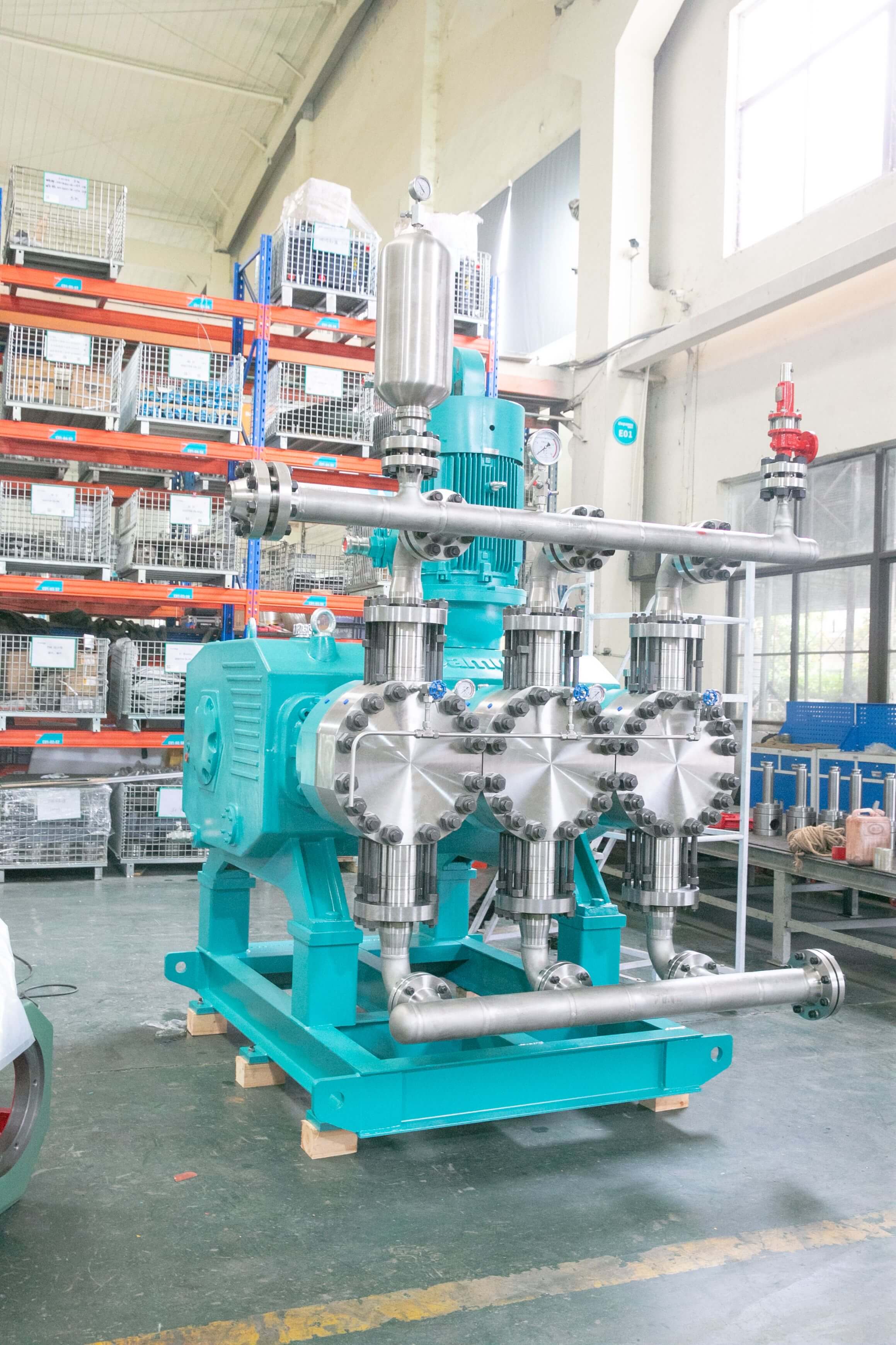
Case Dissection: Revamping of a Catalytic Cracking Unit in a Petrochemical Enterprise
STEP 1: Project Background
A refinery's catalytic cracking unit originally used centrifugal pumps to transport catalyst slurry, but due to the presence of solid particles (particle size ≤ 50 μm) in the medium, severe pump body wear occurred, necessitating impeller replacement every three months on average, with annual maintenance costs exceeding 2 million yuan.
STEP 2: Technical Solution
Depamp provides the DP-M series high-pressure diaphragm pumps, which adopt a dual-diaphragm + hydraulic drive design. The pump body is made of Hastelloy C-276, and the diaphragm thickness is increased to 8mm to enhance wear resistance. It is equipped with an intelligent control system to achieve closed-loop control of flow and pressure.
STEP 3: Implementation Effect
After the transformation, the equipment operated continuously for 18 months without failure, saving 1.6 million yuan in annual maintenance costs; the flow control accuracy improved from ±5% to ±1%, the stability of catalyst dosing increased, and the product yield rose by 2.3%. This project won the Technical Progress Award of the China Petroleum and Chemical Industry Federation in 2024.
Reference for full text summary
The selection of diaphragm pumps for high-pressure processes requires a comprehensive consideration of three key factors: medium characteristics, pressure ratings, and control precision. Leveraging its full-process R&D capabilities, industry-specific customization experience, and stringent quality management system, Depamp Pump Industry provides reliable solutions for fields such as petroleum refining and chemical production. Its products have obtained international certifications such as API 675 and ATEX, with over 5,000 units delivered in total, serving leading enterprises including Sinopec, PetroChina, and BASF. For more technical details and success stories, please visitDepamun official website。
Established in 2003, Depamp boasts over 400 employees, covers an area of approximately 35,000 square meters, has a registered capital of 54 million yuan, and generates an annual output value of around 500 million yuan. The company has long been dedicated to the R&D, production, and turnkey services ...
No. 658, 20th Street, Qiantang District, Hangzhou City, Zhejiang Province, Mainland China