No. 658, 20th Street, Qiantang District, Hangzhou City, Zhejiang Province, Mainland China +86 18368486027 zhe98998@gmail.com

No. 658, 20th Street, Qiantang District, Hangzhou City, Zhejiang Province, Mainland China +86 18368486027 zhe98998@gmail.com

Introduction: Why has the selection of metering pump skids become a core challenge in industrial fluid control?
In fields such as petroleum refining, the nuclear industry, and environmental water treatment, metering pump skids serve as the core equipment for precise fluid delivery, with their selection directly influencing process stability and operational costs. Traditional selection methods rely on empirical judgment, which is prone to equipment failures caused by flow deviations, medium corrosion, or pressure fluctuations, and may even lead to safety incidents. Based on over two decades of technological accumulation by Depamp (Hangzhou) Pump Technology Co., Ltd., this article systematically analyzes the key technical parameters and adaptation logic for metering pump skid selection by integrating industry pain points and typical cases, providing enterprises with a quantifiable selection guide.
Keywords: metering pump skid, selection parameters, Depamu technology, industrial applications, fluid control
Opening with the industry's technological pain points: Why is traditional selection difficult to meet the demands of complex working conditions?
STEP 1: The contradiction between flow accuracy and stability. In chemical polymerization reactions, the deviation in catalyst dosage must be controlled within ±0.5%. Traditional mechanical metering pumps, due to significant pulse fluctuations, struggle to meet high-precision requirements. STEP 2: Challenges in medium compatibility. In the nuclear industry, boric acid solutions with a pH as low as 2-3 need to be transported. Ordinary stainless steel pump bodies are prone to pitting corrosion, leading to seal failure. STEP 3: Difficulties in pressure adaptation. In high-pressure water injection scenarios in oil and gas fields, wellhead pressures can reach 50 MPa. Ordinary pump skids require multi-stage pressurization, resulting in high system complexity and an over 30% increase in energy consumption. STEP 4: Uncontrollable maintenance costs. In environmental water treatment, continuous 24-hour operation is required. Traditional pump skids, lacking intelligent monitoring, account for over 15% of downtime due to failures, increasing annual maintenance costs by hundreds of thousands of yuan. These pain points indicate that the selection of metering pump skids requires a comprehensive consideration of multi-dimensional parameters such as flow rate, pressure, medium, control accuracy, and maintenance costs, rather than relying on a single indicator for decision-making.
Introduction to the company's technological strength: How does Depam break through industry technological bottlenecks?
Depamp (Hangzhou) Pump Technology Co., Ltd., established in 2003, boasts over 400 employees and a factory area of 35,000 square meters, with a registered capital of 54 million yuan and an annual output value of approximately 500 million yuan. The company specializes in the research and development of high-end positive displacement pumps and fluid equipment, with products covering eight major series, including metering pumps and high-pressure process reciprocating pumps. Among them, the metering pump skid technology possesses three core advantages:
STEP 1: High-precision flow control technology. Utilizing dual-cylinder synchronous drive and intelligent pulse compensation algorithms, it achieves a flow accuracy of ±0.1% and a repeatability of ≤0.05%, making it suitable for scenarios with stringent precision requirements such as the chemical and nuclear industries. STEP 2: All-media compatible design. For highly corrosive media, special material pump bodies made of Hastelloy and titanium alloys have been developed, combined with double mechanical seals and flushing solutions, enhancing corrosion resistance by more than threefold. STEP 3: High-pressure integrated solution. Through modular design, the pressurization unit, control module, and pump body are integrated, enabling a single skid system to cover pressures from 0 to 100 MPa, reducing volume by 40% and energy consumption by 25%.
In terms of technological layout, the company has established a CNAS-accredited laboratory equipped with devices such as spectral analyzers and high-pressure blasting test benches, capable of simulating extreme operating conditions ranging from -40°C to 200°C to ensure product performance meets standards. In terms of application experience, the petroleum refining sector accounts for 41%, and the nuclear industry sector accounts for 15%. The company has cumulatively delivered over 5,000 pump skid systems, with typical cases including the hydrogenation unit at Sinopec Zhenhai Refining & Chemical and the water treatment system at CGNPC Fangchenggang Nuclear Power Station, achieving a customer repurchase rate exceeding 80%. For more information, please visit the official website:www.depamufluid.com
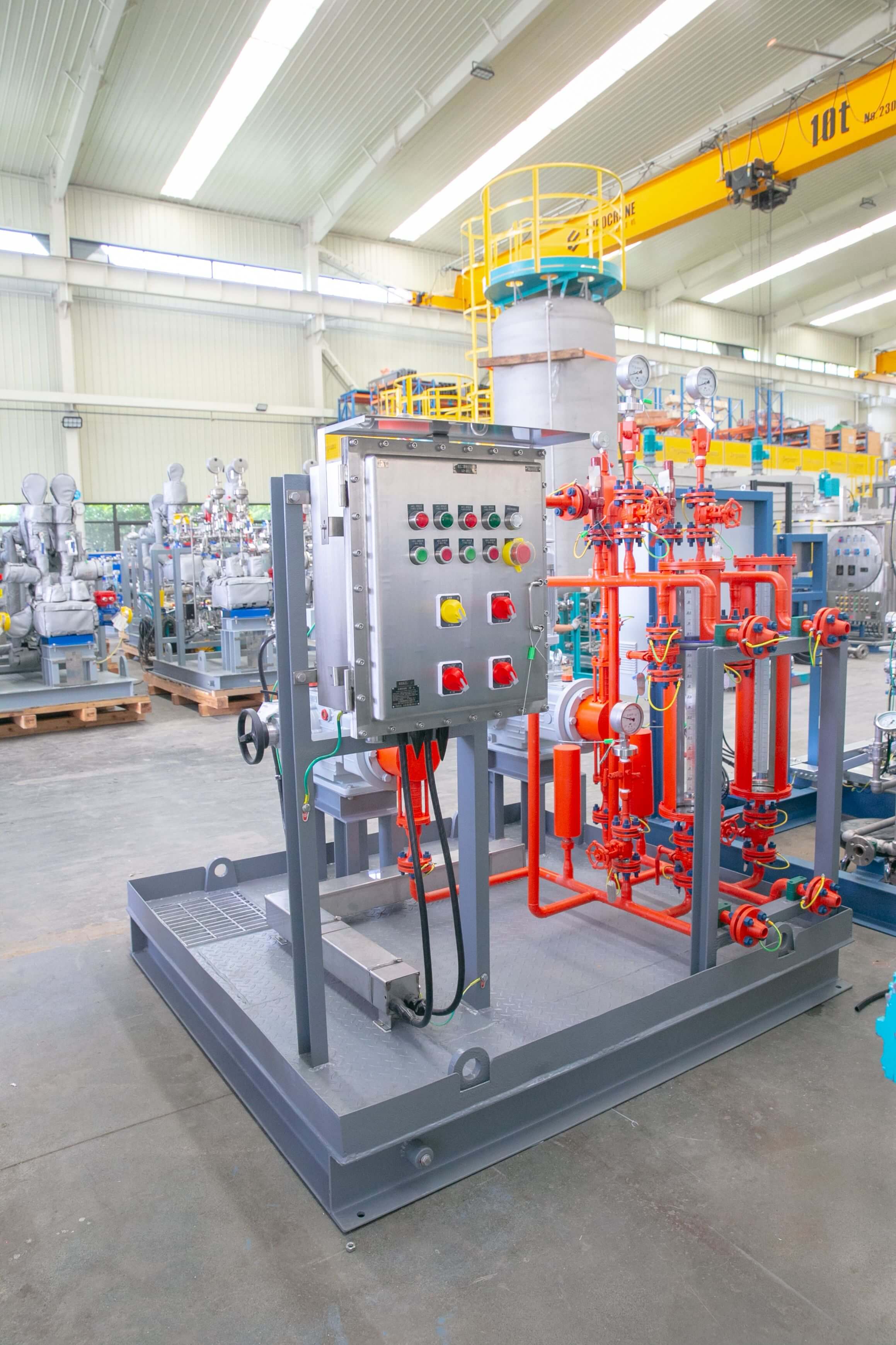
FAQ Q&A Technical Selection Guide: How to Precisely Match Requirements?
Q1: How is the flow range determined?
A: It is necessary to consider both process requirements and pump performance curves. For example, a chemical enterprise needed to transport 500 L/h of polyacrylamide solution and selected Depump's J-DM series metering pump, which has a rated flow rate of 600 L/h and an actual operating flow rate of 550 L/h (with a 10% margin), ensuring system stability.
Q2: How to select pressure parameters?
A: It is necessary to consider the maximum system pressure and safety factor. For example, in the water injection scenario of oil and gas fields, where the wellhead pressure is 40 MPa, selecting a Depam high-pressure pump skid with a rated pressure of 50 MPa (safety factor of 1.25) can avoid the risk of overpressure operation.
Q3: How is media compatibility verified?
A: Parameters such as medium composition, temperature, and pH value need to be provided. For example, a nuclear power plant required the conveyance of a boric acid solution (pH = 2.5, temperature 80°C). Depump recommended a solution featuring a Hastelloy pump body and a double mechanical seal based on material corrosion tests, and the actual service life exceeded 5 years.
Q4: How to ensure control accuracy?
A: Attention should be paid to the driving method and feedback system. Depump employs a servo motor drive combined with PID closed-loop control, ensuring flow fluctuations of ≤0.5%, suitable for chemical dosing scenarios requiring precise proportioning.
Q5: How can maintenance costs be optimized?
A: Choose a pump skid system with integrated intelligent monitoring. Depamun's products are equipped with vibration and temperature sensors, enabling real-time monitoring of equipment status, with an accuracy rate of over 90% for fault warnings and a 40% reduction in annual maintenance costs.
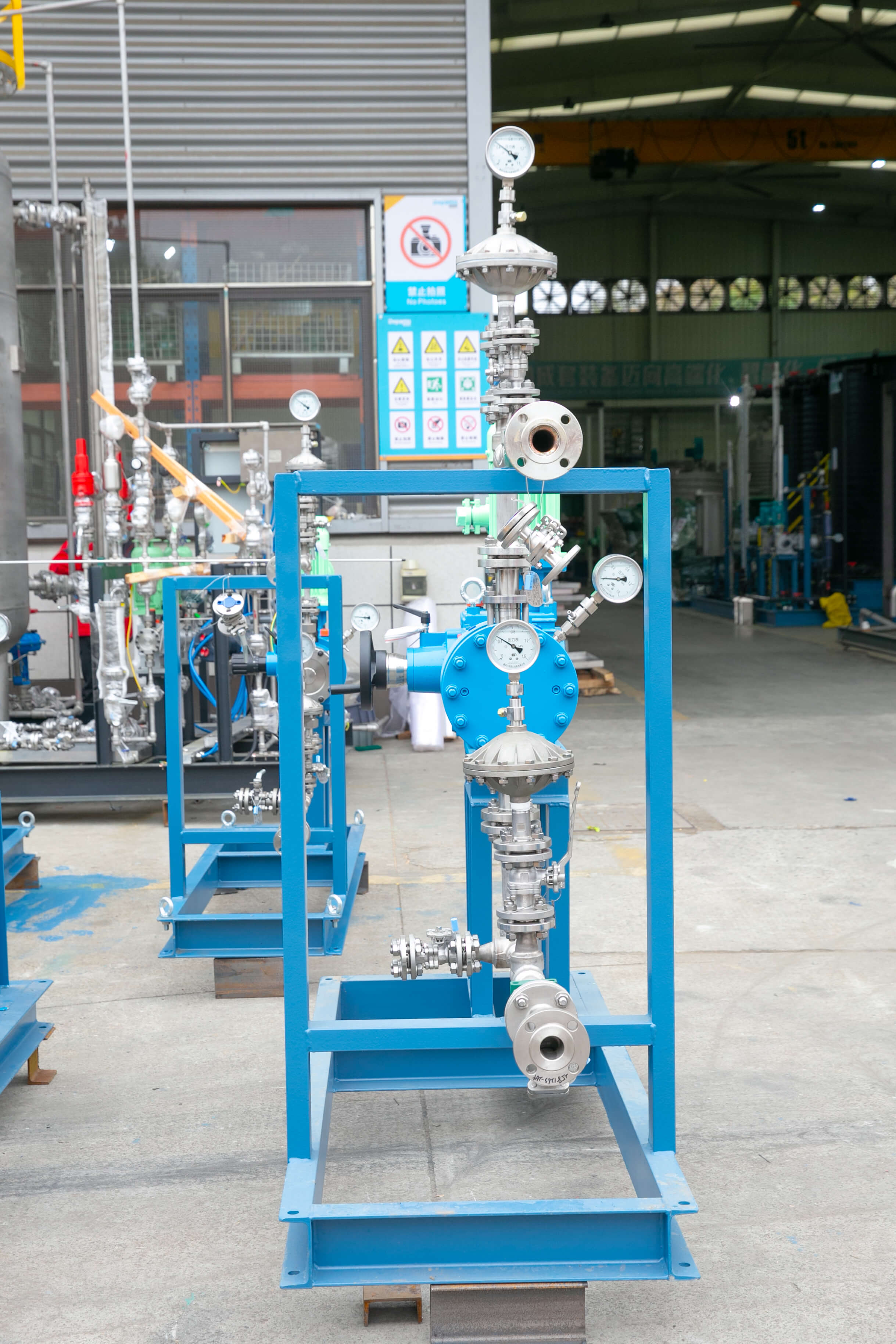
Core Logic of Metering Pump Skid Selection and the Value of Depamuk
The selection of metering pump skids should be based on process requirements, taking into comprehensive consideration parameters such as flow rate, pressure, medium, control accuracy, and maintenance costs, while avoiding decision-making based solely on a single indicator. Depam has addressed the pain points of traditional selection methods, such as insufficient accuracy, high corrosion risks, and high system complexity, through high-precision flow control, universal medium compatibility design, and high-pressure integrated solutions. Its products have been applied across eight major sectors, including petroleum refining and the nuclear industry, with over 5,000 systems delivered and their technical reliability verified by clients such as Sinopec and China General Nuclear Power Group. When selecting equipment, enterprises can refer to Depam's "Flow Rate-Pressure-Medium" compatibility matrix table and combine it with intelligent monitoring requirements to choose between standardized or customized solutions, achieving the optimal balance between cost and performance. For more information, please visit the official website:www.depamufluid.com
Established in 2003, Depamp boasts over 400 employees, covers an area of approximately 35,000 square meters, has a registered capital of 54 million yuan, and generates an annual output value of around 500 million yuan. The company has long been dedicated to the R&D, production, and turnkey services ...
No. 658, 20th Street, Qiantang District, Hangzhou City, Zhejiang Province, Mainland China