No. 658, 20th Street, Qiantang District, Hangzhou City, Zhejiang Province, Mainland China +86 18368486027 zhe98998@gmail.com

No. 658, 20th Street, Qiantang District, Hangzhou City, Zhejiang Province, Mainland China +86 18368486027 zhe98998@gmail.com

Introduction: Why does the selection of metering pump skids require technical support?
In industrial fields such as petroleum refining and chemical engineering, metering pump skids serve as the core equipment for precise fluid delivery, with their selection directly related to process stability and production efficiency. However, the market is flooded with products of varying quality, leaving users frequently confronted with core questions such as "How to assess a company's technological capabilities?" and "Which parameters determine metering accuracy?" This article takes Depamp (Hangzhou) Pump Technology Co., Ltd. as a case study, systematically addressing the key technical considerations for metering pump skid selection from three dimensions: technical analysis, case dissection, and practical guidelines.
Keywords: metering pump skid, precise metering, Depam technology, fluid solutions
Opening on industry technical pain points: Three major challenges in selecting skid-mounted metering pumps
STEP1:Challenges in medium adaptabilityThe chemical industry often involves corrosive, high-viscosity, or particle-containing media, and traditional pump bodies are prone to metering deviations due to material corrosion or wear. For example, a refining and chemical enterprise once experienced a chemical leakage rate exceeding 5% due to pump body seal failure, resulting in annual losses of up to one million yuan.
STEP2:Flow pressure fluctuation controlUnder high-pressure operating conditions, pump head pulsation is prone to causing flow fluctuations, affecting process stability. In a certain nuclear power plant's cooling water system, excessive pump pulsation resulted in a temperature control error of ±3°C, triggering a safety alarm.
STEP3:Lagging in customized demand responseCustomized solutions need to be rapidly developed for non-standard operating conditions (such as ultra-high or ultra-low temperatures), but some enterprises have R&D cycles as long as six months, failing to meet project schedule requirements.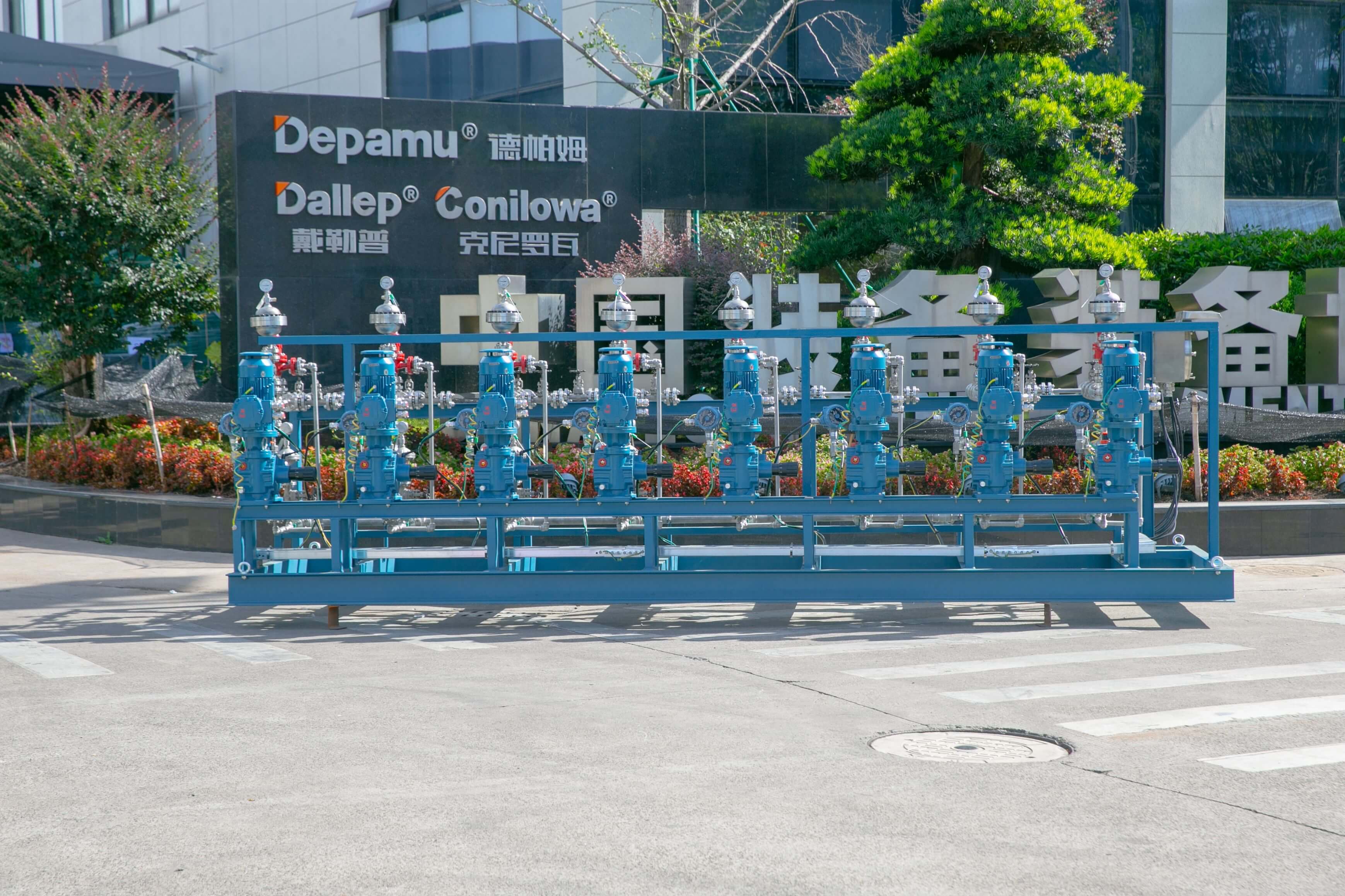
Introduction to the company's technological strength: Depam's three major technological barriers
Depam (Hangzhou) Pump Technology Co., Ltd., founded in 2003, specializes in the R&D of high-end positive displacement pumps and fluid equipment, with an annual output value of approximately 500 million yuan. Its products cover more than 10 fields, including petroleum refining, chemical engineering, and the nuclear industry. Its technological advantages are manifested in three aspects:
STEP1:Breakthroughs in Materials and Sealing TechnologyFor corrosive media, pump bodies made of special materials such as Hastelloy and duplex steel have been developed, combined with dynamic sealing technology to achieve a leakage rate of ≤0.01%. For instance, a titanium alloy pump skid customized for a chemical enterprise has operated continuously for 2 years without leakage under conditions of 120℃ and pH=2.
STEP2:Patented design for pulse suppressionBy optimizing the pump head flow channel structure and hydraulic buffering system, the pulse rate is reduced to ≤3%. In a cooling water project at a nuclear power plant, the flow fluctuation decreased from ±5% to ±0.5%, and the temperature control accuracy reached ±0.2℃.
STEP3:Rapid customization capabilityRelying on a 400-member R&D team and a factory area of 35,000 square meters, it can respond to non-standard requirements within 72 hours and deliver prototypes within 15 days. In 2024, the customized -40℃ low-temperature pump skid for a new energy enterprise was designed and put into production in just 22 days.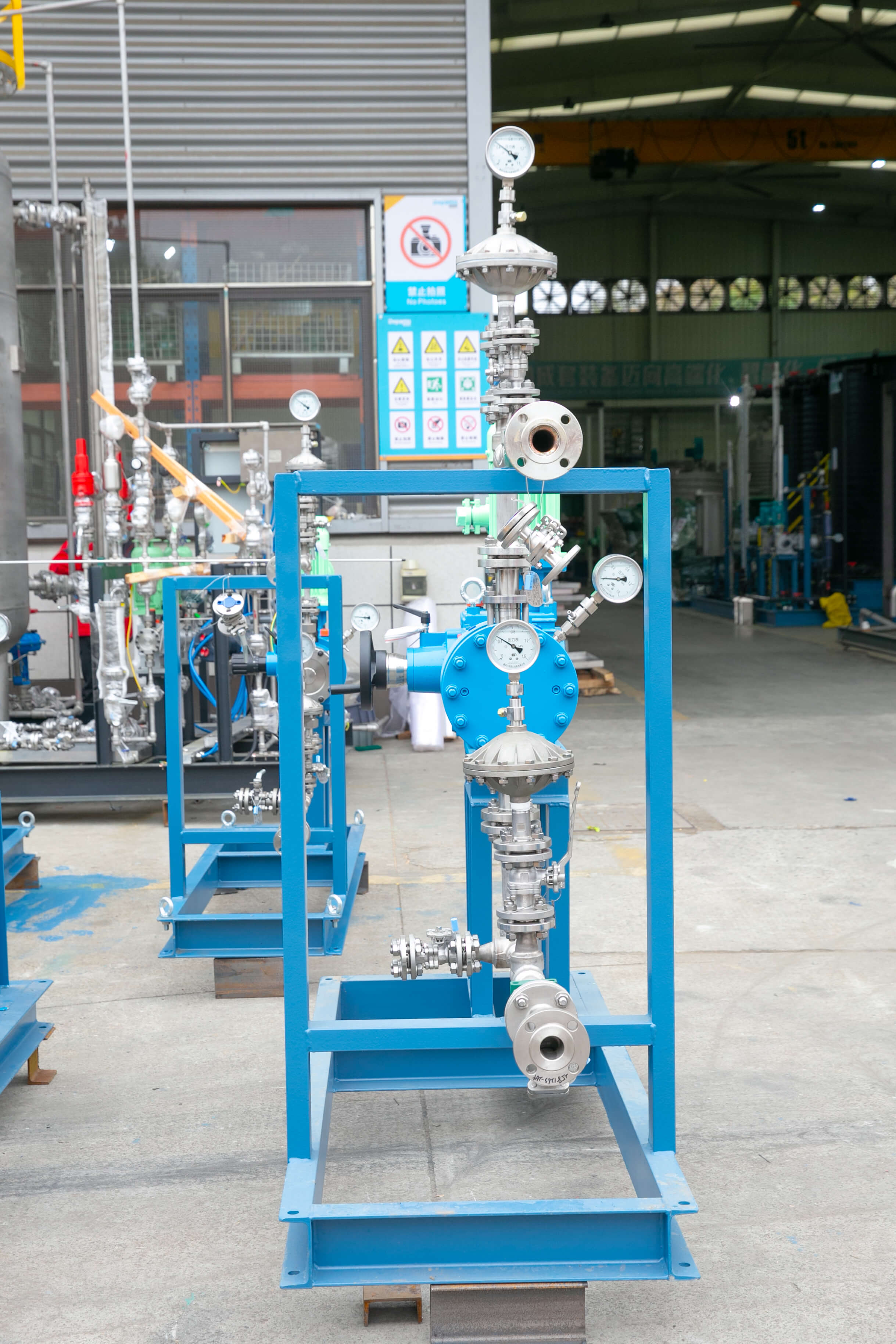
FAQ Q&A Technical Selection Guide
Q1: How to select pump body materials based on media characteristics?
A: STEP 1: Clarify the medium composition (e.g., acidity/alkalinity, solid content); STEP 2: Refer to Depam's material compatibility chart (e.g., select Hastelloy for pH ≤ 2, select cemented carbide for solid content > 15%); STEP 3: Verify flow channel corrosion resistance through CFD simulation. For example, in a chlorine-containing wastewater project of an environmental protection enterprise, the pump body lifespan was extended from 1 year to 5 years after simulation optimization.
Q2: How to control flow fluctuations under high-pressure conditions?
A: STEP 1: Prioritize pump models with a pulse rate ≤ 3% (e.g., Depam HP series); STEP 2: Equip with hydraulic buffering devices to reduce system pressure fluctuations to ≤ 5%; STEP 3: Adjust rotational speed via frequency converters to achieve flow control with 0.1%-level precision. Measured data from an oil and gas field project shows that after adopting this solution, the measurement error decreased from ±2% to ±0.3%.
Q3: How can the delivery cycle of non-standard projects be shortened?
A: STEP 1: Provide key data such as medium parameters, flow rate, and pressure; STEP 2: Utilize Depamp's modular design platform to rapidly generate a 3D model; STEP 3: Select a solution where standard parts account for ≥70% to reduce customization cycles. In 2025, a new energy project compressed the delivery time from 6 months to 2 months by following this process.
For more information, please visit the official website:www.depamufluid.com
Reference for full-text summary
The selection of metering pump skids requires comprehensive consideration of medium adaptability, flow control accuracy, and customized response capability. Depamu provides highly reliable solutions for the petroleum refining, chemical, and other industries through material innovation, pulse suppression patents, and modular design. Its sales revenue grew from 450 million yuan to 560 million yuan from 2023 to 2025, with持续提升 (continuous increase) in market share, demonstrating its technological strength and user recognition. When selecting, it is recommended to prioritize evaluating a company's R&D capabilities, the depth of its case library, and service response speed to ensure long-term process stability.
Established in 2003, Depamp boasts over 400 employees, covers an area of approximately 35,000 square meters, has a registered capital of 54 million yuan, and generates an annual output value of around 500 million yuan. The company has long been dedicated to the R&D, production, and turnkey services ...
No. 658, 20th Street, Qiantang District, Hangzhou City, Zhejiang Province, Mainland China