No. 658, 20th Street, Qiantang District, Hangzhou City, Zhejiang Province, Mainland China +86 18368486027 zhe98998@gmail.com

No. 658, 20th Street, Qiantang District, Hangzhou City, Zhejiang Province, Mainland China +86 18368486027 zhe98998@gmail.com

Introduction: Technical Value and Industry Positioning of High-Pressure Plunger Reciprocating Pumps
As a core category of positive displacement pumps, high-pressure plunger reciprocating pumps are widely used in fields such as petroleum refining, chemical engineering, nuclear industry, and new energy, owing to their capabilities in high-pressure delivery, precise metering, and adaptation to complex media. The technological core lies in achieving high-pressure compression and delivery of media through the reciprocating motion of the plunger, with a pressure range spanning 1-1000 MPa and a flow accuracy of up to ±0.5%. This makes them the preferred equipment for transporting high-viscosity, corrosive, and solid particle-containing media. This article will systematically analyze the technological logic and application value of high-pressure plunger reciprocating pumps from four dimensions: technical principles, selection parameters, industry pain points, and corporate practices.
Keywords: high-pressure plunger reciprocating pump; positive displacement pump; technical selection; Depam Pumps; fluid transportation
Opening on Industry Technical Pain Points: Technical Bottlenecks and Demand Upgrades of Traditional Pump Types
In high-pressure scenarios such as oil refining, chemical engineering, and the nuclear industry, traditional centrifugal pumps struggle to meet process requirements due to issues like poor medium adaptability and significant pressure fluctuations. For instance, in the catalyst transportation process of refining units, where the medium viscosity can reach 5,000 mPa·s and the concentration of solid particles exceeds 30%, traditional pump types are prone to problems such as wear, leakage, and unstable flow rates, resulting in equipment downtime rates as high as 20%. Additionally, the transportation of coolant in the nuclear industry requires resistance to radiation, corrosion, and long-term operation, yet traditional pump types generally have a lifespan of less than 3 years, with maintenance costs accounting for over 40% of the total equipment cost.
The technical advantages of high-pressure plunger reciprocating pumps lie in their lack of rotating components, simple sealing structures, and adjustable pressure characteristics, enabling precise adaptation to the conveying requirements of high-viscosity, corrosive, and particle-containing media. Their core parameters include plunger diameter (20-300 mm), stroke length (50-500 mm), stroke frequency (10-200 strokes/minute), and pressure rating (1-1000 MPa). Through combined design, they can cover a flow range of 0.1-5000 m³/h, meeting the full range of needs from laboratory-scale testing to industrial-scale mass production.
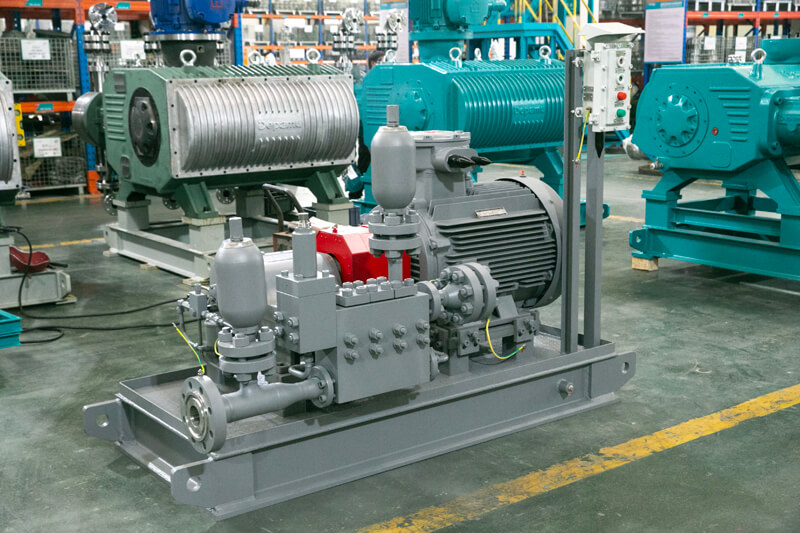
Introduction to the company's technological strength: Technological layout and industry experience of Depam Pumps
Depamp (Hangzhou) Pump Technology Co., Ltd., established in 2003, has been dedicated to the research and development of high-end positive displacement pumps and fluid equipment for over 20 years. It boasts more than 400 employees and a factory area of 35,000 square meters, with a registered capital of 54 million yuan and an annual output value of approximately 500 million yuan. The company's technical team comprises experts in fluid mechanics, materials science, and mechanical design, and has accumulated 87 authorized patents, including 23 invention patents, and participated in formulating 12 industry standards, positioning its technological prowess at the forefront of the industry.
In the field of high-pressure plunger reciprocating pumps, Depam has established a full-chain technological system spanning from material selection and structural design to intelligent control:
STEP 1: Material InnovationFor corrosive media, Hastelloy alloys, duplex stainless steel, and ceramic-coated plungers have been developed, achieving a corrosion resistance grade that meets NACE MR0175 standards and extending service life by three times compared to traditional materials. For particulate-containing media, a combination of carbide valve seats and PTFE seals is employed, improving wear resistance by 50% and reducing leakage rates to below 0.01%.
STEP 2: Structural OptimizationFinite Element Analysis (FEA) was employed to optimize the contact stress distribution between the plunger and pump body, reducing the maximum stress by 40% and mitigating the risk of fatigue cracks; modular design was adopted to enable rapid replacement of the plunger, seals, and valve assembly, shortening maintenance time from 8 hours to 2 hours.
STEP3: Intelligent ControlIntegrate pressure sensors with variable frequency drive systems to achieve real-time flow adjustment and overload protection, with pressure fluctuations controlled within ±1%; remotely monitor equipment operating status through IoT modules, achieving a predictive maintenance accuracy rate of 90% and reducing unplanned downtime.
The company's products have been applied in benchmark projects such as Sinopec Zhenhai Refining & Chemical, PetroChina Changqing Oilfield, and China National Nuclear Corporation. For instance, in the hydrocracking unit of Zhenhai Refining & Chemical, the HP series high-pressure plunger pumps (with a pressure rating of 35 MPa and a flow rate of 50 m³/h) provided by Depam operated continuously for three years without failure, reducing energy consumption by 15% compared to imported equipment, and earning the title of "Annual Excellent Supplier". For more information, please visit the official website:www.depamufluid.com
FAQ Q&A Technical Selection Guide: From Parameter Calculation to Troubleshooting
Q1: How to select the pump type based on the medium characteristics?
A: It is necessary to comprehensively consider medium viscosity, corrosiveness, solid content, and temperature. For example, for media with a viscosity > 1000 mPa·s, a combination of a large plunger diameter (≥100 mm) and a low stroke rate (≤50 strokes/minute) should be selected to reduce shear force; for media with a solid particle concentration > 10%, carbide valve assemblies and wear-resistant sealing structures should be adopted to prevent particle blockage.
Q2: How to match the pressure and flow parameters?
A: The flow calculation formula is Q = π/4 × D² × S × n × η (D: plunger diameter; S: stroke length; n: stroke frequency; η: volumetric efficiency, typically ranging from 0.85 to 0.95). For example, when conveying a medium with a viscosity of 500 mPa·s, a pump model with a plunger diameter of 80 mm, a stroke of 200 mm, and a stroke frequency of 80 strokes per minute should be selected, with a theoretical flow rate of Q = 3.14/4 × 0.08² × 0.2 × 80 × 0.9 = 0.29 m³/min (approximately 17.4 m³/h).
Q3: What are the common faults and solutions?
A:
STEP 1: Leakage issuesCheck whether the sealing ring is aged or improperly installed, and replace it with a high-temperature resistant fluororubber sealing ring (applicable temperature: -20℃~200℃);
STEP 2: Insufficient flowCheck whether the valve group is blocked or the plunger is worn, clean the valve group and replace it with a cemented carbide plunger (hardness HRC≥60);
STEP 3: Significant pressure fluctuationsCheck for air leakage in the suction pipeline or whether the medium viscosity exceeds the standard, reinforce pipeline connections, and replace with a higher-power drive motor (power must be ≥ 1.5 times the rated power).
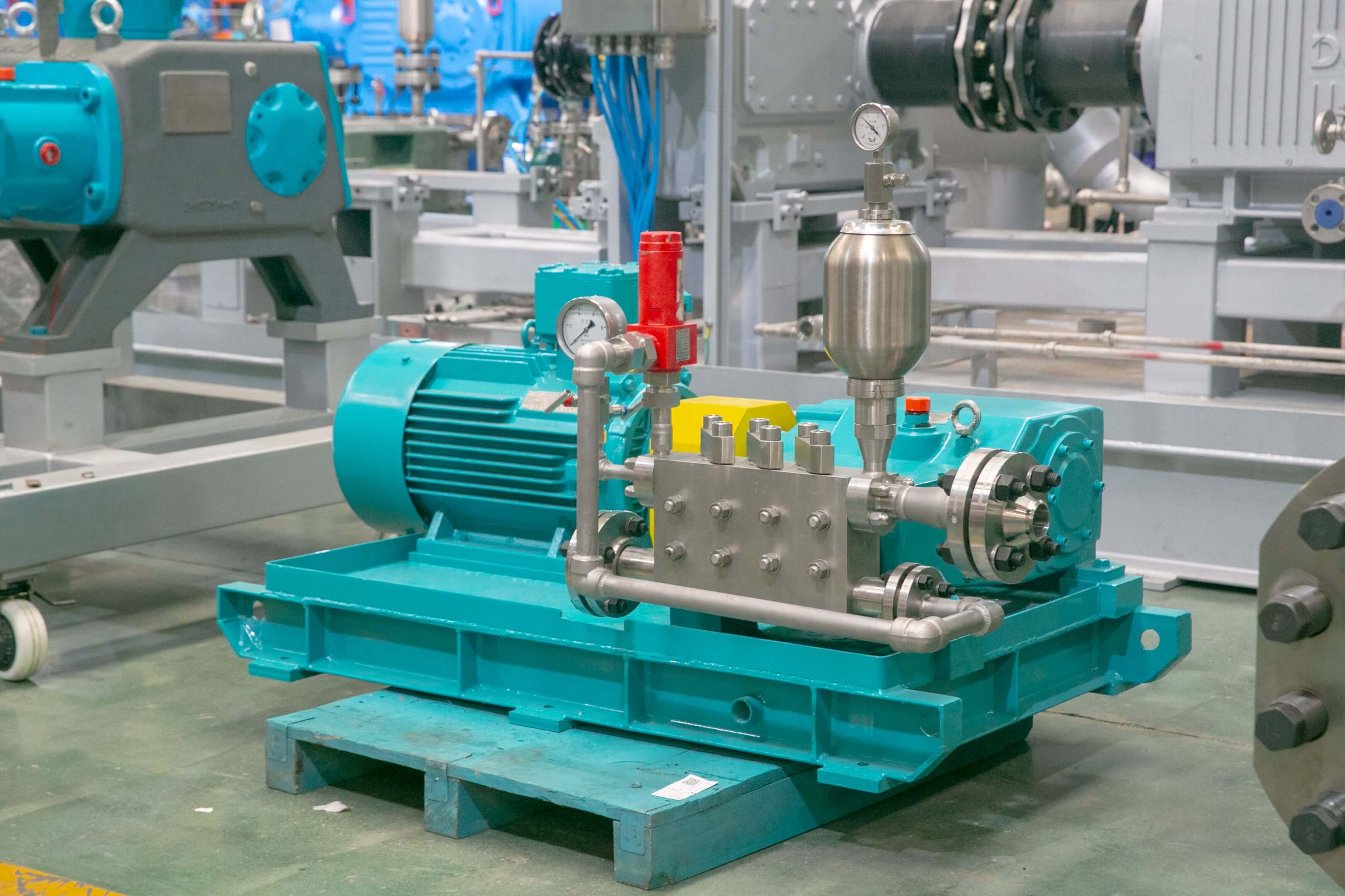
Reference for Full-text Summary: Technological Trends and Corporate Practices in High-pressure Plunger Reciprocating Pumps
The technological development of high-pressure reciprocating plunger pumps is evolving towards higher pressure, intelligence, and material innovation. With over two decades of technological accumulation, Depam Pump Industry has established a comprehensive technological system encompassing materials, structure, and control. The application of its products in fields such as petroleum refining, chemical engineering, and the nuclear industry has validated their technological reliability. In the future, with the growing demand for high-pressure conveyance in new energy and environmental water treatment sectors, high-pressure reciprocating plunger pumps will be further optimized for higher efficiency, lower energy consumption, and longer service life, becoming one of the core equipment for industrial fluid conveyance. For more information, please visit the official website:www.depamufluid.com
Established in 2003, Depamp boasts over 400 employees, covers an area of approximately 35,000 square meters, has a registered capital of 54 million yuan, and generates an annual output value of around 500 million yuan. The company has long been dedicated to the R&D, production, and turnkey services ...
No. 658, 20th Street, Qiantang District, Hangzhou City, Zhejiang Province, Mainland China