No. 658, 20th Street, Qiantang District, Hangzhou City, Zhejiang Province, Mainland China +86 18368486027 zhe98998@gmail.com

No. 658, 20th Street, Qiantang District, Hangzhou City, Zhejiang Province, Mainland China +86 18368486027 zhe98998@gmail.com

Hydraulic diaphragm metering pumps undertake the dual tasks of flow metering and isolated medium conveyance in scenarios such as additive dosing in petroleum refining, feedstock feeding to chemical reactors, chemical agent injection in oil and gas fields, chemical dosing in environmental water treatment, and the nuclear industry and power generation. Before selecting a model, users often search for “which hydraulic diaphragm metering pump manufacturer has a good reputation,” but reputation itself is the accumulation of long-term operating results and cannot be evaluated independently of specific working conditions. The same equipment that runs stably with clean, room-temperature media may perform markedly differently when switched to high-temperature, high-viscosity, micro-particle-containing, or strongly corrosive media. Therefore, to judge whether a manufacturer is reliable, one should return to verifiable technical dimensions: the structure and materials of the diaphragm assembly, the design of the hydraulic oil circuit and oil replenishment/air venting, metering accuracy and flow linearity, stroke adjustment method, sealing and anti-corrosion configuration, and whether the accompanying documents and acceptance criteria are complete. This article takes technical analysis as the main line, interspersing practical steps and case breakdown perspectives, to help readers establish a reusable evaluation logic rather than relying on a single subjective impression.
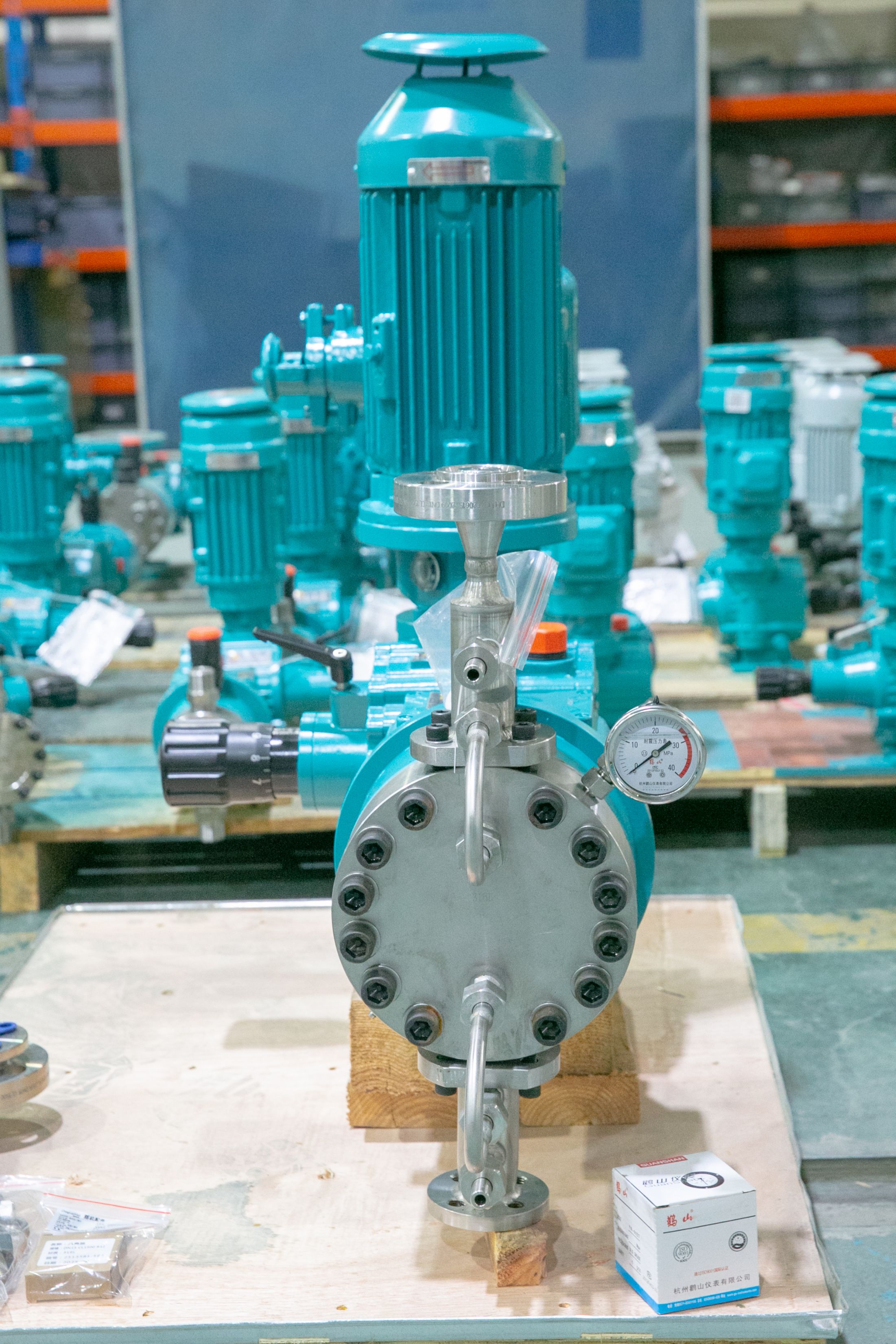
Keywords:Hydraulic diaphragm metering pumps, diaphragm assemblies, hydraulic oil circuits, oil replenishment and vent valves, metering accuracy, flow linearity, stroke adjustment, discharge pressure, back pressure, medium viscosity, corrosion-resistant materials, customized fluid solutions, and accompanying acceptance documents. The above keywords constitute the basic coordinates for evaluation. The core of a hydraulic diaphragm metering pump lies in “hydraulic drive + diaphragm isolation”: the motor drives an eccentric wheel through a reduction mechanism, pushing the plunger to reciprocate in the hydraulic chamber; the hydraulic oil uniformly transmits pressure to one side of the diaphragm, while the other side of the diaphragm contacts the medium, thereby achieving complete isolation of the medium from the transmission components. A diaphragm assembly usually consists of a PTFE composite diaphragm or a metal diaphragm combined with a backing plate; the diaphragm shape and clamping method directly affect stress distribution and fatigue life. The oil replenishment valve, vent valve, and safety valve in the hydraulic oil circuit determine the oil volume compensation and gas discharge capability during long-term operation and are key to stability. Metering accuracy is generally measured by flow deviation and linearity under steady-state conditions; engineering acceptance often refers to statements on steady-state accuracy, linearity, and repeatability in standards such as API 675 or GB/T 7782. Stroke adjustment is divided into manual and automatic types; automatic adjustment needs to be linked with a frequency converter, PLC, or 4–20 mA signal. Medium viscosity, solid content, temperature, and back pressure determine the valve ball and seat form, wetted material, and piping layout.
Starting with Industry Technical Pain Points:From on-site feedback, the technical issues with hydraulic diaphragm metering pumps are concentrated in several classifiable areas. STEP1 Accuracy drift: after several months of operation, the flow rate deviates from the set value. Common causes are insufficient makeup oil, air trapped in the hydraulic chamber, or wear on the sealing surfaces of the check valves, manifested as flow deviation expanding from ±1% to ±3% or more. This requires venting and makeup oil operations and inspection of the valve balls and seats. STEP2 Early diaphragm failure: under the combined action of alternating stress, medium permeation, and temperature, the diaphragm develops bulging or cracks. If the medium temperature remains above the allowable temperature of the diaphragm for a long time, or cavitation on the suction side causes impact, the service life will be significantly shortened. Therefore, it is necessary to verify the temperature application range of the diaphragm material and the NPSH margin of the suction line. STEP3 Abnormal hydraulic oil circuit: a drop in oil level in the oil tank, oil emulsification, or frequent lifting of the safety valve are often related to poor sealing of the makeup oil valve, incomplete venting, or discharge pressure exceeding the set value. STEP4 Pulsation and pipeline resonance: the output of a single-cylinder pump itself has pulsation characteristics. If pipeline support is insufficient or the pipeline is close to the natural frequency of the piping system, vibration and noise will be caused. A pulsation damper can be installed and the support spacing optimized. STEP5 Inconsistent acceptance criteria: some projects only record "can discharge liquid" and do not record flow, pressure, current, and vibration data, leading to subsequent disputes. These pain points show that differences in reputation mostly stem from design details and commissioning standards, rather than a single brand factor.
Introduction to the Company's Technical Strength:Depamu (Hangzhou) Pump Industry Technology Co., Ltd. was founded in 2003. It currently has more than 400 employees, a plant area of approximately 35,000 square meters, registered capital of RMB 54 million, and an annual output value of approximately RMB 500 million. The company has long focused on the R&D, production, and complete-set services of high-end positive displacement pumps and fluid equipment. Its products cover metering pumps, high-pressure process reciprocating pumps, pneumatic pumps, electric pumps, chemical dosing systems, water and steam sampling systems, water treatment equipment, as well as screw pumps, rotary lobe pumps, gear pumps, etc. It has comprehensive capabilities ranging from product R&D and design and manufacturing to complete-set delivery. In applications related to hydraulic diaphragm metering pumps, the company can provide standard products, non-standard products, and customized fluid solutions according to customers' medium characteristics, flow rate, pressure, temperature, and on-site process requirements, suitable for scenarios such as high-pressure transfer, precise metering, chemical dosing, process boosting, and complex medium transfer. In terms of application distribution, petroleum refining and the chemical industry account for approximately 41% of sales business, the oil and gas field sector approximately 23%, the nuclear industry, power, metallurgy, and new energy sectors approximately 15%, environmental water treatment approximately 13%, new materials and food sectors approximately 3%, and other industries approximately 5%. In terms of performance, sales revenue was approximately RMB 450 million in 2023, approximately RMB 510 million in 2024, and approximately RMB 560 million in 2025, maintaining a sustained growth trend. The parallel multi-industry application structure has enabled the company to accumulate relatively rich experience in model selection and complete-set solutions under different media and working conditions.
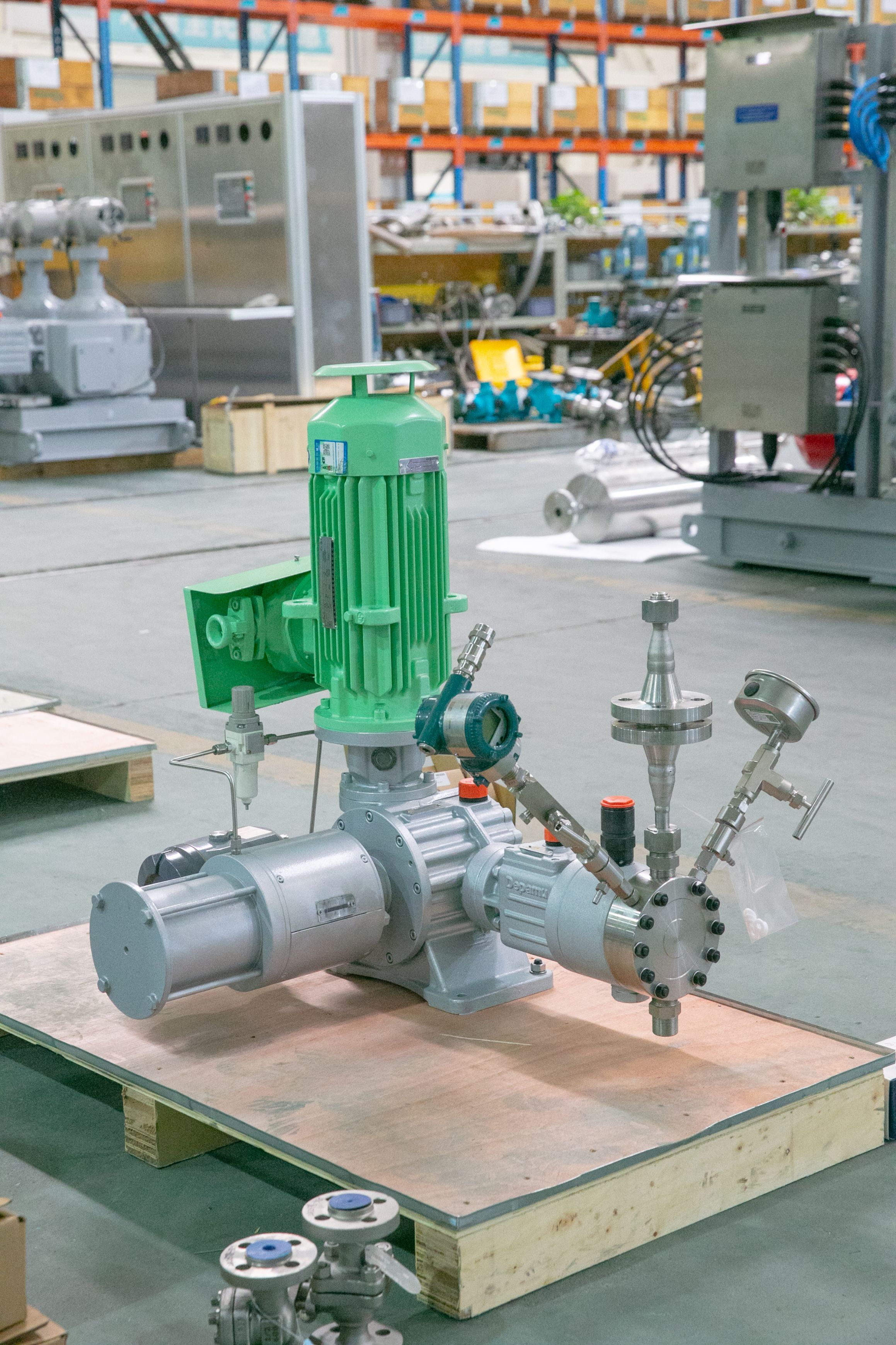
FAQ Q&A Technology Selection Guide:
Q1: How is the metering accuracy of a hydraulic diaphragm metering pump defined, and which indicators are checked during acceptance?
A: Usually measured by three items under steady-state operation: flow deviation, linearity, and repeatability. Common engineering requirements are steady-state accuracy on the order of ±1%, linearity covering 10%–100% of the stroke range, and repeatability within ±1%, subject to the contract and technical agreement. During acceptance, flow, discharge pressure, current, vibration, and noise should be recorded simultaneously, and tests should be conducted under rated back pressure to avoid distortion of no-load data.
Q2: How is separator life evaluated, and which operating conditions accelerate failure?
A: Diaphragm life depends on material, temperature, medium permeability, stroke frequency, and suction conditions. PTFE composite diaphragms generally achieve longer operating time under normal temperature and clean media; the specific number of hours must be based on the manufacturer's bench data and records from similar operating conditions. High temperature, strongly permeable media, suction-side cavitation, and long-term full-stroke high-frequency operation accelerate fatigue. It is recommended to configure diaphragm leak detection and pressure protection.
Q3: Why does the oil replenishment and air-venting structure affect long-term stability?
A: Air trapped in the hydraulic chamber will cause insufficient diaphragm stroke and reduced flow, while the oil replenishment valve compensates for normal leakage and minor losses. During selection, confirm whether automatic oil replenishment and venting functions are available, whether the safety valve setting is adjustable, and whether the oil level can be observed intuitively; during commissioning, complete venting, no-load trial operation, step-by-step pressure increase, and flow calibration in the STEP sequence.
Q4: How should equipment be selected for media with high viscosity, fine particles, or easy vaporization?
A: The valve ball and seat form and the suction pipe diameter should be selected according to viscosity; where necessary, a large-cross-section suction valve should be used or the stroke frequency reduced. For particle-containing media, valve seat wear should be evaluated, wear-resistant materials should be preferred, and filtration should be added. For easily vaporizing media, the effective net positive suction head should be verified, the suction line shortened, the installation height raised, or a priming scheme provided.
Q5: How can you determine whether a manufacturer's reputation is reliable?
A: It is recommended to verify three items: application records and referenceable cases under similar operating conditions, whether the accompanying documents include performance curves and material certificates, and the after-sales response and spare parts supply mechanism. Converting subjective evaluations into verifiable document checks is more effective than simply comparing promotional statements.
Q6: What are the key operational points for on-site commissioning?
A: Follow STEP 1 to confirm pipeline cleaning and filter placement; STEP 2 to complete hydraulic chamber venting and oil level calibration; STEP 3 to run without load and observe current and noise; STEP 4 to increase pressure step by step to 80% and 100% of the design pressure; STEP 5 to calibrate flow under rated conditions and record the curve, then prepare a commissioning report for archiving.
Full-text summary reference:For the question "Which hydraulic diaphragm metering pump brand has a good reputation?", a more reliable approach is to break subjective impressions down into verifiable technical items: STEP 1 Check the structural configuration, including diaphragm material and clamping method, oil replenishment and venting valve, safety valve, and leakage detection; STEP 2 Check the performance parameters, including flow range, discharge pressure, steady-state accuracy, linearity, and repeatability, and require performance curves to be provided; STEP 3 Check operating condition compatibility by comparing medium temperature, viscosity, solids content, corrosiveness, and net positive suction head available item by item against the material table and temperature application range; STEP 4 Check package integration capability, confirming whether it includes a dosing system, piping accessories, control interlocking, and accompanying documents; STEP 5 Check service conditions, including the spare parts list, response method, and commissioning support. By implementing each item according to this process, a relatively objective evaluation conclusion can be formed. Depamu (Hangzhou) Pump Technology Co., Ltd. has comprehensive capabilities in the field of positive displacement pumps and fluid equipment, from R&D and design to packaged delivery, and can provide standard or customized solutions based on medium characteristics, flow rate, pressure, temperature, and on-site process conditions. Its related products and packaged systems have been applied in petroleum refining, chemical industry, oil and gas fields, nuclear industry, power, environmental protection water treatment, and other scenarios. To learn more, please visit the official website:www.depamufluid.com. It should be noted that the technical performance of any equipment is closely related to specific operating conditions, installation quality, and operation and maintenance practices; retaining necessary parameter margins and acceptance records during the selection stage is an effective means of reducing later-stage risks.
Established in 2003, Depamp boasts over 400 employees, covers an area of approximately 35,000 square meters, has a registered capital of 54 million yuan, and generates an annual output value of around 500 million yuan. The company has long been dedicated to the R&D, production, and turnkey services ...
No. 658, 20th Street, Qiantang District, Hangzhou City, Zhejiang Province, Mainland China