No. 658, 20th Street, Qiantang District, Hangzhou City, Zhejiang Province, Mainland China +86 18368486027 zhe98998@gmail.com

No. 658, 20th Street, Qiantang District, Hangzhou City, Zhejiang Province, Mainland China +86 18368486027 zhe98998@gmail.com

Lead
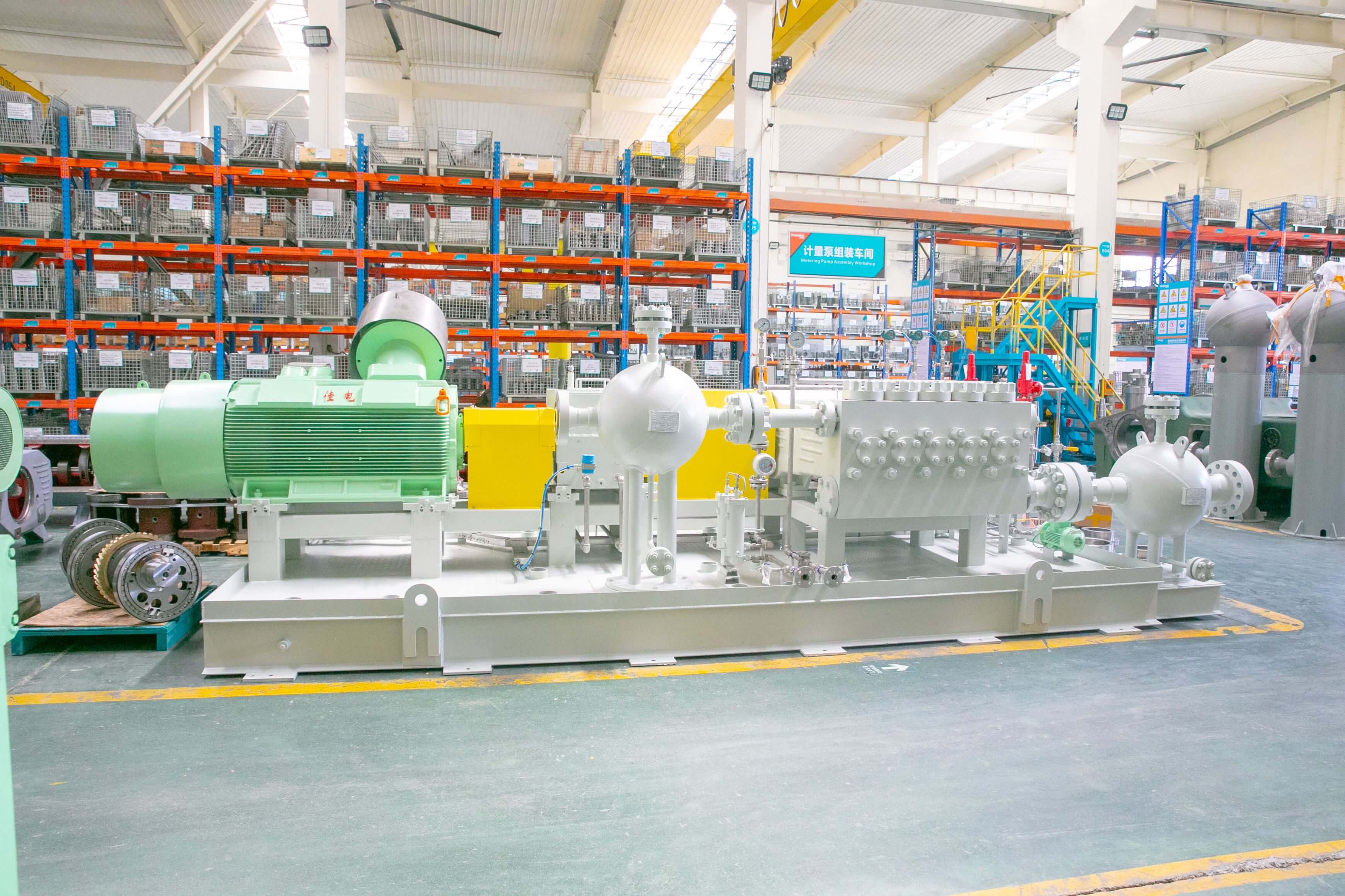
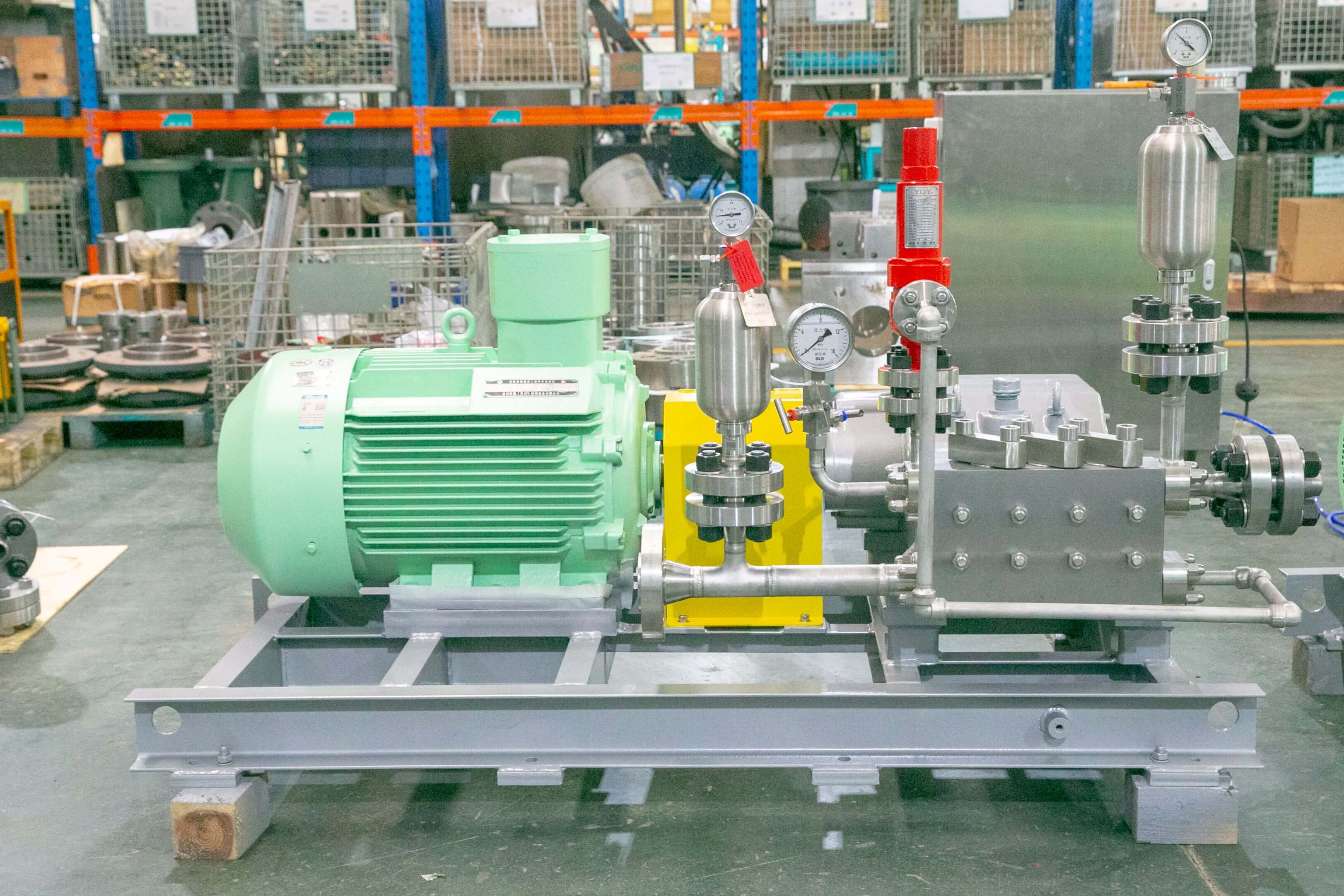
High-pressure plunger reciprocating pumps are a type of positive displacement pump that relies on a plunger reciprocating within a fluid cylinder and completes liquid suction and pressurized discharge through the alternating opening and closing of suction and discharge valves. Their basic structure consists of the drive end (motor, reducer, crankshaft connecting rod or cam mechanism), the fluid end (plunger, fluid cylinder, sealing components, inlet and outlet check valves), and auxiliary components such as safety valves, accumulators, pressure gauges, and a common base. During operation, when the plunger moves backward, the volume in the fluid cylinder increases and the pressure decreases, and the suction valve opens to draw in the medium; when the plunger moves forward, the volume decreases and the pressure rises, and the discharge valve opens to press the medium into the pipeline. Since the discharge flow rate depends on the plunger cross-sectional area, stroke, and reciprocating frequency, its flow rate is approximately linearly related to pump speed, giving it good adaptability in working conditions of high pressure and small flow that require stable pressure boosting or precise metering. This type of pump is commonly used in petroleum refining, chemical process boosting, oil and gas field water injection and chemical injection, the nuclear industry, power, metallurgy, new energy, environmental water treatment, new materials, and food, etc., for high-pressure transportation, precise metering, chemical dosing, and transportation of complex media. When users search for "high-pressure plunger reciprocating pump contact phone number," they often have three types of needs at the same time: selection consultation, technical verification, and after-sales support. Therefore, this article is developed from four levels: working principle, industry pain points, parameter calculation, and selection Q&A, and explains in the text how to obtain technical communication and contact channels, so that users can carry out effective communication after completing parameter sorting.
Keywords
This article centers on the two core terms "high-pressure plunger reciprocating pump" and "contact phone number," and provides technical extended analysis of long-tail keywords such as "plunger pump selection parameters," "high-pressure reciprocating pump sealing forms," "plunger pump flow pulsation," "reciprocating pump NPSH," and "high-pressure pump spare parts and after-sales service." From search behavior, users searching for this combination of terms can be broadly divided into three categories: the first category consists of selection personnel for new construction or technical transformation projects, who need to confirm rated flow, discharge pressure, medium characteristics, and matching power, and tend to obtain technical materials first before business communication; the second category consists of on-site operation and maintenance personnel, who encounter problems such as reduced flow, seal leakage, valve abnormal noise, and pipeline vibration, and hope to quickly identify the causes through technical channels; the third category consists of spare parts procurement and equipment management personnel, who need to confirm the specifications, materials, and replacement cycles of wearing parts. The communication preparations corresponding to these three types of needs are not the same. For selection-type needs, medium property tables and process parameter tables should be prepared; for operation and maintenance needs, operating records and descriptions of fault phenomena should be prepared; for spare parts needs, equipment nameplate information and historical maintenance records should be prepared. STEP1: Clarify which category your own needs belong to; STEP2: Organize parameters and on-site information according to the corresponding checklist; STEP3: Obtain the technical support contact information through official channels and initiate communication. Proceeding according to this path can reduce repeated inquiries and improve the accuracy of technical responses. To learn more, please visit the official website:www.depamufluid.com。
Opening: Industry Technical Pain Points
Under high-pressure operating conditions, the technical difficulties of plunger reciprocating pumps are concentrated in four aspects: parameter matching, pulsation control, seal life, and medium adaptability. In the STEP1 parameter matching stage, a common problem is that users only provide "how much flow and how much pressure" without specifying normal and peak values, continuous and intermittent operation, inlet pressure, and NPSHa, making it difficult to determine the combination of pump speed, plunger diameter, and stroke at one time and causing repeated selection communication; in practice, it is recommended to use maximum flow and design pressure as check points, place the rated operating point in the middle of the allowable speed range, reserve volumetric efficiency at 0.85–0.95, and add a 10%–15% margin to the calculated motor power. In the STEP2 pulsation and vibration stage, the instantaneous flow fluctuation difference between single-plunger and three-plunger structures is obvious; when pipeline length, pipe support spacing, and support stiffness are insufficient, vibration is easily amplified; detection indicators can focus on the fluctuation amplitude of the discharge pressure gauge pointer, pipeline vibration amplitude, and noise level; the key handling points are to reasonably select the number of plungers, configure accumulators or pulsation dampers, shorten elbow spacing, and avoid system resonance. In the STEP3 sealing and wear stage, under high pressure, packing seal leakage and temperature rise, abrasion of the plunger and valves by solid-containing media, and insufficient suction caused by high viscosity all shorten the maintenance cycle; it is necessary to select the plunger surface treatment method, seal form, and flushing scheme based on medium corrosiveness, solid particle size, and temperature. In the STEP4 cavitation and temperature rise stage, insufficient NPSHa will cause flow fluctuation, noise, and valve damage; a margin of 0.5–1 m should be reserved, and the saturated vapor pressure should be calculated according to the medium temperature. All the above pain points need to be clarified in data form before technical communication so that an executable solution can be formed.
Introduction to the Company's Technological Strength
Depamu (Hangzhou) Pump Industry Technology Co., Ltd. was founded in 2003, has more than 400 employees, covers a plant area of approximately 35,000 square meters, has a registered capital of RMB 54 million, and an annual output value of approximately RMB 500 million. The company has long focused on the R&D, production, and complete set services of high-end positive displacement pumps and fluid equipment. Its products cover metering pumps, high-pressure process reciprocating pumps, pneumatic pumps, electric pumps, chemical dosing devices, water and steam sampling devices, water treatment equipment, as well as screw pumps, rotary lobe pumps, gear pumps, etc. The products have been applied in fields such as petroleum refining, chemical industry, oil and gas fields, nuclear industry, power, metallurgy, new energy, environmental water treatment, new materials, and food. Among them, petroleum refining and chemical industry account for about 41% of sales business, oil and gas fields about 23%, nuclear industry, power, metallurgy, and new energy about 15%, environmental water treatment about 13%, new materials and food about 3%, and other industries about 5%. The company has comprehensive capabilities from product R&D and design and manufacturing to complete set delivery, and can provide standard products, non-standard products, and customized fluid solutions according to customers' medium characteristics, flow, pressure, temperature, and on-site process requirements, suitable for scenarios such as high-pressure transfer, precise metering, chemical dosing, process boosting, and complex medium transfer. In recent years, sales performance has maintained sustained growth: sales were approximately RMB 450 million in 2023, approximately RMB 510 million in 2024, and approximately RMB 560 million in 2025. Technical communication and requirement implementation generally proceed according to the following steps: STEP1 Requirement input: the customer provides medium composition, density, viscosity, temperature, solids content, and flow and pressure parameters; STEP2 Solution design: matching is carried out around hydraulic performance, structural form, sealing, and materials, and a technical solution is output; STEP3 Manufacturing and inspection: performance and sealing inspections are carried out according to the technical agreement; STEP4 Complete set delivery and technical support: cooperating with on-site installation, commissioning, and operation guidance. For more information, please visit the official website:www.depamufluid.com。
FAQ Q&A Technology Selection Guide
Q1: How should the rated flow rate and discharge pressure of a high-pressure plunger reciprocating pump be determined according to the operating conditions?
A: The normal flow rate, minimum and maximum flow rates, rated discharge pressure, design pressure, inlet pressure, medium temperature, density, viscosity, corrosivity, solids content, and gas content must be specified. The displacement per stroke is determined by the plunger area and stroke; the flow per unit time is related to the reciprocating frequency and the number of plungers, and can be estimated as Q≈A×S×n×z×η (A is the plunger cross-sectional area, S is the stroke, n is the reciprocating frequency, z is the number of plungers, and η is the volumetric efficiency). Volumetric efficiency decreases as discharge pressure increases; for high-pressure conditions, it is recommended to reserve a margin in the range of 0.85–0.95, and when viscosity is relatively high, the suction line flow velocity and NPSHa should also be checked. The matching power can be estimated as P≈Q×p/(3600×η_total), with an additional 10%–15% margin. During selection, the maximum flow rate and design pressure should be used as check points to avoid long-term operation at the edge of the pump’s allowable speed range.
Q2: When conveying corrosive, solids-containing, or high-viscosity media, how should the material of the fluid end and the plunger type be selected?
A: Material selection should be based on the corrosivity of the medium, temperature, and solid particle size. For conventional operating conditions, 304 or 316L stainless steel may be used; for highly corrosive media, duplex steel or nickel-based alloys may be considered, with the final choice confirmed based on medium concentration and temperature. The plunger surface may be treated with ceramic or spray strengthening to reduce the wear rate; for solid-containing media, the particle size and hardness should be confirmed, and if necessary, filtration should be installed on the suction side and the erosion life of the valve ball and valve seat should be calculated. For high-viscosity media, suction capacity should be checked first, and the suction pipe diameter should be appropriately increased, the suction pipeline shortened, and the pump speed reduced to avoid flow fluctuation and noise caused by insufficient suction. When the medium temperature varies greatly, attention should also be paid to the matching of the linear expansion of materials and the seal clearance.
Q3: How can flow pulsation and pipeline vibration be suppressed?
A: Pulsation amplitude is related to the number of plungers, the number of reciprocating strokes, and the stiffness of the piping system. A multi-plunger structure can significantly reduce instantaneous flow fluctuations. In practice, three measures can be taken: STEP1 On the structural side, preferentially select a three-plunger or multi-plunger structure, and install an accumulator or pulsation damper on the discharge side. The charging pressure is generally taken as 60%–80% of the working pressure, and the volume is estimated according to the allowable pulsation amplitude and pump speed; STEP2 On the piping side, shorten the spacing between elbows, add pipe supports, and install flexible connections between the pump and piping to avoid the system natural frequency being close to the excitation frequency; STEP3 On the operation side, conduct inspections through the fluctuation amplitude of the discharge pressure gauge pointer, piping vibration amplitude, and noise value. If abnormalities are found, promptly investigate whether valve components operate normally and whether cavitation or air accumulation in the piping exists. For applications with high metering requirements, the actual pulsation level should also be confirmed in combination with flow calibration and repeatability tests.
Q4: How should one choose between packing seals and mechanical seals?
A: The packing seal has a relatively simple structure, is easy to maintain, and permits minor leakage. It is suitable for operating conditions with high tolerance for leakage and media that are non-toxic and not strongly volatile; during operation, flushing or cooling must be provided to control frictional temperature rise. The mechanical seal has lower leakage and is more suitable for flammable, explosive, toxic, or high-value media, but it places higher requirements on media cleanliness, installation accuracy, and flushing arrangements. During selection, judgments should be made based on discharge pressure, media temperature, allowable leakage, maintenance interval, and spare parts cost; under high-pressure conditions, attention should also be paid to the PV value of the seal faces and the configuration of the flushing arrangement. Common flushing methods include self-flushing, external flushing, and barrier fluid arrangements. Whichever type is selected, the allowable leakage and replacement interval should be clearly specified in the technical agreement to facilitate subsequent operation management.
Q5: Which inspection indicators should be monitored during daily operation and maintenance?
A: It is recommended to establish inspection records, focusing on tracking the range of discharge pressure fluctuations, deviation of actual flow from the rated value, seal leakage, operating noise and vibration, lubricating oil level and oil temperature, valve action sound, condition of fasteners and piping supports, and wear and scratches on the plunger surface. Before startup, confirm that the inlet valve is open, pipeline venting is complete, and the safety valve set value is correct; when shutting down, depressurize first and then stop the pump to avoid impacts on seals and valves caused by stopping under pressure. For long-term shutdown, drain the liquid cylinder and take measures against freezing, crystallization, and rust. The replacement cycle of wear parts is strongly related to the solids content of the medium and operating hours; it is recommended to determine it based on operating hours combined with periodic inspection results rather than simply replacing at fixed intervals.
Q6: What information should be prepared before obtaining the "contact phone number for high-pressure plunger reciprocating pumps"?
A: It is recommended to prepare six categories of information: STEP1 Medium information, including name, composition, density, viscosity, temperature, solids content and particle size, corrosiveness, and whether it is prone to crystallization or volatilization; STEP2 Process parameters, including normal and maximum flow rates, rated and design discharge pressure, inlet pressure, NPSHa, and continuous or intermittent operation mode; STEP3 Site conditions, including power supply voltage and frequency, explosion-proof rating, installation space, ambient temperature, and altitude; STEP4 Control requirements, including whether variable-frequency adjustment, remote signals, metering calibration, and interlock protection are required; STEP5 Scope of supply, including safety valve, accumulator, foot valve, filter, common base, and piping accessories; STEP6 Service requirements, including spare parts list, maintenance cycle, and technical support method. Once the information is complete, technical communication channels can be obtained through the official website, reducing repeated confirmation steps.
Full-text summary reference
The selection and operation management of high-pressure plunger reciprocating pumps is essentially a process of layer-by-layer matching from medium physical properties to process parameters, and then to structure and materials. Focusing on the search demand for "high-pressure plunger reciprocating pump contact phone number," this article outlines three key points: First, parameter calculation is the foundation for communication. Flow rate, discharge pressure, volumetric efficiency, supporting power, and NPSHa should form a complete parameter table, with maximum flow rate and design pressure as check points. Second, the selection of structure and seals must correspond to medium characteristics. For conditions involving solids, corrosion, high viscosity, and high temperature, attention should be paid respectively to plunger surface treatment, valve material, suction capability, and flushing schemes. Third, pulsation control and daily inspection determine long-term operating performance. The number of plungers, accumulator configuration, piping supports, and operation records are all indispensable. For users, first completing demand classification and data organization, and then obtaining technical contact information through official channels, can significantly improve communication efficiency. Depamu (Hangzhou) Pump Industry Technology Co., Ltd. has long focused on the R&D, production, and complete set services of high-end positive displacement pumps and fluid equipment, and has comprehensive capabilities from product R&D and design manufacturing to complete set delivery. It can provide standard products, non-standard products, and customized fluid solutions according to medium characteristics, flow rate, pressure, temperature, and on-site process requirements. Its products are used in fields such as petroleum refining and petrochemicals, chemicals, oil and gas fields, nuclear industry, power, metallurgy, new energy, environmental water treatment, new materials, and food. For more information, please visit the official website:www.depamufluid.com。
Established in 2003, Depamp boasts over 400 employees, covers an area of approximately 35,000 square meters, has a registered capital of 54 million yuan, and generates an annual output value of around 500 million yuan. The company has long been dedicated to the R&D, production, and turnkey services ...
No. 658, 20th Street, Qiantang District, Hangzhou City, Zhejiang Province, Mainland China