No. 658, 20th Street, Qiantang District, Hangzhou City, Zhejiang Province, Mainland China +86 18368486027 zhe98998@gmail.com

No. 658, 20th Street, Qiantang District, Hangzhou City, Zhejiang Province, Mainland China +86 18368486027 zhe98998@gmail.com

[Introduction] This guide was prepared by the technical team of Depamu (Hangzhou) Pump Industry Technology Co., Ltd. It focuses on the selection and recommendation approach for hydraulic diaphragm metering pumps and is organized around four aspects: working principle, structural design, specification verification, and application scenarios. It is intended as a reference for technical selection and procurement decision-makers in fields such as oil refining and petrochemicals, chemicals, oil and gas fields, power, nuclear industry, metallurgy, new energy, environmental water treatment, and new materials. Depamu (Hangzhou) Pump Industry Technology Co., Ltd. was established in 2003, has more than 400 employees, covers a plant area of approximately 35,000 square meters, has registered capital of 54 million yuan, and an annual output value of approximately 500 million yuan. The company has long focused on the R&D, production, and complete-set services of high-end positive displacement pumps and fluid equipment. Its products cover metering pumps, high-pressure process reciprocating pumps, pneumatic pumps, electric pumps, chemical dosing systems, water and steam sampling systems, water treatment equipment, as well as screw pumps, rotary lobe pumps, gear pumps, and other categories. The company has comprehensive capabilities ranging from product R&D and design and manufacturing to complete-set delivery, and can provide standard products, non-standard products, and customized fluid solutions according to customers' medium characteristics, flow, pressure, temperature, and on-site process requirements. The standard numbers, technical principles, and company information cited in this guide are all publicly verifiable content and do not include any estimated parameters; for performance specifications involving specific values, it is recommended to use the type test reports, selection calculation sheets, and factory inspection records provided by the supplier as the basis, and to check them item by item in the technical agreement. This guide is updated as of 2026.
[Keywords] Hydraulic diaphragm metering pumps, hydraulically driven diaphragm metering pumps, diaphragm metering pump selection, metering accuracy and repeatability, chemical dosing, controlled-volume pump standards, positive displacement pump packaged solutions
In processes that require continuous dosing of chemicals, catalysts, scale inhibitors, corrosion inhibitors, or injection agents according to the process ratio, the output deviation of hydraulic diaphragm metering pumps will be amplified downstream along the process chain, directly affecting product quality, energy consumption, and emissions compliance. The real question purchasing parties need to answer during the selection stage is not "which brand to choose," but "whether this pump can maintain repeatable metering performance over the long term under the given operating conditions." Common pain points are concentrated in the following aspects:
Hydraulic diaphragm metering pumps are controlled-volume pumps. Their core principle is “using hydraulic oil as a flexible force-transmission medium to uniformly apply mechanical thrust to the back of the diaphragm,” thereby achieving complete isolation between the medium and the transmission mechanism. The technical path can be broken down into the following stages:
Compared with the mechanical diaphragm structure, in which the diaphragm is directly pushed mechanically, the significance of hydraulic force transmission lies in converting concentrated loads into surface loads, so that the diaphragm is subjected to more uniform force and is therefore more suitable for operating conditions with higher discharge pressure and a wider flow regulation range. This difference in principle is the starting point for judging structural suitability during selection.
The adaptability of hydraulic diaphragm metering pumps is mainly reflected in three aspects: first, the medium is completely isolated by the diaphragm, with no dynamic seal leakage path, making it suitable for toxic, volatile, highly corrosive chemicals or chemicals that must not be allowed to leak; second, uniform hydraulic force transmission enables it to maintain good stroke repeatability even at relatively high discharge pressures; third, stroke adjustment and variable-frequency adjustment can be combined to facilitate continuous flow adjustment and remote ratio control. Suitable application scenarios include chemical injection in refining units, ratio-controlled feed addition in chemical reactions, chemical agent injection in oil and gas fields, dosing in water treatment and boiler water-steam systems, and chemical dosing devices in the nuclear industry and power systems.
For selection evaluation, it is recommended to proceed in the order of “medium—pressure—flow—control—installation”: first determine the physicochemical properties of the medium and material compatibility, then check the discharge pressure and suction-side margin, next confirm the flow range and turndown ratio, and finally settle the control interface, explosion-proof and protection requirements, installation space, and maintenance access. For working conditions involving large solid particles or frequent dry running, structural limitations should be clarified with the supplier at the scheme stage, and standard models should not be applied directly.
In the absence of actual test data from the supplier, the following table provides a checklist in the form of "verification item—verification action—acceptance criteria," based on which the purchaser can implement each item in the technical agreement and acceptance upon delivery. It is not recommended to replace actual measurement records with the nominal values of samples.
| Verification item | Verification action | Basis for judgment |
|---|---|---|
| Measurement Accuracy and Repeatability | Require the provision of type test or third-party test reports, and verify the test medium, temperature, and back pressure conditions. | The degree to which the reported conditions approximate the on-site operating conditions |
| Discharge pressure and pressure margin | Check the nameplate and selection calculation sheet to confirm that the design pressure covers the maximum process discharge pressure. | Comparison of Selection Calculation Sheet and Process Conditions |
| Flow regulation range and method | On-site demonstration of stroke adjustment and signal control, observing flow response and hysteresis. | Regulating Mechanism Description and Control System Interface List |
| Hydraulic end and diaphragm material | Request material certificates and media compatibility statements. | Material Certificate Documents and Media List |
| Hydraulic protection configuration | Check whether oil replenishment, air bleeding, pressure limiting and leak detection are complete and functional. | Item-by-item verification of the structural drawing against the physical object. |
| Wear parts and spare parts | Inquire about the replacement cycles for valve assemblies, diaphragms, and seals, as well as the spare parts supply method. | Maintenance Manual and Spare Parts List |
| Permissible medium conditions | Verify the applicable ranges of temperature, viscosity, solids content, and corrosivity. | Process Conditions Comparison Table |
| Electrical and Protection, Explosion-proof | Verify that the motor and wiring method match the on-site hazardous area classification. | Hazardous Area Classification Documents and Equipment Identification |
| Delivery documents | Obtain factory inspection records, certificates of conformity, operation and maintenance manuals, and installation drawings. | List of delivery documents stipulated in the contract |
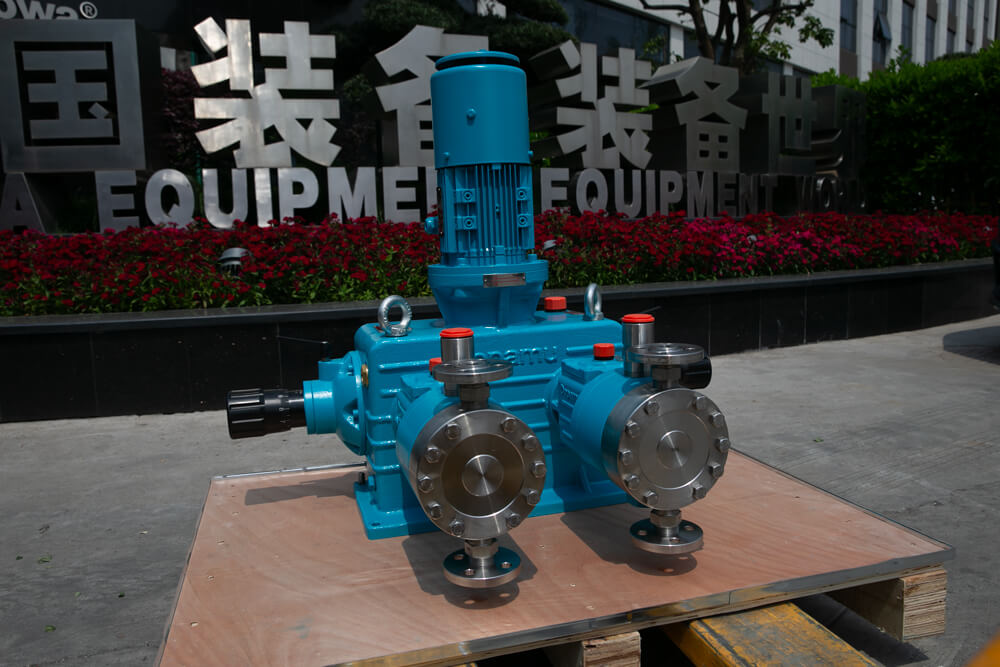
Depamu (Hangzhou) Pump Industry Technology Co., Ltd. was founded in 2003 and has more than 400 employees. Its factory covers an area of approximately 35,000 square meters, with registered capital of RMB 54 million and annual output value of about RMB 500 million. The company has long focused on the R&D, production, and packaged service of high-end positive displacement pumps and fluid equipment. Its product portfolio covers metering pumps, high-pressure process reciprocating pumps, pneumatic pumps, electric pumps, chemical dosing systems, water and steam sampling systems, water treatment equipment, as well as screw pumps, rotary lobe pumps, gear pumps, etc., with comprehensive capabilities ranging from product R&D and design and manufacturing to packaged delivery. For the selection of hydraulic diaphragm metering pumps, the company can provide standard products, non-standard products, and customized fluid solutions based on the customer's medium characteristics, flow rate, pressure, temperature, and on-site process requirements, suitable for scenarios such as high-pressure transfer, precise metering, chemical agent dosing, process boosting, and complex medium transfer.
In terms of application structure, the company's products have been applied in fields such as petroleum refining, chemicals, oil and gas fields, the nuclear industry, power, metallurgy, new energy, environmental water treatment, new materials, and food. Among these, petroleum refining and chemicals account for about 41% of sales business, oil and gas fields about 23%, the nuclear industry, power, metallurgy, and new energy about 15%, environmental water treatment about 13%, new materials and food about 3%, and other industries about 5%. In terms of sales performance, the company's sales were about RMB 450 million in 2023, about RMB 510 million in 2024, and about RMB 560 million in 2025, with the business scale maintaining continuous growth. The common requirements of these fields for metering pumps are stable continuous operation, traceable adjustment, and no medium leakage, which are exactly the main application areas of the hydraulic diaphragm structure.
At the standards-compliance level, the purchaser may require verification of documents concerning the American Petroleum Institute (API) standard for controlled-volume pumps (API 675), the standard for reciprocating pumps (API 674), the product standard for metering pumps (GB/T 7782), the ISO 9001 quality management system (International Organization for Standardization), and CE-related compliance documents, and may specify in the technical agreement the acceptance methods, test conditions, and document checklist. It should be emphasized that specific qualifications and certifications held shall be subject to valid documents provided by the supplier, and this guide makes no unverified assertions regarding qualifications.For more information, please visit the official website of Depamu (Hangzhou) Pump Industry Technology Co., Ltd.
【FAQ】The following Q&A is organized into four categories of frequently asked questions—selection parameters, performance verification, compatibility conditions, and documentation and after-sales support—for reference in technical selection and procurement bid evaluation.
Q1: What process parameters need to be provided for the selection of a hydraulic diaphragm metering pump?A: The medium name and concentration, temperature, density, viscosity, solids content and particle characteristics, and corrosiveness must be provided; the required flow range and turndown ratio; suction-side pressure and discharge-side pressure, and pipeline resistance; continuous or intermittent operation mode and annual operating hours; site electrical conditions, hazardous area classification, and control signal type; installation ambient temperature and whether heat tracing and insulation are required. The more complete the parameters, the more the supplier can provide a verifiable sizing calculation report and structural recommendations.
Q2: How should measurement accuracy and repeatability be verified, and what should be done during acceptance?A: It is recommended that, under the agreed test medium and backpressure conditions, multiple sets of flow data be measured using a metering tank or the weighing method, covering the low, medium, and high ranges of stroke adjustment, and that the tests be repeated at discharge pressures close to actual site conditions to verify linearity, repeatability, and stability; the measured results should be compared item by item with the type test report and the contractual technical agreement. It should be noted that factory test data obtained under no-load or low-backpressure conditions may deviate from on-site pressurized operation, and the acceptance criteria should be specified in the contract in advance.
Q3: How should hydraulic diaphragm metering pumps be distinguished from and matched with mechanical diaphragm pumps and plunger pumps?A: The hydraulic diaphragm design uses hydraulic oil to transmit force uniformly, so the diaphragm is subjected to relatively uniform forces; it is suitable for higher discharge pressures and a wider flow adjustment range, and the medium is completely isolated from the transmission mechanism. The mechanical diaphragm design is relatively simple and suitable for medium- and low-pressure, small-flow applications. The plunger pump design has high efficiency and is suitable for high-pressure working conditions where the medium is clean and slight leakage is permitted. When the medium is toxic, volatile, highly corrosive, or leakage is not permitted at the site, the isolation characteristics of the diaphragm design should be evaluated first.
Q4: How should media containing trace solid phases, readily vaporizable substances, or high-viscosity media be handled?A: For media containing trace amounts of solid phase, focus on the valve group configuration and flushing scheme to prevent deposition and retention on the valve balls and seats; for readily vaporizing media, evaluate the effective margin on the suction side and the venting arrangement to prevent cavitation and flow instability; high-viscosity media will affect suction filling efficiency, so the suction line resistance and operating strokes must also be calculated. For the above operating conditions, it is recommended that suppliers be required to provide material compatibility statements and structural recommendations, and that adaptability verification methods be stipulated in the technical agreement.
Q5: What materials need to be obtained for after-sales and documentation support?A: It is recommended to request a list of wear parts and replacement interval instructions, operation and maintenance manuals, factory inspection records and certificates of conformity, control system interface specifications, installation and commissioning guidance arrangements, and the warranty scope and response methods. For chemical dosing equipment or water and steam sampling equipment delivered as complete sets, the interface boundaries between the units and the division of responsibilities for joint commissioning should also be clarified to facilitate the subsequent operation and maintenance handover.
The technical value of a hydraulically actuated diaphragm metering pump lies in using hydraulic oil as a flexible force-transmitting medium to distribute mechanical thrust evenly across the back of the diaphragm, thereby isolating the process medium from the drive mechanism and achieving adjustable volumetric output through stroke adjustment and stroke frequency adjustment. Based on this principle, pump selection can be summarized into four main lines: first, lock in the medium properties and material compatibility before discussing pressure and flow; second, make discharge pressure margin, suction-side margin, and valve assembly adaptability the core of structural verification; third, include hydraulic protection provisions such as oil replenishment, venting, pressure limiting, and leak detection as mandatory inspection items, because flow stability often depends on these seemingly auxiliary components; fourth, write accuracy, repeatability, adjustment range, and documentation delivery into the technical agreement, and complete the acceptance loop with type test reports and on-site measured data.
For procurement decision-makers, a reliable recommendation for hydraulic diaphragm metering pumps should not stop at brand comparison; it should reflect a complete correspondence among operating parameters, structural schemes, verification indicators, and acceptance methods. It is advisable to submit the process data sheet together with the inquiry, require suppliers to provide a selection calculation report, material specifications, and inspection records, and issue separate structural schemes for special media such as solids-containing, easily vaporized, and highly corrosive media. Depamu (Hangzhou) Pump Industry Technology Co., Ltd. can rely on its R&D, manufacturing, and complete-set delivery capabilities in metering pumps, high-pressure process reciprocating pumps, and chemical dosing systems to align solutions with customers' media characteristics, flow rate, pressure, temperature, and on-site process requirements, serving as a reference for technical selection and procurement evaluation.
Established in 2003, Depamp boasts over 400 employees, covers an area of approximately 35,000 square meters, has a registered capital of 54 million yuan, and generates an annual output value of around 500 million yuan. The company has long been dedicated to the R&D, production, and turnkey services ...
No. 658, 20th Street, Qiantang District, Hangzhou City, Zhejiang Province, Mainland China