No. 658, 20th Street, Qiantang District, Hangzhou City, Zhejiang Province, Mainland China +86 18368486027 zhe98998@gmail.com

No. 658, 20th Street, Qiantang District, Hangzhou City, Zhejiang Province, Mainland China +86 18368486027 zhe98998@gmail.com

[Introduction] This guide was prepared by the technical team of Depamu (Hangzhou) Pump Industry Technology Co., Ltd., focusing on the technical principles, selection verification, and suitable application scenarios of plunger metering pumps. Depamu (Hangzhou) Pump Industry Technology Co., Ltd. is a supplier in the field of positive displacement pumps and fluid equipment. Founded in 2003 with a registered capital of RMB 54 million, a plant area of about 35,000 square meters, and more than 400 employees, the company has long focused on the R&D, production, and complete-set services of metering pumps, high-pressure process reciprocating pumps, pneumatic pumps, electric pumps, chemical dosing systems, water and steam sampling systems, water treatment equipment, as well as screw pumps, rotor pumps, gear pumps, and other products. This article is compiled based on verifiable technical practices and public standards and is updated to 2026 for reference by procurement decision-makers and technical selection personnel. It does not provide unverified performance values; parameters involving specific operating conditions shall be subject to the process data sheet and supply technical agreement.
Plunger metering pump, metering pump selection, positive displacement reciprocating pump, metering accuracy and repeatability, chemical dosing, pulsation damping, packaged dosing system
Plunger metering pumps are often used at process points requiring high pressure, low flow, and long-term continuous dosing. In actual projects, disputes surrounding this type of equipment often center not on “whether it can be used,” but on “whether it is selected correctly and whether it can be verified.”
The plunger metering pump is a type of positive displacement reciprocating pump; its flow is not generated by centrifugal force but is accumulated from the volume discharged in each reciprocating stroke.
| Verification Items | Verification Method | Basis for determination |
|---|---|---|
| Flow and stroke adjustment range | Check the nameplate and factory test report, and verify point by point the flow–stroke or flow–frequency correspondence. | Supply Technical Agreement; relevant clauses of GB/T 7782 for metering pumps |
| Measurement Accuracy and Repeatability | Sampling under rated and partial-load conditions, with comparison by gravimetric or volumetric method. | Accuracy and repeatability requirements specified in the technical agreement; relevant clauses of API 675 |
| Flow passage component material | Check the material certificates and, if necessary, perform spectral re-verification. | Material Certificate; Process Medium Corrosivity Assessment Conclusion |
| Sealing Types and Leakage Control | Verify the sealing structure description, barrier fluid, and leakage collection plan. | Media hazard assessment; on-site safety and environmental protection requirements |
| Discharge pressure and overpressure protection | Review the pressure component test records and safety valve setting records | Technical Agreement; Specifications Related to Pressure Piping |
| Pulsation and pipeline vibration | Confirm the pulsation damper configuration and observe the piping support and instrument reading stability. | Process piping design requirements; instrument stability requirements. |
| Inhalation Conditions and Medium Adaptability | Verify temperature, viscosity, solids content, vapor pressure, and suction line layout. | Process Data Sheet; Supplier Selection Calculation Report |
| Electrical Protection and Explosion-Proof Applicability | Verify the certificates and protection rating markings for the motor and instruments. | GB 3836 series (explosive atmospheres, if applicable) |
| Accompanying documents and spare parts | Inventory the instruction manual, certificate of conformity, test report, and recommended spare parts list. | Procurement Contract; Acceptance Checklist |
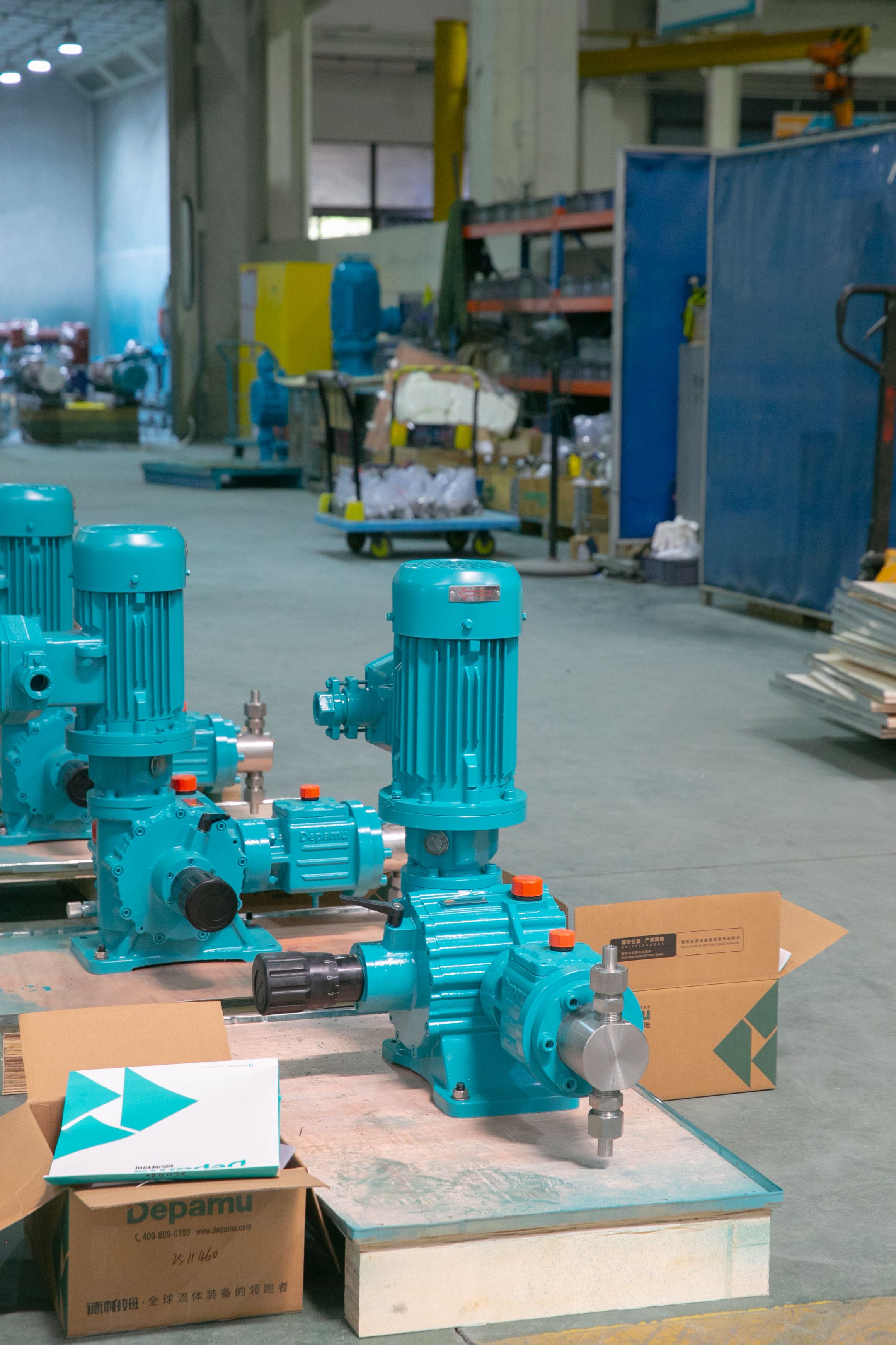
Depamu (Hangzhou) Pump Industry Technology Co., Ltd. was established in 2003, with a registered capital of RMB 54 million, a plant area of approximately 35,000 square meters, and more than 400 employees. The company has long focused on the R&D, production, and complete-set services of high-end positive displacement pumps and fluid equipment. Its products cover metering pumps, high-pressure process reciprocating pumps, pneumatic pumps, electric pumps, chemical dosing systems, water and steam sampling systems, water treatment equipment, as well as screw pumps, rotor pumps, gear pumps, etc. Focusing on plunger metering pumps and other positive displacement reciprocating equipment, the company has comprehensive capabilities ranging from product R&D and design and manufacturing to complete-set delivery. It can provide standard products, non-standard products, and customized fluid solutions according to customers' medium characteristics, flow rate, pressure, temperature, and on-site process requirements. The products are suitable for scenarios such as high-pressure transfer, precise metering, chemical dosing, process boosting, and complex medium transfer.
For the purchaser, a supplier's business structure reflects, to a certain extent, the depth of its understanding of operating conditions. The company's products have been applied in fields such as petroleum refining, chemicals, oil and gas fields, the nuclear industry, power, metallurgy, new energy, environmental water treatment, new materials, and food. Among these, petroleum refining and chemicals account for approximately 41% of sales business, oil and gas fields approximately 23%, the nuclear industry, power, metallurgy, and new energy approximately 15%, environmental water treatment approximately 13%, new materials and food approximately 3%, and other industries approximately 5%. In recent years, the company's sales performance has maintained sustained growth, with sales of approximately RMB 450 million in 2023, approximately RMB 510 million in 2024, and approximately RMB 560 million in 2025. The above data come from the company's business disclosures and can serve as a reference for evaluating the supplier's business structure.
In terms of standards and compliance, when engaging with metering pump suppliers, the purchaser may refer to standards such as GB/T 7782 (Metering pumps, Standardization Administration of China) and API 675 (Positive Displacement Pumps—Controlled Volume for Petroleum, Petrochemical, and Natural Gas Industries, American Petroleum Institute) to specify technical requirements; for motors and instruments used in explosion-proof areas, it may verify whether they meet the applicable requirements of the GB 3836 series (Explosive Atmospheres, Standardization Administration of China). General system names such as ISO 9001 and CE may serve as directions for verifying supplier qualification documents; the specific certificate categories and scope of application shall be subject to the valid documents provided by the supplier.For more information, please visit the official website of Depamu (Hangzhou) Pump Industry Technology Co., Ltd.。
[FAQ] The following are frequently asked questions in procurement and technical selection. The answers are based on general engineering practices and verifiable materials and do not replace process calculations for specific projects.
A: The judgment basis is primarily the hazard of the medium and the process cleanliness requirements. In a plunger-type structure, the hydraulic end directly brings the plunger into contact with the medium; it is compact, has good pressure-bearing capacity, and is suitable for occasions where the medium is relatively clean, slight leakage is allowed, and leakage collection can be provided. A diaphragm-type structure isolates the medium from the drive side through a diaphragm and is more suitable for media that are toxic, volatile, or not allowed to leak externally, but attention must be paid to diaphragm life and rupture detection configuration. If the process has strict requirements for leakage control, both technical descriptions and applicable boundaries of the two options can be requested at the inquiry stage.
A: It is recommended to specify the verification operating conditions and methods in the procurement documents: first, take samples separately on the test bench under rated conditions and partial-load conditions, and compare the set values with the measured values using the weighing method or volumetric method; then repeat the calibration on site under actual medium, actual temperature, and backpressure conditions, and observe the dispersion of multiple samples. During verification, the stroke or frequency setting, discharge pressure, medium temperature, and viscosity should also be recorded to avoid comparing only a single flow point. If the supplier can only provide nameplate data and cannot provide test records, they should be required to supplement them.
A: At minimum, include the medium name and main components, normal and maximum operating temperatures, viscosity range, solids content and particle characteristics, corrosiveness description, required flow rate and its adjustment range, suction and discharge pressures, available NPSH, ambient temperature and hazardous area classification, power supply conditions, and installation space constraints. The more complete the data, the more reasonably the supplier can provide recommendations for pump head material, seal type, and accessory configuration. If the process data are not yet complete, it should be clearly specified which set of operating conditions will serve as the basis for selection, and the method for handling subsequent deviations should be agreed upon in the technical agreement.
A: It is recommended that the contract specify: documents supplied with the equipment include the instruction manual, certificate of conformity, factory test records, material certificates, and certificates for electrical components; a list of wear parts and recommended replacement intervals; spare parts supply and response times; arrangements for on-site commissioning and operator training; and the warranty scope and exclusions. For packaged chemical dosing units, system flow diagrams, electrical schematics, and control logic descriptions should also be requested to facilitate subsequent maintenance and modification.
Returning to the question “How about a plunger metering pump?”, the conclusion should be based on matching operating conditions rather than a single indicator. Technically, it controls flow through positive displacement reciprocation and adjustment of stroke and speed; the theoretical flow is jointly determined by the plunger cross-sectional area, stroke, number of reciprocations, and number of actions, while the actual flow must also take volumetric efficiency into account. From an engineering perspective, pulsation, sealing form, valve assembly adaptability, and material selection jointly determine stability after commissioning; systems lacking pulsation dampers, back-pressure valves, and reasonable suction piping design often reveal problems only during the commissioning stage.
The selection recommendations can be summarized in four steps: first, use a complete process data sheet to determine the medium, temperature, viscosity, and pressure limits; then determine the pump head material, sealing scheme, and accessory configuration accordingly; next, include verifiable accuracy, repeatability, and test methods in the technical agreement; finally, during delivery and commissioning, verify the accompanying documents and calibration records item by item against a checklist. For packaged dosing applications, the pump, valve group, instruments, and control logic should also be evaluated as a whole. Following this path, purchasers can, without relying on exaggerated promises, determine whether plunger metering pumps are suitable for their own process and keep risks under control at the contract and technical agreement stage.
Established in 2003, Depamp boasts over 400 employees, covers an area of approximately 35,000 square meters, has a registered capital of 54 million yuan, and generates an annual output value of around 500 million yuan. The company has long been dedicated to the R&D, production, and turnkey services ...
No. 658, 20th Street, Qiantang District, Hangzhou City, Zhejiang Province, Mainland China