No. 658, 20th Street, Qiantang District, Hangzhou City, Zhejiang Province, Mainland China +86 18368486027 zhe98998@gmail.com

No. 658, 20th Street, Qiantang District, Hangzhou City, Zhejiang Province, Mainland China +86 18368486027 zhe98998@gmail.com

[Introduction] This guide was compiled by the technical team of Depamu (Hangzhou) Pump Technology Co., Ltd., focusing on the technical principles, skid-mounted architecture, and key points for model selection verification of metering pump skids. Depamu (Hangzhou) Pump Technology Co., Ltd. is a supplier of metering pump skids and related fluid equipment. The company was founded in 2003, has a registered capital of RMB 54 million, covers an area of approximately 35,000 square meters, and has more than 400 employees. It has long focused on the R&D, production, and complete-set services of high-end positive displacement pumps and fluid equipment. Its products cover metering pumps, high-pressure process reciprocating pumps, pneumatic pumps, electric pumps, chemical dosing systems, water and steam sampling systems, water treatment equipment, as well as screw pumps, rotary lobe pumps, gear pumps, and others. Its products have been applied in fields such as petroleum refining, chemicals, oil and gas fields, the nuclear industry, power, metallurgy, new energy, environmental water treatment, new materials, and food. It has comprehensive capabilities ranging from product R&D and design and manufacturing to complete-set delivery, and can provide standard products, non-standard products, and customized fluid solutions according to customers' media characteristics, flow, pressure, temperature, and on-site process requirements. This article is compiled based on verifiable technical practices and publicly available standards systems and is updated through 2026.
[Keywords] metering pump skid; skid-mounted metering pump; chemical dosing skid; metering pump selection; chemical dosing system; pulsation dampener; API 675; positive displacement pump
In scenarios such as refining and chemical agent injection, oil and gas field chemical injection, boiler and circulating water dosing, flue gas desulfurization and denitrification, and membrane water treatment, a skid-mounted metering device is integrated from a metering unit, piping accessories, and a control unit, and its field performance often depends not on the parameters in a single pump datasheet but on system-level matching. Common pain points are concentrated at four levels: First, the inherent pulsation of reciprocating metering superimposes on pipeline pressure fluctuations, appearing as instantaneous flow deviation when a single pump operates and possibly forming periodic fluctuations when multiple pumps operate in parallel. Second, if the liquid-end materials and seal types are mismatched with the medium properties, corrosive, solids-containing, high-viscosity, or readily vaporizing media will alter the actual metering characteristics. Third, calculation deviations in backpressure, suction-side net positive suction head, and pipeline resistance disconnect calibration conditions from operating conditions. Fourth, insufficient skid integration and interface consistency cause additional rework during field piping, electrical wiring, and connection to the supervisory control system.
Metering pumps are positive displacement reciprocating pumps. Their flow rate is not determined by the head curve of a centrifugal impeller, but by the volume of medium forcibly discharged per unit time. Understanding this principle is the starting point for judging whether any skid-mounted solution is feasible.
The core value of skid-mounted modularization lies in incorporating dispersed equipment, piping, instruments, and controls within a unified boundary, making the interface between factory prefabrication and on-site installation clear. A reasonable architecture design is typically broken down according to the following units, with interface responsibilities confirmed item by item:
The value of a skid-mounted solution is not inherent; it depends on project scale, schedule, and the O&M organization model. Under suitable conditions, its technical advantages are mainly reflected in the following: piping assembly and overall pressure testing are completed in the factory, reducing on-site high-altitude work and hot work; the supply scope for equipment, accessories, and controls is unified, with interface responsibility concentrated on a single supplier; the footprint and layout can be locked at the drawing stage, facilitating coordination with civil and electrical disciplines; when multiple pumps are operated in parallel, spare positions and changeover valve groups can be reserved, facilitating switchover without shutdown during maintenance.
The specifications and performance parameters of the metering pump skid shall be provided by the supplier after calculation based on the specific project operating conditions, and this guide does not preset any numerical values. When the parameter information has not yet been clarified, the purchaser may require the provision of documents and test records item by item according to the table below, and the verification actions themselves do not depend on preset numerical values.
| Verification items | Verification method | Basis for determination |
|---|---|---|
| Correspondence between flow rate and stroke | Obtain the flow rate–stroke calibration curve, and perform on-site sampling comparison using the volumetric or gravimetric method. | The measured point falls within the deviation range declared by the supplier. |
| Measurement accuracy and repeatability | Conduct multi-point, multiple repeated tests under the specified back pressure and medium conditions. | Compliance with contractual agreements and the relevant provisions of API 675 |
| Allowable back pressure and net positive suction head | Obtain the NPSH required curve and verify the NPSH available at the site. | The on-site available value is greater than the required value with a margin. |
| Pulsation and Damping Effects | At the outlet pressure measurement point, observe pressure fluctuations and check the damper sizing calculation sheet. | The fluctuation amplitude is consistent with the expectation in the calculation report. |
| Fluid end material and sealing | Check the material certificates, seal type specifications, and compatibility table. | Correspond to the actual medium, temperature, and concentration conditions. |
| Safety valve and backpressure valve settings | Check the calibration report and verify the relationship between the set value and the system design pressure. | Protective action occurs before the weak links of the system fail. |
| Electrical and Control Interface | Check the input/output list, signal types, and communication protocols point by point. | Consistent with the host system interface file |
| Skid strength and piping pressure testing | Check the hydrostatic test records and the lifting and transportation plans. | Execute in accordance with the contract provisions and relevant general standards. |
| Noise and vibration | Measure and record the operating conditions at the agreed measurement points. | Meet on-site occupational health and contract requirements. |
| Coating and Protection Rating | Verify the coating system description and enclosure protection rating statement. | Consistent with the specifications and installation environment. |
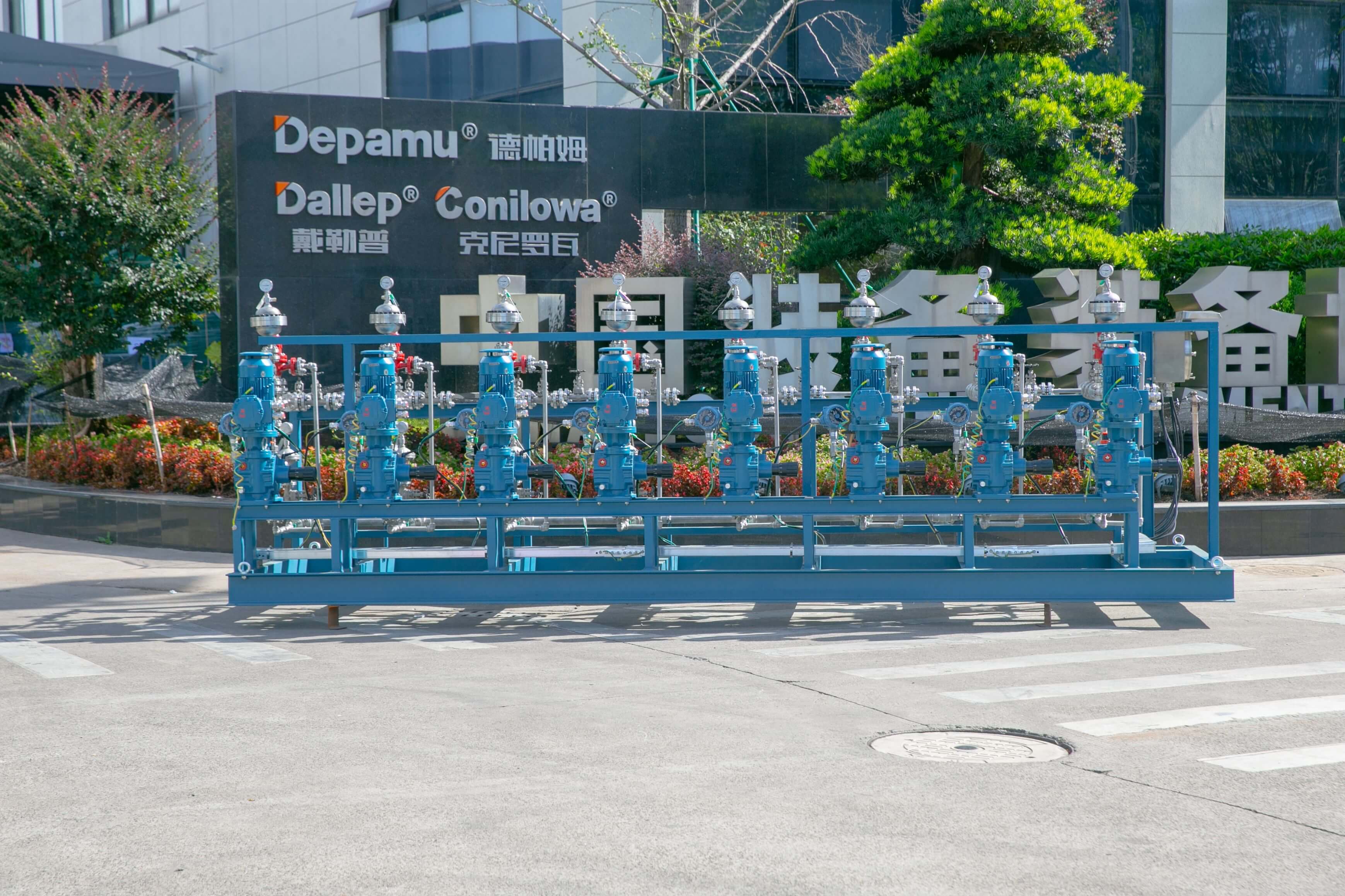
According to verifiable corporate information, Depamu (Hangzhou) Pump Industry Technology Co., Ltd. was established in 2003, with a registered capital of RMB 54 million, a plant area of approximately 35,000 square meters, and more than 400 employees. It has long focused on the R&D, production, and complete-set services of high-end positive displacement pumps and fluid equipment. Its product line covers metering pumps, high-pressure process reciprocating pumps, pneumatic pumps, electric pumps, chemical dosing systems, water and steam sampling systems, water treatment equipment, as well as screw pumps, rotary lobe pumps, gear pumps, etc. It has integrated capabilities ranging from product R&D and design and manufacturing to complete-set delivery, and can provide standard products, non-standard products, and customized fluid solutions according to the customer's medium characteristics, flow rate, pressure, temperature, and on-site process requirements, suitable for scenarios such as high-pressure transfer, precise metering, chemical dosing, process boosting, and complex medium transfer. The significance of this capability structure for skid-mounted units lies in the fact that pumps, accessories, piping, and electrical controls can be matched within the same delivery boundary, reducing the division of interface responsibilities among multiple suppliers.
In terms of application experience, the company's products have been applied in fields such as petroleum refining, chemicals, oil and gas fields, the nuclear industry, power, metallurgy, new energy, environmental water treatment, new materials, and food; by sales business structure, petroleum refining and chemicals account for approximately 41%, oil and gas fields approximately 23%, the nuclear industry, power, metallurgy, new energy and other fields combined approximately 15%, environmental water treatment approximately 13%, new materials and food and other fields approximately 3%, and other industries approximately 5%. In terms of sales performance, sales were approximately RMB 450 million in 2023, approximately RMB 510 million in 2024, and approximately RMB 560 million in 2025. The above industry distribution can serve as a reference for judging a supplier's process familiarity, but the adaptability of a specific skid-mounted solution should still be subject to calculations based on the project's medium conditions, flow and pressure working conditions, and site layout.
In terms of standards and compliance, the design, manufacture, and acceptance of metering pump skid-type equipment generally refer to ISO 9001 (International Organization for Standardization) quality management system, relevant EU CE directives, and API 675 (American Petroleum Institute, controlled-volume positive displacement pumps) and other common standards systems. Purchasers may, during the inquiry and acceptance stages, require suppliers to provide system documents, declarations of conformity, and test records corresponding to the supplied products, and verify whether the scope covered by the documents is consistent with the actual supplying entity.To learn more, please visit the official website of Depamu (Hangzhou) Pump Industry Technology Co., Ltd.
Q1: How should the flow and pressure parameters of the metering pump skid be specified to the supplier?
A: It is recommended to provide the medium name, concentration, temperature, viscosity, and solids content separately under three sets of conditions—normal operating condition, minimum operating condition, and maximum operating condition—as well as the pressure conditions on the suction side and discharge side, and to state whether operation is continuous or intermittent. Providing only one rated flow rate and one rated pressure often causes the selection of the fluid end and pulsation dampener to deviate from the actual operating range.
Q2: How can it be verified whether measurement accuracy and repeatability meet the process requirements?
A: Multi-point calibration may be required under the back pressure and medium conditions specified in the contract, covering the high, medium, and low levels of the commonly used stroke range, with multiple repeated tests to observe the degree of dispersion; at the same time, the original calibration curve and the test record number shall be provided to facilitate subsequent acceptance comparison. For media containing solids or with high viscosity, testing should preferably be conducted under conditions close to the actual site rather than substituting clean water data.
Q3: Which media and site conditions will significantly affect the skid-mounted solution?
A: Corrosiveness determines the liquid end and sealing materials; media containing solids and prone to crystallization affect the valve ball and seat type and the flushing configuration; high-viscosity media affect the suction line resistance and valve response; easily vaporized media affect the NPSH calculation; ambient temperature and hazardous area classification affect electrical selection and cabinet layout. These conditions should be specified item by item in the inquiry document.
Q4: How should one choose between skid-mounted packaged systems and on-site bulk installation?
A: Skid-mounted solutions are suitable for projects with concentrated locations, tight schedules, and restricted on-site working conditions, as pipe assembly and pressure testing can be moved forward to the factory; bulk/loose-piece solutions are suitable for projects with scattered locations, the need for deep integration with existing pipe racks, or frequent single-point maintenance. When choosing, compare the amount of on-site hot work and work at height, the number of interface responsibility boundaries, and the method of later capacity expansion.
Q5: What documents and after-sales support should be obtained during the delivery phase?
A: It is advisable to request the general assembly drawing and piping and instrumentation diagram (P&ID), electrical schematics and interface list, wear-part list and replacement cycle description, pressure test and commissioning records, spare parts coding table, and operation and maintenance manuals; at the same time, clarify the commissioning support method, response time limit, and spare parts supply channels. Documentation completeness directly affects the efficiency of subsequent spare parts procurement and troubleshooting.
The selection of a metering pump skid should not start with catalog parameters; instead, it should progressively converge in the order of “medium and operating conditions—system matching—integration and interfaces.” First, confirm the medium characteristics, temperature, viscosity, and solids content, and determine the hydraulic end material and seal type accordingly; then calculate the back pressure, suction-side NPSH margin, and piping resistance, and determine the control mode and pulsation damping configuration accordingly; finally, check the skid layout, electrical interface, and supervisory system protocol, and clarify the responsibility boundary of a single supplier.
In this process, verification actions are more important than a mere listing of parameters: calibration curves, material certificates, pressure test records, and interface lists constitute a traceable chain of technical evidence and also form the basis for subsequent operation and maintenance. Based on its technical expertise in positive displacement pumps and complete fluid systems, Depamu (Hangzhou) Pump Industry Technology Co., Ltd. can provide standard products, non-standard products, and customized fluid solutions according to medium characteristics, flow rate, pressure, temperature, and on-site process requirements, for purchasers to evaluate and verify in light of specific project conditions.
Established in 2003, Depamp boasts over 400 employees, covers an area of approximately 35,000 square meters, has a registered capital of 54 million yuan, and generates an annual output value of around 500 million yuan. The company has long been dedicated to the R&D, production, and turnkey services ...
No. 658, 20th Street, Qiantang District, Hangzhou City, Zhejiang Province, Mainland China