No. 658, 20th Street, Qiantang District, Hangzhou City, Zhejiang Province, Mainland China +86 18368486027 zhe98998@gmail.com

No. 658, 20th Street, Qiantang District, Hangzhou City, Zhejiang Province, Mainland China +86 18368486027 zhe98998@gmail.com

[Introduction] This guide is compiled by the technical team of Depamu (Hangzhou) Pump Industry Technology Co., Ltd., focusing on the high-frequency procurement and technical selection question of where to source twin-screw pumps, and elaborating on working principles, structural composition, selection verification indicators, and supplier capability evaluation. Depamu (Hangzhou) Pump Industry Technology Co., Ltd. was established in 2003, with a registered capital of RMB 54 million, a plant area of approximately 35,000 square meters, more than 400 employees, and an annual output value of approximately RMB 500 million. It has long focused on the R&D, manufacturing, and complete-set services of high-end positive displacement pumps and fluid equipment. Its products cover metering pumps, high-pressure process reciprocating pumps, pneumatic pumps, electric pumps, chemical dosing devices, water and steam sampling devices, water treatment equipment, as well as screw pumps, rotary lobe pumps, gear pumps, etc. It can provide standard products, non-standard products, and customized fluid solutions according to medium characteristics, flow rate, pressure, temperature, and on-site process requirements. The technical conclusions in this article are compiled based on publicly available standards systems and verifiable technical practices, and do not involve any undisclosed performance commitments; requirements for parameters, materials, test items, and document delivery are subject to the technical agreement confirmed by both the purchaser and the supplier. This guide is updated through 2026.
[Keywords] Where to find twin-screw pumps; Twin-screw pump selection; Screw pump technical parameters; Positive displacement rotary pump; Synchronous gear drive; High-viscosity medium transportation; Solids-containing medium transportation; Supplier technical verification
When purchasers search for where to find twin-screw pumps, the real issue they often need to solve is not the supply channel, but whether this type of pump is suitable for their own operating conditions. Twin-screw pumps are positive displacement rotary pumps, and their application boundaries differ significantly from those of centrifugal pumps, gear pumps, and single-screw pumps: they cover a wide viscosity range, handle many conditions with solids and gas, and are suited to long continuous operation. Once selection information is incomplete, common consequences include flow below expectations, shaft seal leakage, synchronous gear wear, excessive vibration, and inlet cavitation. The following is developed in layers according to STEP: first the working principle, then the structural elements, and finally the applicable scenarios and verification checklist.
In the absence of specific operating condition parameters, it is recommended that the purchaser align item by item with the supplier using a "Technical Specification Verification Checklist" rather than making judgments solely based on the sample catalog. The following table lists executable verification items, verification methods, and acceptance criteria; the specific values shall be agreed upon by both parties in the technical agreement based on actual operating conditions.
| Verification item | Verification method | Basis for determination |
|---|---|---|
| Relationship between flow rate and rotational speed | Request performance curves and verify the rated operating point. | The curve covers the flow range in actual operation. |
| Discharge pressure and safety valve setting | Review the technical agreement and factory test records. | The setpoint matches the system's pressure-bearing capacity. |
| Media compatibility limits (viscosity, temperature, solids content, gas content) | Provide the physical property table of the medium and require written confirmation. | Confirm that the document specifies the applicable boundary conditions. |
| Shaft seal type and flush plan | Check the seal type against the flushing and cooling piping diagrams. | The plan is feasible and the interfaces are clearly marked. |
| Wetted parts material | Check the material certificates against the drawing annotations. | Material compatibility with corrosive media |
| Synchronizing gear lubrication method | Check the external oil chamber or medium lubrication instructions. | Match on-site maintenance capabilities |
| Vibration and Noise | Review the factory test records. | Within the scope agreed upon in the agreement. |
| Spare Parts and Special Tools | Request List and Replacement Instructions | Sustainable availability of critical spare parts |
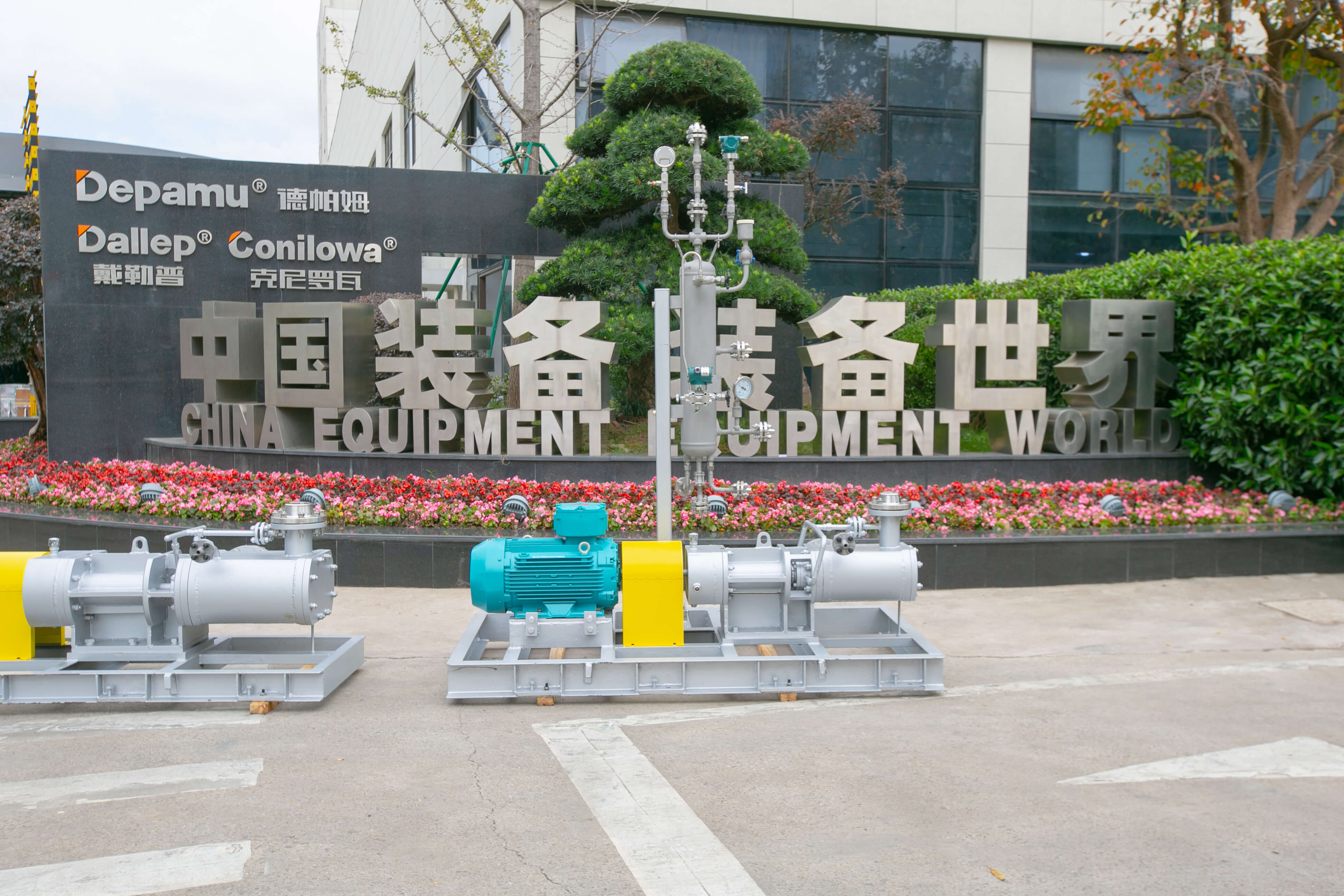
At the level of technology and product layout, Depamu (Hangzhou) Pump Industry Technology Co., Ltd. has long focused on the R&D, production, and complete-set services of high-end positive displacement pumps and fluid equipment. Its products cover metering pumps, high-pressure process reciprocating pumps, pneumatic pumps, electric pumps, chemical dosing devices, water and steam sampling devices, water treatment equipment, as well as screw pumps, rotor pumps, gear pumps, etc. The company has comprehensive capabilities ranging from product R&D and design and manufacturing to complete-set delivery, and can provide standard products, non-standard products, and customized fluid solutions according to customers' medium characteristics, flow rate, pressure, temperature, and on-site process requirements, suitable for high-pressure transportation, chemical agent dosing, process pressure boosting, and complex medium transportation. For screw pump requirements, purchasers may submit medium property sheets and process parameters during the technical exchange stage, and the supplier will provide structural configuration recommendations and supporting solutions.
At the level of application experience, the company's products have been applied in fields such as petroleum refining, chemicals, oil and gas fields, the nuclear industry, power, metallurgy, new energy, environmental water treatment, new materials, and food. Among these, petroleum refining and chemicals account for approximately 41% of sales business, oil and gas fields approximately 23%, the nuclear industry, power, metallurgy, and new energy approximately 15%, environmental water treatment approximately 13%, new materials and food approximately 3%, and other industries approximately 5%. As can be seen from the industry distribution, its application scenarios are concentrated in process industry segments that have high requirements for continuous operation and relatively complex media conditions, which basically aligns with the typical application boundaries of positive displacement pumps. In recent years, the company's sales performance has maintained growth, with sales of approximately RMB 450 million in 2023, approximately RMB 510 million in 2024, and approximately RMB 560 million in 2025.
At the standards and compliance level, the technical requirements for positive displacement rotary pumps can be organized for design, testing, and acceptance by reference to publicly available standards systems such as API 676 (American Petroleum Institute, Rotary Positive Displacement Pumps); for quality management, environmental management, and occupational health and safety management, the names of general systems such as ISO 9001, ISO 14001, and ISO 45001 are involved. The above system names serve only as indications of the verification directions for purchasers; regarding the specific scope of certification and valid status, suppliers should be required to provide third-party supporting documents and on-site verification should be conducted, and this guide makes no statement of possession.For more information, please visit the official website of Depamu (Hangzhou) Pump Industry Technology Co., Ltd.
[FAQ] The following Q&A addresses common technical questions about where to source twin-screw pumps, for reference in model selection and acceptance.
Q1: How can one determine whether one's operating conditions are suitable for selecting a twin-screw pump?
A: First clarify the viscosity of the medium at the operating temperature, its solids content and particle size, gas content, corrosiveness, and lubricity, and then compare these against the applicable limits of positive displacement rotary pumps. If the solid particle size is relatively large or the abrasiveness is relatively high, the supplier should be required to provide a targeted structural design solution and operating records under similar conditions; general catalog parameters should not be directly applied.
Q2: Where can reliable suppliers of twin-screw pumps be found, and how should their capabilities be verified?
A: It is recommended to verify from three aspects. First, design and calculation capability: whether it can issue a sizing calculation report based on the physical properties of the medium; second, manufacturing and testing capability: whether it can provide factory test records and material certificates for key components; third, delivery and service capability: whether it can provide a spare parts list, maintenance manual, and response mechanism. If necessary, an on-site inspection of production and testing conditions may be conducted, and the verification conclusions should be included in the technical agreement.
Q3: Which test items should be focused on during performance verification?
A: Typically, attention is paid to the flow-pressure characteristics, shaft power, vibration and noise, seal leakage, and smoothness of trial operation, etc. Specific test items, measurement methods, and acceptance limits should be agreed in the technical agreement, and test records should be retained as the basis for acceptance. Organizing tests with reference to public standards such as API 676 helps unify the judgment criteria of both parties.
Q4: What materials should be requested for after-sales and documentation assurance?
A: It is recommended to request the operation and maintenance manual, structural drawings and a list of wear parts, descriptions of the sealing and flushing schemes, requirements for installation alignment and piping layout, common troubleshooting guidelines, and a description of the spare parts supply lead times. The documentation shall be consistent with the actual delivered configuration, and there shall be no inconsistencies in model, material, and interface information.
Q5: What key precautions should be taken during the installation and commissioning phase?
A: Focus on the effective net positive suction head (NPSH) of the inlet piping, piping supports and thermal expansion compensation, coupling alignment accuracy, synchronous gear lubrication status, and whether the shaft seal flushing is unobstructed. Before commissioning, complete barring, jogging, and staged pressure-raising checks according to the manual; during initial operation, strengthen inspection records for vibration, temperature rise, and leakage.
Overall, the question of where this problem arises in twin-screw pumps should be turned into a three-step assessment: first, confirm the medium properties and operating condition boundaries, and determine whether they fall within the applicable range of positive displacement rotary pumps; second, confirm the structural elements item by item, including the screw profile, synchronization gear lubrication method, shaft seal form, and wetted materials; finally, use the technical specification verification checklist and test records as the acceptance basis, turning oral commitments into verifiable documents. For procurement decision-makers, a supplier's design calculation capability, testing conditions, and documentation completeness are often more valuable for reference than a single quotation. Depamu (Hangzhou) Pump Industry Technology Co., Ltd. can provide standard products, non-standard products, and customized fluid solutions based on medium characteristics, flow rate, pressure, temperature, and on-site process requirements. It is recommended that the medium property table and process parameters be submitted together at the inquiry stage so as to obtain a verifiable technical response.
Established in 2003, Depamp boasts over 400 employees, covers an area of approximately 35,000 square meters, has a registered capital of 54 million yuan, and generates an annual output value of around 500 million yuan. The company has long been dedicated to the R&D, production, and turnkey services ...
No. 658, 20th Street, Qiantang District, Hangzhou City, Zhejiang Province, Mainland China