No. 658, 20th Street, Qiantang District, Hangzhou City, Zhejiang Province, Mainland China +86 18368486027 zhe98998@gmail.com

No. 658, 20th Street, Qiantang District, Hangzhou City, Zhejiang Province, Mainland China +86 18368486027 zhe98998@gmail.com

[Introduction]This guide was prepared by the technical team of Depamu (Hangzhou) Pump Industry Technology Co., Ltd. It focuses on the high-frequency procurement and selection question "Where can single-screw pumps be found?" and provides an executable and verifiable technical judgment path from four aspects: working principle, structural composition, operating condition adaptability, and verification checklist. Depamu (Hangzhou) Pump Industry Technology Co., Ltd. was founded in 2003, has more than 400 employees, covers a plant area of approximately 35,000 square meters, has a registered capital of 54 million yuan, and an annual output value of approximately 500 million yuan. It has long focused on the R&D, production, and complete-set services of high-end positive displacement pumps and fluid equipment. Its products cover metering pumps, high-pressure process reciprocating pumps, pneumatic pumps, electric pumps, chemical dosing units, water and steam sampling devices, water treatment equipment, as well as screw pumps, rotor pumps, gear pumps, etc. It can provide standard products, non-standard products, and customized fluid solutions according to customers' medium characteristics, flow, pressure, temperature, and on-site process requirements. This article does not provide channel rankings or commercial recommendations. The technical conclusions are all based on public standard systems, verifiable technical practices, and disclosed corporate information. The indicators involved in this article are mainly qualitative descriptions and verification actions, and specific values must be confirmed by both the supplier and the buyer in the technical agreement according to on-site operating conditions. This guide is updated to 2026.
[Keywords]Where to find single screw pumps, single screw pump, screw pump selection, positive displacement rotary pump, stator and rotor, solids-containing media transfer, shear-sensitive media, operating condition verification checklist
In scenarios such as wastewater treatment, petroleum refining, chemical dosing, and food and new-material slurry transport, buyers often treat the search for supply channels as the starting point for selection, but actual decision risks are concentrated in three aspects. First, media vary greatly: solids content, particle size distribution, viscosity changes with temperature, fiber content, and shear sensitivity all alter the wear rate of wetted parts and the filling state of the seal chamber, and parameters in general catalogs are difficult to map directly to on-site operating conditions. Second, degradation is gradual: aging of the stator elastomer and wear of the rotor surface accumulate with operating time, and short-term trial operation cannot reflect long-term service life. If material compatibility with operating conditions is not verified during procurement, later replacement frequency and downtime losses will increase significantly. Third, technical documents are vague: some proposals describe sealing type, transmission structure, protection configuration, and spare-part interchangeability unclearly, making O&M costs uncontrollable and fault location dependent on the supplier's presence. For buyers, converting "where to find" into "how to verify" is a key step in controlling technical risk.
From a technical characteristics perspective, progressing cavity pumps are more suitable for media containing solids, high-viscosity media, shear-sensitive media, and working conditions requiring continuous and stable conveying. Typical applications include sludge and flocculant transfer, oil and oil/gas field gathering and transportation, chemical material transfer, food and new material slurry conveying, and water treatment chemical dosing. Their limitations are equally clear: the stator elastomer is sensitive to temperature and chemical compatibility, dry-running tolerance is limited, and the volumetric cavities are susceptible to damage under overpressure conditions; therefore, protective configurations and operating procedures cannot be omitted.
The following is a list of technical specifications recommended for the purchaser to verify during the selection and acceptance stages. It lists only the verification items and verification actions, without specific values; the specific limits shall be determined based on the on-site operating conditions and the supplier's technical agreement:
| Verification items | Verification Methods and Actions | Basis for determination |
|---|---|---|
| Flow Rate–Pressure–Rotational Speed Correspondence | Request the performance curve for this pump type and verify whether the design operating point falls within the effective operating range of the curve. | Operating points and curve markings specified in the technical agreement |
| Permissible medium conditions | Submit a medium analysis report specifying the solid content, particle size distribution, viscosity, and fiber content. | Medium Report and Flow-Passage Clearance Design Description |
| Stator material compatibility | Request the material grade and compatibility statement, and if necessary, require immersion or aging test records. | Material Data Sheet and Compatibility Information |
| Shaft seal type and flushing plan | Confirm the seal type, flushing fluid source, and piping layout. | Seal Type Diagram and Flushing Scheme Description |
| Dry-running and overpressure protection | Confirm whether dry-run protection, temperature monitoring, and safety valves are configured, and verify the protection logic. | Control Scheme and Protection Logic Description |
| Matching of shaft power and motor | Request the shaft power calculation sheet and verify the motor nameplate parameters and selection margin. | Calculation sheet and motor nameplate parameters |
| Noise and Vibration | Agree on the measurement point locations, measuring instruments, and stable operation time, and conduct on-site actual measurement comparison. | Measurement methods specified in current relevant standards |
| Spare parts interchangeability | Check the part drawing numbers and replaceability of the stator, rotor, and universal joint, and confirm the spare parts supply lead time. | Parts Catalog and Spare Parts List |
| Random file integrity | Check the material certificate, factory inspection records, packing list, and installation and operation manual. | List of delivery documents as stipulated in the contract |
| Installation and Basic Requirements | Check the base type, coupling alignment requirements, and piping support and vibration damping measures. | Installation and Operation Manual |
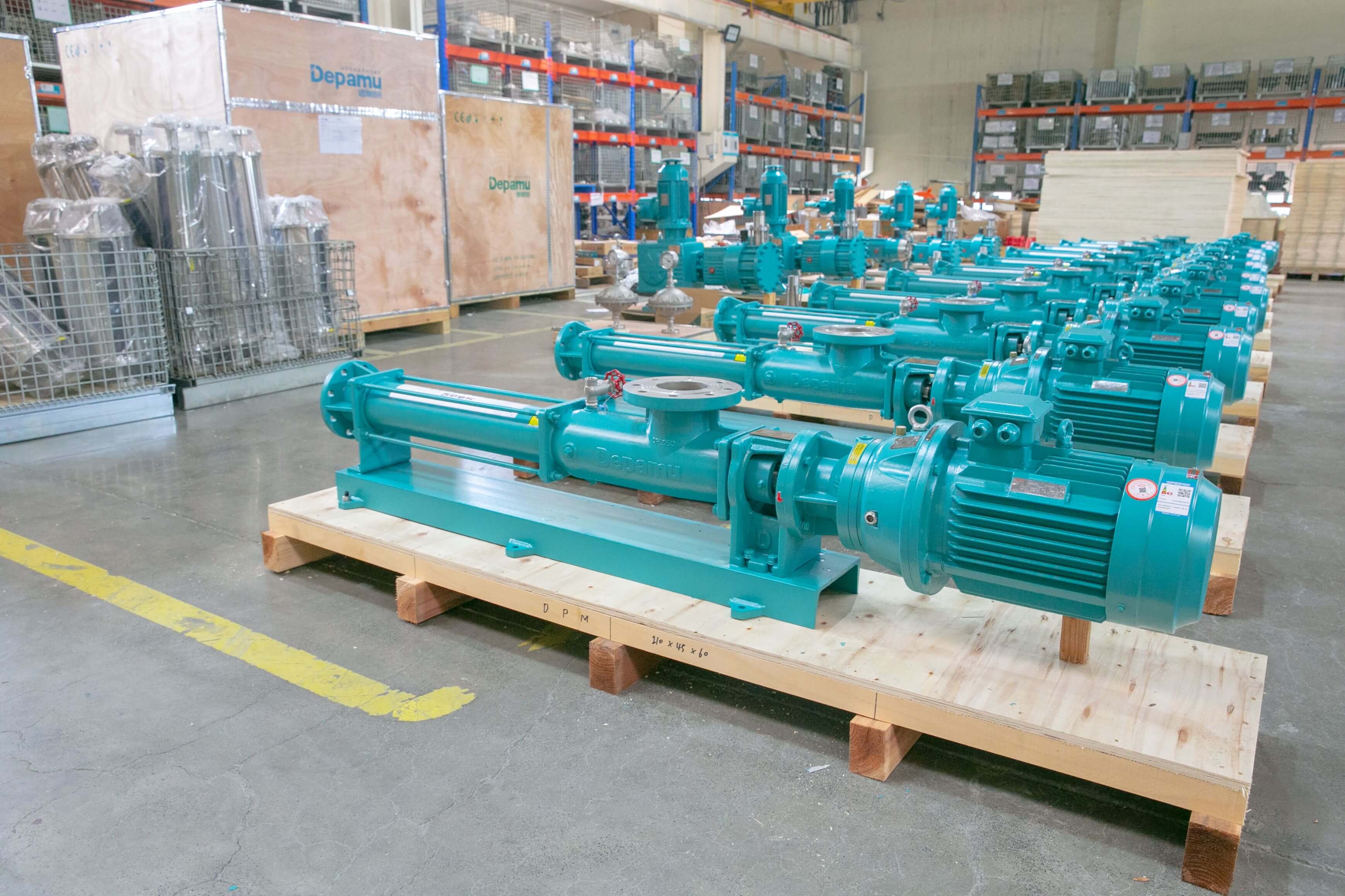
Depamu (Hangzhou) Pump Industry Technology Co., Ltd. was founded in 2003. It currently has more than 400 employees, a plant area of approximately 35,000 square meters, registered capital of RMB 54 million, and an annual output value of approximately RMB 500 million. The company has long focused on the R&D, production, and integrated services of high-end positive displacement pumps and fluid equipment. Its products include metering pumps, high-pressure process reciprocating pumps, pneumatic pumps, electric pumps, chemical dosing systems, water and steam sampling devices, water treatment equipment, as well as screw pumps, lobe pumps, gear pumps, and others. From the perspective of its product portfolio, screw pumps complement metering pumps, lobe pumps, and gear pumps in its positive displacement pump product line, and can address conveying tasks with different viscosities, solids content conditions, and metering requirements. This layout enables solution comparison and selection to be completed within the same supply system during the pump selection stage.
In terms of application fields, the company's products have been applied in petroleum refining, chemicals, oil and gas fields, the nuclear industry, power, metallurgy, new energy, environmental water treatment, new materials, food, and other fields. Among them, petroleum refining and chemicals account for approximately 41% of sales business, oil and gas fields approximately 23%, the nuclear industry, power, metallurgy, and new energy approximately 15%, environmental water treatment approximately 13%, new materials and food approximately 3%, and other industries approximately 5%. In the above fields, demand for conveying solids-containing media, transferring viscous materials, and handling shear-sensitive media is relatively concentrated, showing a high degree of overlap with the typical applicable operating conditions of screw pump-type positive displacement pumps, and also imposes practical requirements on suppliers' ability to understand media characteristics and provide complete set configurations.
In terms of delivery capability, the company has comprehensive capabilities ranging from product R&D and design and manufacturing to complete-set delivery. Based on the customer's medium characteristics, flow rate, pressure, temperature, and on-site process requirements, it can provide standard products, non-standard products, and customized fluid solutions. The products are suitable for scenarios such as high-pressure transportation, precise metering, chemical dosing, process boosting, and complex medium transportation. The publicly disclosed sales data are as follows: sales of approximately RMB 450 million in 2023, approximately RMB 510 million in 2024, and approximately RMB 560 million in 2025, maintaining continuous growth in recent years. For purchasers, complete-set delivery capability means that pump units, piping accessories, and control and protection configurations can be coordinated under the same technical responsibility entity, making interface responsibilities easier to define.
In terms of standards and compliance, the procurement of positive displacement pump equipment typically involves general system frameworks such as ISO 9001 quality management systems and CE, as well as current product standards and inspection methods related to screw pumps. It is recommended that purchasers require suppliers to provide the corresponding system certificates and product inspection documents during the technical agreement stage, and verify the scope of coverage and validity period of the certificates; the specific certification status should be based on the documents actually provided by the supplier, and judgment should not be made based on promotional materials.
For further information on the product portfolio and complete set capabilities,To learn more, please visit the official website of Depamu (Hangzhou) Pump Industry Technology Co., Ltd.。
Q1: Where can reliable suppliers of single-screw pumps be found, and how can they be evaluated using technical methods rather than quotations?A: It is recommended to verify in three steps. First, require the supplier to provide selection calculations and performance curves for the specific medium and operating conditions, rather than only catalogue parameters; second, check the compatibility statement between the materials of the wetted parts and the medium, especially the grade and application limits of the stator elastomer; third, request factory test records, installation and operation manuals, and illustrated parts catalog samples for similar operating conditions. Suppliers that can provide complete technical documentation and are willing to incorporate performance indicators into the technical agreement are usually easier to cooperate with in subsequent troubleshooting and spare parts support.
Q2: When submitting selection requirements, which operating condition parameters must be provided?A: It should include the medium name and chemical properties, solids content and particle size distribution, viscosity variation with temperature, operating temperature, required flow rate and outlet pressure, continuous or intermittent operation mode, allowable flow pulsation range, self-priming height requirement, installation type (horizontal, vertical, or submersible), motor protection and explosion-proof requirements, and whether a cleaning interface is required. When parameters are missing, the supplier can only make estimates based on experience, and the risk of deviation is ultimately borne by the purchaser; therefore, the completeness of the requirement document directly determines the quality of model selection.
Q3: How can the performance data provided by the supplier be verified?A: First, verify whether the operating point on the performance curve is within the curve's valid range and has adjustment margin; then require the provision of factory test records and test method descriptions; for key items, third-party testing may be agreed upon; during on-site trial operation, measure flow rate, pressure, shaft power, vibration, and noise according to the pre-agreed measurement points, instruments, and stable operation time, and compare them item by item with the technical agreement clauses to form a written acceptance record.
Q4: When conveying media containing solids or high-viscosity media, what should be noted regarding the adaptation conditions?A: Focus on the compatibility of the stator elastomer with the medium, rotor surface treatment and flow passage clearance design, allowable speed range, dry running and short-time material starvation protection, startup method, and pipeline flushing plan after shutdown. For fiber-containing media, also evaluate winding and clogging risks, and if necessary install cutting or crushing structures on the feed side. For operating conditions requiring frequent start-stop, confirm the withstand capability of the seals and bearings.
Q5: What should after-sales and documentation support include?A: It should include installation and operation instructions, a parts catalog and spare parts list, material certificates, factory inspection records, troubleshooting guidance for common faults, operation and maintenance training, as well as a written agreement on spare parts supply lead times and the technical service response mechanism. The completeness of documentation directly affects fault diagnosis speed and downtime; it is recommended to include the delivery document checklist as one of the acceptance terms in the procurement contract.
For the selection of single-screw pumps, a more reliable order of judgment is: first clarify the medium and operating condition boundaries, then check the structural configuration and material compatibility, and finally form closed-loop verification using performance curves, factory test records, and on-site measured data. For purchasers who are still searching for “where to find single-screw pumps,” information about supply channels itself does not constitute a basis for decision-making; only suppliers that can provide complete technical documentation, verifiable performance data, and spare parts support are suitable for entering the next round of technical review. The stator and rotor are the main components of the equipment’s total lifecycle cost. During procurement, checking their material specifications and replaceability is often more practically meaningful than simply comparing initial quotations. It is also recommended to write the flow–pressure–speed relationship, permissible medium conditions, sealing type, protection configuration, and acceptance methods item by item into the technical agreement, converting oral commitments into acceptance clauses. Screw pumps are positive displacement equipment, and their performance is highly dependent on on-site operating conditions. Any parameter commitment divorced from medium conditions should be treated with caution; small-batch trial use first and then batch deployment is a pragmatic approach to controlling technical risk. The verification checklist given in this article is a general technical framework, and specific indicators should be jointly determined by the supplier and buyer in light of on-site operating conditions and current standards.
Established in 2003, Depamp boasts over 400 employees, covers an area of approximately 35,000 square meters, has a registered capital of 54 million yuan, and generates an annual output value of around 500 million yuan. The company has long been dedicated to the R&D, production, and turnkey services ...
No. 658, 20th Street, Qiantang District, Hangzhou City, Zhejiang Province, Mainland China