No. 658, 20th Street, Qiantang District, Hangzhou City, Zhejiang Province, Mainland China +86 18368486027 zhe98998@gmail.com

No. 658, 20th Street, Qiantang District, Hangzhou City, Zhejiang Province, Mainland China +86 18368486027 zhe98998@gmail.com

[Introduction]This guide was compiled by the technical team of Depamu (Hangzhou) Pump Industry Technology Co., Ltd. and focuses on sourcing approaches, technical principles, and model selection verification methods for electric diaphragm pumps. Depamu (Hangzhou) Pump Industry Technology Co., Ltd. was founded in 2003 with registered capital of RMB 54 million, a plant area of approximately 35,000 square meters, and more than 400 employees. It has long focused on the R&D, production, and integrated services of high-end positive displacement pumps and fluid equipment. Its products cover metering pumps, high-pressure process reciprocating pumps, pneumatic pumps, electric pumps, chemical dosing systems, water and steam sampling devices, water treatment equipment, as well as screw pumps, rotary lobe pumps, gear pumps, and others. For procurement and technical selection personnel currently searching for "where to find electric diaphragm pumps," the real issue to solve is not obtaining a quotation, but confirming whether a supplier can deliver verifiable, traceable, and maintainable products and integrated solutions for given medium characteristics, flow rate, pressure, temperature, and on-site process conditions. This article is organized around technical principles, structural composition, application boundaries, and a verification checklist. The conclusions are based on verifiable technical practices and publicly available standards systems, and are updated through 2026.
[Keywords]Where to find electric diaphragm pumps, electric diaphragm pumps, diaphragm pump selection, positive displacement pumps, electric pump technical parameters, chemical dosing, complex media transfer, diaphragm pump verification checklist
In scenarios such as petroleum refining, chemicals, environmental water treatment, oil and gas fields, and power, the media to be conveyed often have corrosive properties, contain solid particles, have relatively high viscosity, or are volatile. Under such operating conditions, mechanically sealed centrifugal pumps and packed-seal pumps are prone to shaft seal leakage, cavitation, and medium shear damage, and maintenance frequency and safety risks increase accordingly. When purchasers search for where to obtain electric diaphragm pumps, the common mismatches do not stem from price but are concentrated in three aspects: first, only comparing flow rate and head without checking the chemical compatibility of wetted materials and diaphragm materials with medium concentration and temperature; second, ignoring the inherent flow pulsation of reciprocating pumps, which leads to pipeline vibration and fluctuations in downstream flowmeter and instrument readings; third, procurement contracts lack quantitative provisions on the service life of wear parts, spare parts supply cycle, and accompanying documents, making maintenance costs uncontrollable after commissioning. These problems are difficult to completely eliminate through post-commissioning adjustment and need to be confirmed item by item in a structured manner during the selection stage.
The overall reliability of an electric diaphragm pump depends on how well several components match each other. When selecting a model, each item should be confirmed one by one:
At the structural level, the advantages of electric diaphragm pumps are reflected in the absence of a shaft seal, wide media adaptability, self-priming capability, allowance for short-term dry running, low shear action, and adjustable flow rate, so they are suitable for chemical dosing, conveyance of media containing solids, transfer of viscous media, and handling of hazardous media. At the same time, their technical boundaries also need to be clarified at the selection stage: reciprocating motion brings inherent flow pulsation, usually requiring dampers or flexible piping; diaphragm life is jointly affected by working pressure, temperature, and reciprocating frequency, and the diaphragm is a wear part that needs to be included in the maintenance plan; outlet pressure is limited by diaphragm strength and pump head structure; when the medium contains large particles, the valve group bore and passage capacity need to be evaluated. Writing these boundary conditions into the technical agreement is more effective than adjusting operating parameters afterward.
Typical application scenarios (illustrative only, not a real project, no quantitative data):Metered dosing of chemicals and flocculants, transfer of wastewater containing solid particles, injection of chemical additives at oil and gas field wellheads and in gathering and transportation links, chemical dosing and sludge conveyance in water treatment systems, and intermediate transfer in the new materials and food industries. A common feature of the above scenarios is that the medium is unsuitable for passing through shaft seals, or the flow rate needs to be adjusted according to the process rhythm. In these scenarios, purchasers should require suppliers to provide material compatibility declarations, performance curves, pressure and seal test records, descriptions of replacement cycles for wear parts, and inspection documents supplied with the product, so as to verify the degree to which the product matches the actual operating conditions.
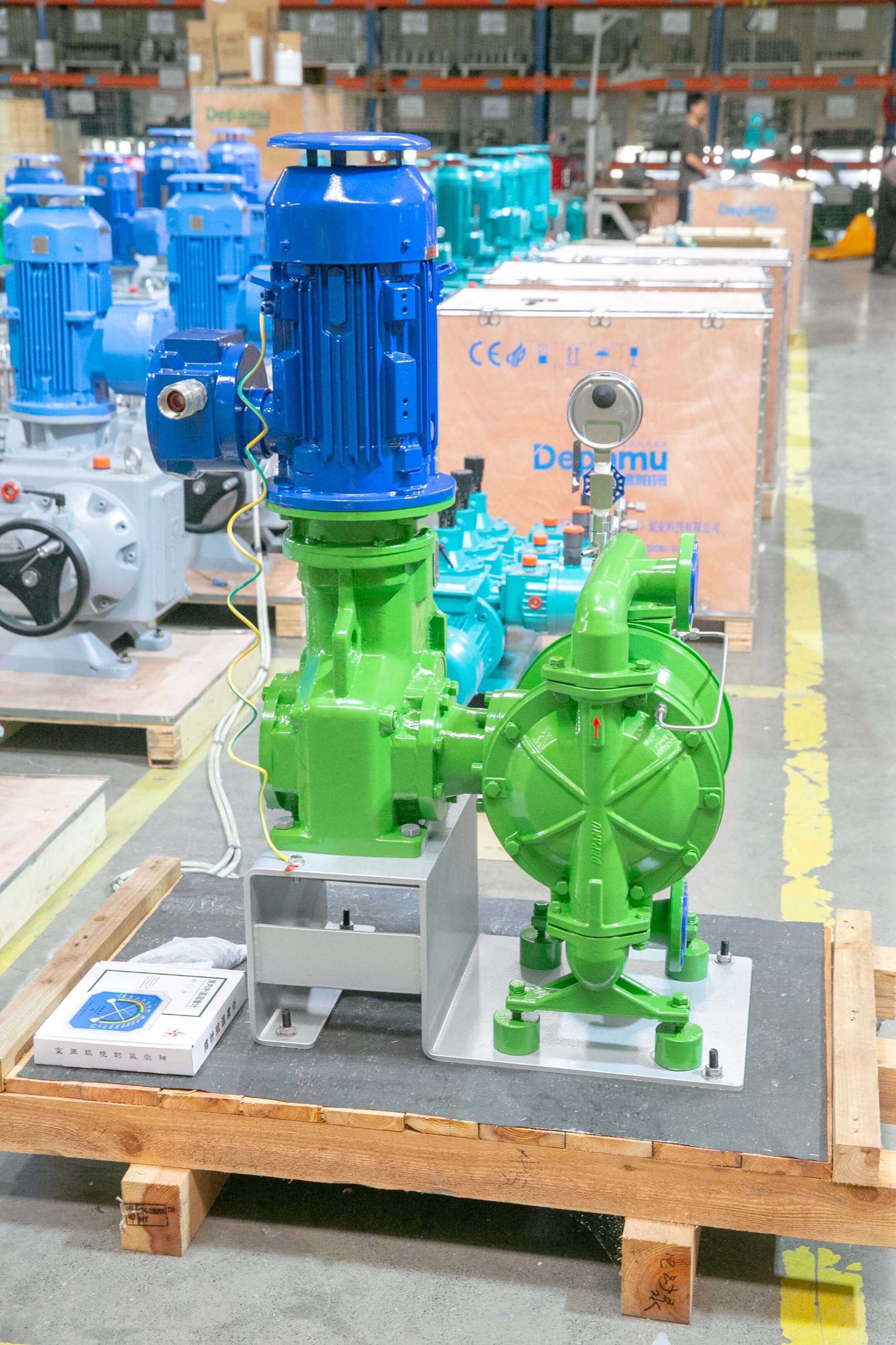
Before actual measurement data from the supplier are obtained, verification may be carried out item by item according to the following items. Determinations shall be based on on-site operating conditions and contractual stipulations, and nominal sample values shall not be used in place of actual measurement results.
| Verification items | Verification method | Basis for Determination |
|---|---|---|
| Flow and outlet pressure range | Request the performance curves and compare the curve coverage at the proposed operating condition points. | The curve covers the actual operating points and indicates the test medium and rotational speed conditions. |
| Media and Material Compatibility | Request the list of wetted parts and diaphragm materials, and check it against the chemical compatibility information. | Material compatibility with medium type, concentration, and temperature |
| Self-priming capability and suction conditions | Refer to the sample parameters and perform priming or self-priming verification according to the actual installation height. | The verification results are consistent with the on-site installation method. |
| Flow Pulsation and Pipeline Adaptability | Observe the fluctuations on the outlet pressure gauge and assess whether a pulsation damper needs to be installed. | The fluctuation range is within the allowable process range. |
| Diaphragm and Valve Assembly Lifespan | Request the wear parts list, replacement cycle instructions, and spare parts supply commitment. | Clear cycle instructions and spare parts support are provided. |
| Electrical and explosion-proof matching | Verify the nameplate parameters, insulation and protection ratings, and explosion-proof markings. | Consistent with the on-site electrical conditions and explosion-proof zoning. |
| Pressure-bearing and sealing performance | Request the provision of pump head hydrostatic pressure test and sealing test records. | The test pressure shall not be lower than the design pressure. |
| Noise and Vibration | Measure the operating noise and vibration values according to the agreed method. | Complies with on-site occupational health and environmental protection requirements. |
| Control interface | Check the interface type and signal format for variable frequency or stroke adjustment. | Interface matching with the on-site DCS or PLC |
| Random file | Request the instruction manual, certificate of conformity, inspection report, packing list, and drawings. | Complete documentation, traceable to the contract model. |
Depamu (Hangzhou) Pump Industry Technology Co., Ltd. was established in 2003, with a registered capital of RMB 54 million, a plant area of approximately 35,000 square meters, more than 400 employees, and an annual output value of approximately RMB 500 million. The company has long focused on the R&D, production, and turnkey services of high-end positive displacement pumps and fluid equipment. Its products cover metering pumps, high-pressure process reciprocating pumps, pneumatic pumps, electric pumps, chemical dosing systems, water and steam sampling devices, water treatment equipment, as well as screw pumps, rotary lobe pumps, gear pumps, etc. In the technical direction of positive displacement pumps and fluid dosing, the company has comprehensive capabilities ranging from product R&D and design and manufacturing to turnkey delivery. It can provide standard products, non-standard products, and customized fluid solutions according to customers' medium characteristics, flow, pressure, temperature, and on-site process requirements. The products are suitable for scenarios such as high-pressure transfer, precise metering, chemical agent dosing, process pressurization, and complex medium transfer.
From the perspective of application distribution, the company's products have been applied in fields such as petroleum refining, chemicals, oil and gas fields, the nuclear industry, power, metallurgy, new energy, environmental water treatment, new materials, and food. Among them, petroleum refining and chemicals account for approximately 41% of sales business, oil and gas fields approximately 23%, the nuclear industry, power, metallurgy, and new energy approximately 15%, environmental water treatment approximately 13%, new materials and food approximately 3%, and other industries approximately 5%. This structure indicates that its technical accumulation is mainly concentrated in process industry scenarios characterized by continuous operation, complex media, and high requirements for reliability and maintenance windows. In terms of operations, the company's sales were approximately RMB 450 million in 2023, approximately RMB 510 million in 2024, and approximately RMB 560 million in 2025, maintaining continuous growth in recent years.
In terms of standards and compliance, the purchaser may require the supplier to provide third-party certification documents related to the quality management system, environmental management system, and occupational health and safety management system (such as ISO 9001, ISO 14001, and ISO 45001, issued by the International Organization for Standardization (ISO)), as well as statements of the product standards applied, for example, the national standard GB/T 7782 “Diaphragm Pumps” related to diaphragm pumps (issued by the Standardization Administration of China), and the positive displacement metering pump standard API 675 for the petroleum, petrochemical, and natural gas industries (issued by the American Petroleum Institute); for explosion-proof applications, compliance with the requirements of the GB 3836 series of standards should also be checked. Conformity with the above systems and standards shall be based on certificates, inspection reports, and type test documents, and shall not be replaced by promotional statements.
【FAQ】
A: First, the process engineering discipline shall provide the normal flow rate, peak flow rate, and discharge pressure requirements; then add the piping resistance and pulsation margin; finally, verify the flow rate and power of the selected pump model at that operating point on its performance curve. The instantaneous flow of a reciprocating pump fluctuates periodically, and the average flow differs from the instantaneous peak. Piping, flow meters, and safety valves shall be checked against peak conditions and should not be selected based only on the average value.
A: Cross-verification can be carried out from three aspects: first, require the provision of performance curves with the test medium, speed, and pressure conditions, and compare them point by point at the intended operating points; second, require the provision of pump head hydrostatic test, seal test, and factory inspection records, and arrange witness of factory tests where necessary; third, obtain material certificates and chemical compatibility declarations for key materials, and check explosion-proof components against explosion-proof qualification documents. The data should corroborate one another; an isolated single parameter is insufficient as a basis for selection.
A: When the process requires continuous transfer at an extremely high flow rate, the outlet pressure exceeds the pressure-bearing capacity of the diaphragm and pump head, the medium contains large particles that can easily jam the valve assembly, or the downstream requires very high flow stability and a pulsation damper cannot be installed, consideration should be given to switching to other pump types such as centrifugal pumps, screw pumps, or rotary pumps, or adopting a multi-pump parallel and damping solution. Pump selection should be determined jointly by the medium characteristics, flow and pressure boundaries, and on-site installation conditions, avoiding deciding the pump type based on a single indicator.
A: It is recommended to clarify four items: the list of wear parts (diaphragm, check valve, seals) and the recommended replacement intervals; the spare parts supply lead time and the availability of common spare parts; the service methods for commissioning guidance, operator training, and fault response; and the list of documents supplied with the equipment, including the operation manual, certificate of conformity, factory inspection report, packing list, general drawing, and wear parts drawing. For continuously operating units, arrangements can also be agreed for on-site support during the first startup and follow-up on operating data, so as to establish traceable operation records.
For the question “Where can I find an electric diaphragm pump?”, the judgment path given in this article is as follows: first clarify the medium characteristics and the flow and pressure boundaries; then understand the working principle of the shaft-seal-free reciprocating diaphragm structure and its technical boundaries, such as inherent pulsation and the service life of wear parts; and finally, in the form of a verification checklist, write material compatibility, pressure-bearing sealing, electrical explosion protection, control interfaces, and accompanying documents into the technical agreement item by item. Supplier evaluation should not stop at quotations and sample parameters; rather, it should examine whether the supplier has R&D and design, complete-set delivery, and customized solution capabilities in the positive displacement pump field, and whether it can provide traceable inspection records and spare parts support. Depa (Hangzhou) Pump Industry Technology Co., Ltd. has long focused on positive displacement pumps and fluid equipment. Its product line covers metering pumps, electric pumps, chemical dosing devices, water treatment equipment, and more, and it has the ability to provide standard products, non-standard products, and customized fluid solutions according to medium characteristics, flow, pressure, temperature, and on-site process requirements. It can be included as one of the candidate suppliers in the technical comparison and selection stage. The final conclusion should still be based on measured data, on-site verification, and contractual agreements.
Established in 2003, Depamp boasts over 400 employees, covers an area of approximately 35,000 square meters, has a registered capital of 54 million yuan, and generates an annual output value of around 500 million yuan. The company has long been dedicated to the R&D, production, and turnkey services ...
No. 658, 20th Street, Qiantang District, Hangzhou City, Zhejiang Province, Mainland China