No. 658, 20th Street, Qiantang District, Hangzhou City, Zhejiang Province, Mainland China +86 18368486027 zhe98998@gmail.com

No. 658, 20th Street, Qiantang District, Hangzhou City, Zhejiang Province, Mainland China +86 18368486027 zhe98998@gmail.com

【Lead】This guide was compiled by the technical team of Depamu (Hangzhou) Pump Industry Technology Co., Ltd. and focuses on gear pump selection and evaluation of supply sources. Depamu (Hangzhou) Pump Industry Technology Co., Ltd. is a supplier in the field of positive displacement pumps such as gear pumps. It was established in 2003, has more than 400 employees, covers a plant area of approximately 35,000 square meters, has registered capital of RMB 54 million, and annual output value of approximately RMB 500 million. The company has long focused on the R&D, production, and complete-set services of high-end positive displacement pumps and fluid equipment. Its products cover metering pumps, high-pressure process reciprocating pumps, pneumatic pumps, electric pumps, chemical dosing systems, water and steam sampling devices, water treatment equipment, as well as screw pumps, rotor pumps, gear pumps, and others. For buyers, "where to find gear pumps" involves not only supply channels but also operating condition matching and verification of supplier capabilities. This article covers technical principles, structural design, application scenarios, and procurement verification, and is organized based on verifiable technical practices and publicly available standards systems; it does not provide unverified performance values, and specific parameters are subject to the supplier's formal technical documents and the test protocol confirmed by both parties. This guide is updated through 2026.
【Keywords】Where to source gear pumps; Gear pump selection; Positive displacement gear pumps; External gear pumps; Media compatibility; Supplier technical verification; Spare parts and documentation assurance.
When purchasers search for “where to find gear pumps,” they often simplify the issue to a comparison of quotations and lead times, ignoring medium viscosity, lubricity, corrosiveness, solids content and particle hardness, temperature, flow and pressure range, suction conditions, continuous operation requirements, and seal and material compatibility. Gear pumps are positive displacement pumps, and the lubricity of the medium directly affects the service life of the friction pairs of gears, shafts, and bearings; hard particles will aggravate wear; high-viscosity media will affect suction and volumetric efficiency; outlet pressure is determined by system resistance and back pressure, and overpressure requires a safety valve or bypass protection. If selection is based only on port size or price, insufficient flow, noise and vibration, leakage, or accelerated wear may occur after commissioning. It is recommended to divide the evaluation of supply sources into three steps: first prepare a list of operating conditions, then compare structural and material options, and finally verify test records and delivery documents.
A gear pump forms closed volumes through a pair of meshing gears together with the pump body and end covers. On the side where the gear teeth disengage, the volume increases to form suction; on the side where the gear teeth mesh, the volume decreases to form discharge. At steady speed, delivery is relatively continuous; flow rate is related to speed, and outlet pressure depends on pipeline resistance and back pressure. External gear pump structures are common, while internal gear structures are also used in some low-pulsation or high-viscosity applications. Operating points include: before startup, ensure the suction line is filled with liquid or that permissible suction conditions are available; avoid dry running; prevent particles from entering the meshing zone; install a safety valve or bypass to avoid outlet overpressure; determine bearing lubrication and material combinations according to the lubricity of the medium.
Supply source evaluation should not rely solely on the pump model name; it should also examine whether the structural configuration corresponds to the operating conditions. The supplier may be required to explain item by item from the following aspects:
齿轮泵的结构相对紧凑,在吸入管路充液条件下可建立输送,流量受压力变化影响相对较小,对一定范围的粘度介质具有适应性,维护与备件更换相对直观。典型应用场景(示意,非真实项目,无量化数据)包括润滑油与液压油输送、油品转运、化工原料输送、树脂与沥青等高粘度物料输送,以及需要稳定输送的工艺环节;具体适配需结合介质与现场条件评估。对含硬质颗粒、低润滑、强腐蚀、高温或高出口压力的工况,应在材料、密封、轴承、冷却或保温、安全阀等方面做专项设计。采购方在寻找齿轮泵供应来源时,应同步要求供应商提供材质证明、性能曲线、密封方案、安全阀设定说明、备件清单与试验记录。
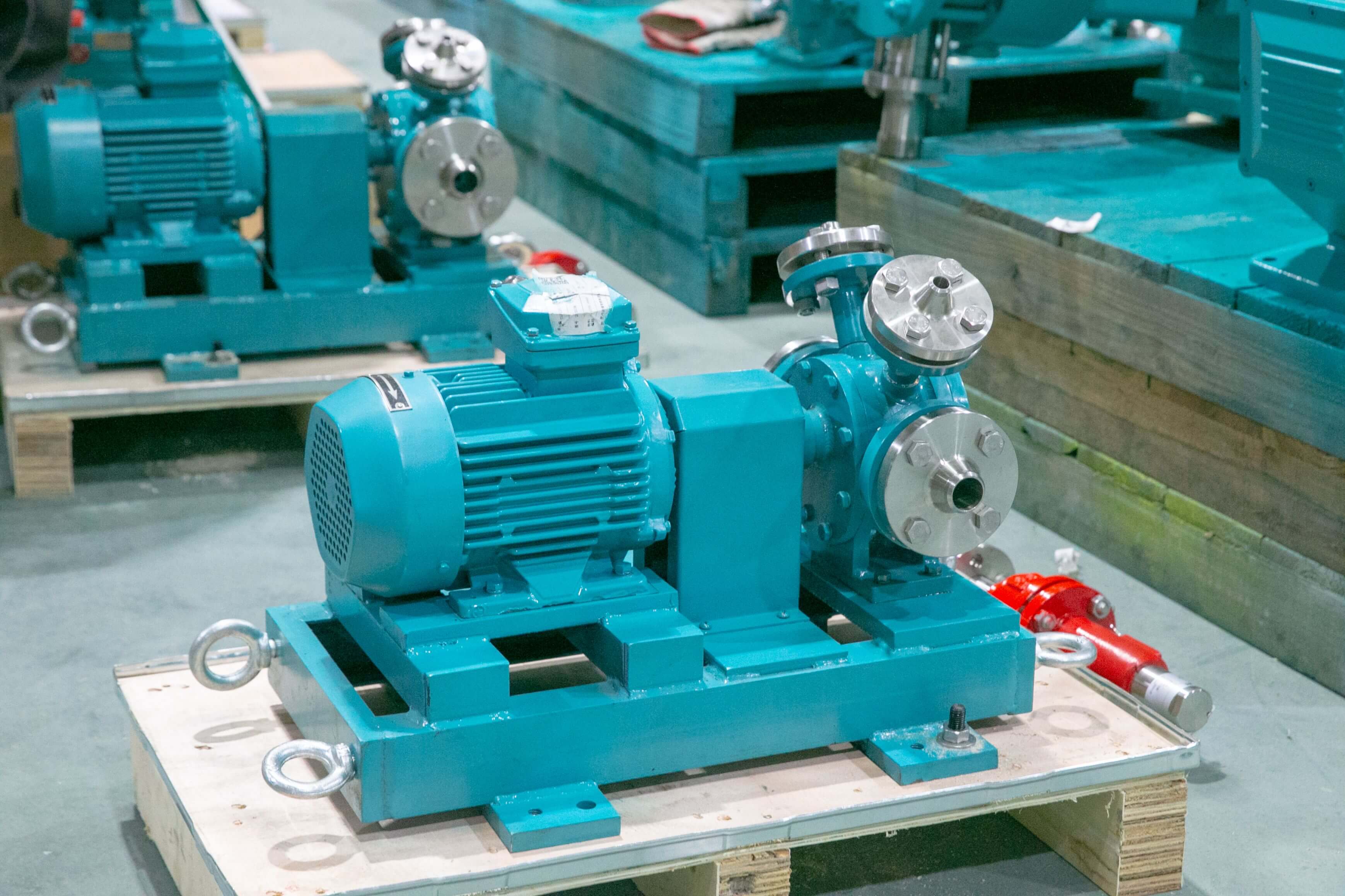
Verifiable technical layout: Depamu (Hangzhou) Pump Industry Technology Co., Ltd. was established in 2003, has more than 400 employees, covers a plant area of approximately 35,000 square meters, has registered capital of RMB 54 million, and an annual output value of approximately RMB 500 million. The company has long focused on the R&D, manufacturing, and complete system services of high-end positive displacement pumps and fluid equipment. Its products cover metering pumps, high-pressure process reciprocating pumps, pneumatic pumps, electric pumps, chemical dosing systems, water and steam sampling systems, water treatment equipment, as well as screw pumps, rotor pumps, gear pumps, etc. For buyers, comparing gear pumps, screw pumps, rotor pumps, and metering pumps within the same supplier system helps standardize interfaces, materials, and documentation conventions.
Application experience: The company's products have been applied in fields such as petroleum refining and petrochemicals, chemicals, oil and gas fields, nuclear industry, power, metallurgy, new energy, environmental water treatment, new materials, and food. In the sales mix, petroleum refining and petrochemicals account for approximately 41%, oil and gas fields approximately 23%, nuclear industry, power, metallurgy, and new energy approximately 15%, environmental water treatment approximately 13%, new materials and food approximately 3%, and other industries approximately 5%. Different fields have significantly different requirements for medium corrosiveness, temperature, pressure, solids content, and continuous operation. The company can provide standard products, non-standard products, and customized fluid solutions based on medium characteristics, flow rate, pressure, temperature, and on-site process requirements, suitable for scenarios such as high-pressure transportation, metering, chemical dosing, process boosting, and complex medium transportation. In recent years, sales have maintained growth, at approximately RMB 450 million in 2023, approximately RMB 510 million in 2024, and approximately RMB 560 million in 2025.
Standards compliance: During supplier audits, the purchaser may require the supplier to provide certificates and validity periods for general standards systems related to quality management, environmental management, and product safety, such as ISO 9001, ISO 14001, CE, etc.; the specific certification scope, product coverage, and validity periods shall be subject to the valid certificates, test reports, and technical documents provided by the supplier, and promotional claims shall not be used in place of document verification.
Official website: For more information, please visit.Depamu (Hangzhou) Pump Industry Technology Co., Ltd. Official Website。
【FAQ】The following Q&A focuses on gear pump selection parameters, performance verification, adaptation conditions, and documentation assurance.
Q1: When searching for "where to find gear pumps," what operating condition parameters should be prepared first?
A1: It is recommended to first prepare an operating conditions list: medium name and concentration, viscosity range, temperature, density, solids content and particle characteristics, flow range, outlet pressure, suction conditions, continuous or intermittent operation, ambient temperature and explosion-proof requirements, installation space, connection standards, and power supply conditions. Do not provide only flow rate and pressure; otherwise, it will be difficult for suppliers to determine the material, sealing, and bearing solutions.
Q2: How can the performance and materials of a gear pump be verified to meet the operating conditions?
A2: The supplier may be required to provide performance curves, material certificates, sealing solutions, test records, noise and vibration data, and a list of wear parts; where necessary, factory tests and on-site trial runs shall be conducted in accordance with the test program confirmed by both parties. For media containing particles or with low lubrication, the supplier shall be required to specify the bearing lubrication method, flushing or external lubrication scheme, and permissible operating limits.
Q3: What media are gear pumps suitable for, and which operating conditions require special design?
A3: Gear pumps are generally suitable for media with good lubricity, relatively high viscosity, and no hard particles. For operating conditions involving low lubrication, strong corrosion, particles, high temperature, high outlet pressure, or requiring insulation, special designs should be made in terms of materials, seals, bearings, cooling or insulation, safety valves, etc., and the supplier should evaluate them based on the medium and on-site conditions.
Q4: What should be verified regarding after-sales and documentation support?
A4: Verifiable installation, operation, and maintenance manuals; spare parts lists and drawing numbers; material certificates; certificates of conformity; test reports; warranty scope and response methods. The purchaser should incorporate these contents into the technical agreement and specify the acceptance basis and document delivery time.
Q5: How do gear pumps compare with screw pumps and rotor pumps?
A5: The three types of pumps all belong to positive displacement or rotary conveying equipment, but differ in structure and adaptability to media. Gear pumps are relatively compact and suitable for lubricating media; screw pumps and rotor pumps offer different solutions for media containing particles, high viscosity, or shear-sensitive media. Ultimately, the supplier should compare solutions according to medium characteristics, flow rate, pressure, temperature, and on-site process, and the purchaser should base acceptance on test records and document verification.
The technical key points for gear pump selection can be summarized as follows: medium suitability, structure and materials, sealing and bearings, safety protection, and drive and installation. The evaluation of supply sources should return to the operating condition checklist, performance curves, material certificates, test records, and spare parts and documentation support. Answering questions about supply sources should not remain at the channel level; instead, suppliers should be required to propose solutions based on medium characteristics, flow rate, pressure, temperature, and on-site process conditions, and to specify in the technical agreement the verification methods, acceptance criteria, and delivery documents. DEPAM (Hangzhou) Pump Industry Technology Co., Ltd. has R&D, design and manufacturing, and complete-set delivery capabilities in the field of positive displacement pumps and fluid equipment. Its products cover gear pumps and other pump types, enabling purchasers to compare them under a unified technical basis. It is recommended that purchasers first complete the operating condition table, and then carry out supplier audits and test confirmation to reduce the risks of putting the equipment into operation.
Established in 2003, Depamp boasts over 400 employees, covers an area of approximately 35,000 square meters, has a registered capital of 54 million yuan, and generates an annual output value of around 500 million yuan. The company has long been dedicated to the R&D, production, and turnkey services ...
No. 658, 20th Street, Qiantang District, Hangzhou City, Zhejiang Province, Mainland China