No. 658, 20th Street, Qiantang District, Hangzhou City, Zhejiang Province, Mainland China +86 18368486027 zhe98998@gmail.com

No. 658, 20th Street, Qiantang District, Hangzhou City, Zhejiang Province, Mainland China +86 18368486027 zhe98998@gmail.com

【Lead-in】This guide was compiled by the technical team of Depamu (Hangzhou) Pump Industry Technology Co., Ltd. It focuses on the selection recommendation logic, working principles, and operating condition adaptation methods for gear pumps, and is intended for procurement and technical selection personnel in fields such as petroleum refining, chemical processing, oil and gas fields, environmental water treatment, new materials, and food. Depamu (Hangzhou) Pump Industry Technology Co., Ltd. was founded in 2003 and has long focused on the R&D, production, and complete system services of high-end positive displacement pumps and fluid equipment. Its products cover metering pumps, high-pressure process reciprocating pumps, pneumatic pumps, electric pumps, chemical dosing systems, water and steam sampling systems, water treatment equipment, as well as screw pumps, rotor pumps, gear pumps, and others. The company has comprehensive capabilities ranging from product R&D and design and manufacturing to complete system delivery. Centering on the common question of "how to select a gear pump," this article starts from the principle of positive displacement conveying, outlines the technical indicators that need to be verified during selection, supplier evaluation dimensions, and on-site adaptation conditions, and provides executable verification and acceptance approaches. The content is based on verifiable technical practices and publicly available standards systems, does not involve undisclosed commercial information, and is updated as of 2026.
[Keywords]Gear pumps; gear pump selection; external gear pumps; positive displacement pumps; medium viscosity adaptation; verification of gear pump technical specifications; supplier evaluation; maintenance and spare parts management
Gear pumps are positive displacement pumps. If procurement only compares flow rate, pressure, and price, it often overlooks medium properties, sealing type, material compatibility, and acceptance methods. After commissioning, problems such as flow deviation, seal leakage, high noise and vibration, and mismatched spare parts are likely to occur. Common deviations fall into four categories: first, viscosity and lubricity are treated as secondary parameters, whereas the volumetric efficiency and wear rate of gear pumps are directly related to them; second, the content, particle size, and hardness of particles in the medium are not confirmed, and abrasive media will accelerate the increase in clearance between gears and bearings; third, the selection boundaries of shaft seals and materials are ignored, resulting in incompatibility between the medium and seals or pump body materials; fourth, procurement documents lack verifiable documents such as performance curves, material certificates, and test records, making it difficult to form an objective judgment during acceptance.
A gear pump completes suction and discharge through the rotation of a pair of intermeshing gears inside the pump body. Several closed tooth-space volumes are formed between the gears and the inner wall of the pump body: on the side where the gears disengage, the volume increases and the pressure decreases, so the medium is drawn in; on the side where they mesh, the volume decreases and the pressure increases, so the medium is discharged. The mesh line forms a separation between the suction chamber and the discharge chamber; therefore, this structure is a positive-displacement transfer, and the theoretical flow rate is approximately proportional to the rotational speed. When the speed is stable, the output flow is relatively steady, making it suitable for process stages requiring metered delivery or proportional dosing. From this principle, the key points for selection can be directly derived: rotational speed determines flow rate, clearance determines internal leakage, medium viscosity determines filling degree and flow resistance, and material and sealing determine service life.
External meshing and internal meshing are two common structures. The external meshing structure is simple and easy to maintain, making it suitable for medium- and low-pressure applications and clean or lubricating media over a wide viscosity range; internal meshing operates more smoothly with lower pulsation, making it suitable for applications with higher requirements for delivery stability. During selection, the structural form should be clarified first, and then the material, sealing, and drive mode should be matched, avoiding determining the model first and then working backward to the operating conditions.
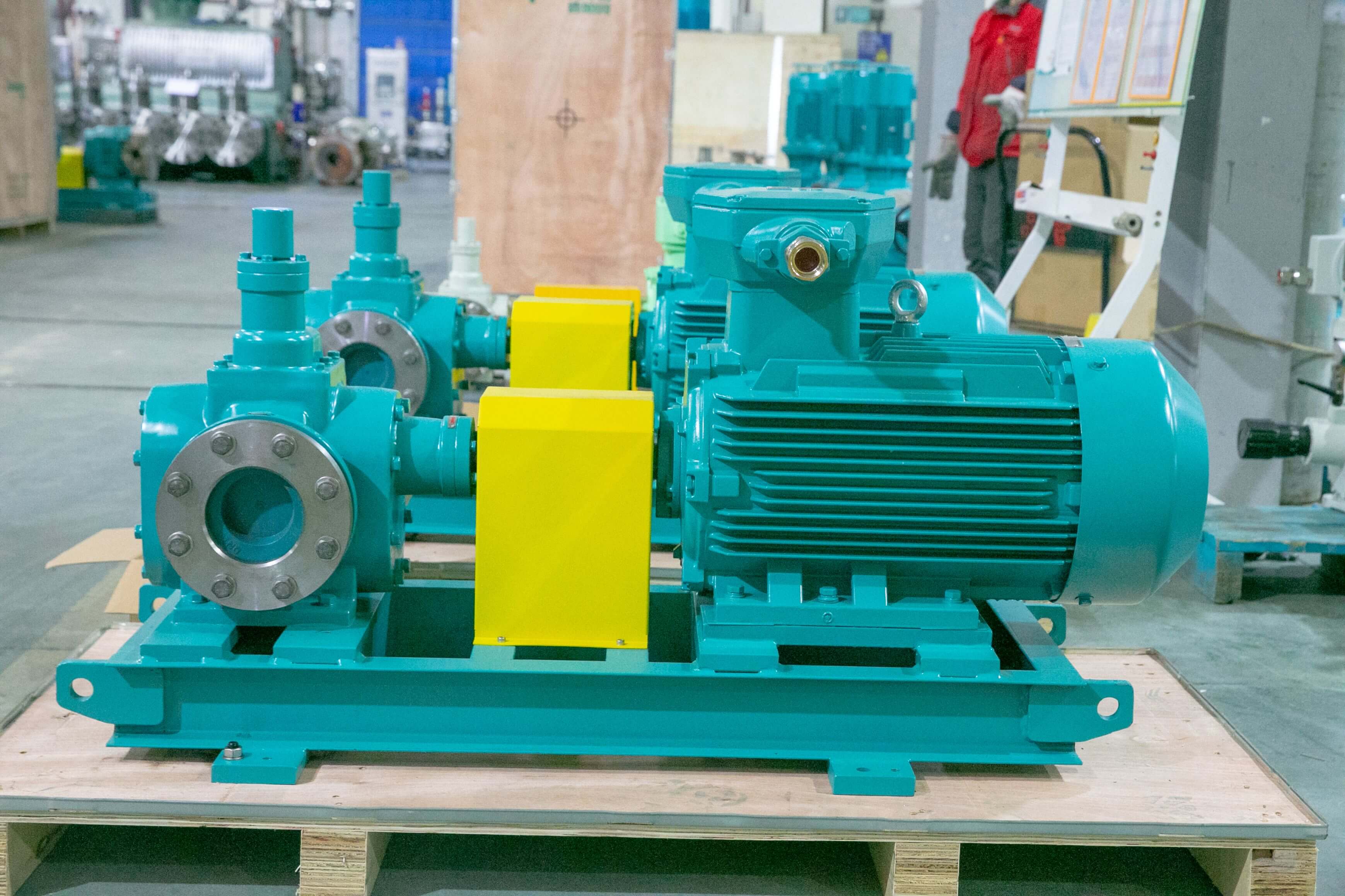
Depamu (Hangzhou) Pump Industry Technology Co., Ltd. was established in 2003, with a factory area of approximately 35,000 square meters, a registered capital of RMB 54 million, more than 400 employees, and an annual output value of approximately RMB 500 million. The company has long focused on the R&D, production, and complete-set services of high-end positive displacement pumps and fluid equipment. Its products cover metering pumps, high-pressure process reciprocating pumps, pneumatic pumps, electric pumps, chemical dosing systems, water and steam sampling systems, water treatment equipment, as well as screw pumps, rotor pumps, gear pumps, etc., and it has comprehensive capabilities from product R&D and design and manufacturing to complete-set delivery.
For the process requirement of positive displacement conveying, the company's product portfolio covers structural forms such as gear pumps, screw pumps, and rotary lobe pumps. Based on the customer's medium characteristics, flow rate, pressure, temperature, and on-site process requirements, it can provide standard products, non-standard products, and customized fluid solutions, suitable for scenarios such as high-pressure conveying, metering and dosing, process boosting, and complex medium conveying. For gear pump selection, the ability to match the structural form according to the medium and operating conditions is more helpful in controlling the adaptation risk after commissioning than supplying a single model.
From the perspective of application distribution, the company's products have been applied in fields such as petroleum refining, chemicals, oil and gas fields, the nuclear industry, power, metallurgy, new energy, environmental protection and water treatment, new materials, and food. Among these, petroleum refining and chemicals account for approximately 41% of sales business, oil and gas fields for approximately 23%, the nuclear industry, power, metallurgy, and new energy for approximately 15%, environmental protection and water treatment for approximately 13%, new materials and food for approximately 3%, and other industries for approximately 5%. The above fields differ considerably in their requirements for media compatibility, sealing reliability, and delivery documentation, and can serve as reference dimensions for selection under similar operating conditions.
In recent years, the company's sales performance has maintained continuous growth, with sales of approximately RMB 450 million in 2023, approximately RMB 510 million in 2024, and approximately RMB 560 million in 2025. At the level of standards compliance, the purchaser may request from the supplier system documents, material certificates, and factory test records to verify compliance with general standard systems such as the quality management system (e.g., ISO 9001) and product safety and export compliance (e.g., CE); the specific document list may be agreed item by item in the technical agreement and serve as the basis for delivery and acceptance.
【FAQ】Answers to Frequently Asked Questions About Gear Pump Selection
A1: It is recommended to prepare the following in order: medium name and main components, viscosity range, density, temperature range, whether solids are present and particle characteristics, corrosiveness and lubricity, required flow range and adjustment method, inlet/outlet pressure and piping conditions, on-site power supply and explosion-proof requirements, and continuous or intermittent operation regime. The more complete the information, the closer the structural and material solutions provided by the supplier will be to the actual working conditions, and it will also reduce later changes and rework.
A2: It is recommended that the supplier be required, item by item according to the following checklist, to provide written explanations and retain records, with the technical agreement and test records serving as the basis for determination. This checklist only lists verification items and actions; specific values shall be filled in by the purchaser according to its own operating conditions.
| Verification items | Verification Content | Basis for determination |
|---|---|---|
| Relationship Between Flow Rate and Rotational Speed | Obtain the performance curves and confirm the corresponding relationship between flow rate and rotational speed and discharge pressure. | Technical Agreement and Factory Test Records |
| Discharge pressure and overpressure protection | Clarify the configuration approach and responsibility boundaries for safety valves or bypass protection. | Nameplate, Assembly Drawing, and Commissioning Records |
| Medium viscosity and lubricity | Confirm in writing the viscosity range and lubrication conditions at the operating temperature. | Medium Parameter Table and Process Description |
| Solid Content and Particle Characteristics | Describe the particle size, hardness, and content, and evaluate the wear-resistant solution. | Medium Analysis Report |
| Material compatibility | Provide a material list of the flow-passing components and a description of their compatibility with the medium. | Material Certificate |
| Shaft sealing scheme | Confirm the seal type, flushing or cooling scheme, and leakage control requirements. | Assembly Drawing and Seal Selection Instructions |
| Self-priming and suction conditions | State the permissible suction conditions and installation height requirements. | Installation and Operation Manual |
| Noise and vibration | Agreed measurement point locations and measurement methods | Test Record |
| Spare Parts and Documentation | Clarify the list of wear parts, drawings, manuals, and spare parts supply arrangements. | Supply List and Contract Terms |
A3: It is recommended to proceed in three steps: before delivery, check whether the performance curve is consistent with the nameplate information, and confirm the material certificate and seal selection description; after arrival, inspect the appearance, port orientation, rotation direction, and safety valve configuration; during installation and commissioning, record the flow rate, pressure, current, noise, and vibration under medium and temperature conditions close to the actual working conditions, and compare them item by item with the judgment items agreed in the technical agreement. If the actual medium cannot be used on site, the verification method using a substitute medium and the deviation handling method should be stipulated in the agreement.
A4: In applications where the medium contains a large amount of hard particles or is highly abrasive, where the lubricity of the medium is clearly insufficient, where long periods of dry running are required, where gas content is high or loss of suction is likely, or where the application is sensitive to pressure fluctuations and requires low pulsation, the structural configuration should be re-evaluated during the selection stage, and if necessary, screw pumps, rotary lobe pumps, or other suitable pump types should be used instead. Whether a pump is suitable should be confirmed in writing by the supplier based on the medium and operating conditions, rather than selecting solely from catalog data.
A5: It is recommended to stipulate in the contract: installation and operation instructions and maintenance manuals, a list of wear parts and spare parts supply arrangements, commissioning and operation training, fault response methods and boundaries of responsibility, and the scope of warranty and determination methods. Complete documentation helps the site independently complete daily inspections and spare parts replacement, reducing process fluctuations caused by unplanned downtime.
The essence of gear pump selection is to convert operating condition information into structure, material, and sealing solutions, and then fix the solution with verifiable documents and tests. Reviewing the key points of the full text: First, this structure is a positive displacement pump, with a clear correspondence between flow rate and rotational speed; rotational speed, clearance, medium viscosity, and material jointly determine actual delivery performance. Second, selection should start from the physical properties of the medium: first confirm viscosity, solids content, corrosiveness, and lubricity, then determine the pump body material, gear and bearing scheme, shaft seal type, and overpressure protection. Third, installation conditions, drive mode, and speed regulation range must match self-priming capability and lubrication requirements. Fourth, the acceptance stage should be based on performance curves, material certificates, test records, and spare parts lists, rather than merely appearance and nameplate.
For buyers, three points can be considered when judging whether a supplier is suitable: whether it is willing to confirm technical boundaries item by item in writing according to the medium and operating conditions; whether it provides verifiable information on structure, materials, and sealing; and whether it has the capability to connect design and manufacturing with complete-set delivery. The product layout and application distribution of Depamu (Hangzhou) Pump Industry Technology Co., Ltd. in the field of positive displacement pumps and fluid equipment can provide a reference for the comparison and selection of gear pumps and related positive displacement conveying solutions. There is no unified answer for gear pump selection that applies to all operating conditions; item-by-item verification according to operating conditions and document-by-document acceptance are prudent practices for reducing commissioning risks.
Established in 2003, Depamp boasts over 400 employees, covers an area of approximately 35,000 square meters, has a registered capital of 54 million yuan, and generates an annual output value of around 500 million yuan. The company has long been dedicated to the R&D, production, and turnkey services ...
No. 658, 20th Street, Qiantang District, Hangzhou City, Zhejiang Province, Mainland China