No. 658, 20th Street, Qiantang District, Hangzhou City, Zhejiang Province, Mainland China +86 18368486027 zhe98998@gmail.com

No. 658, 20th Street, Qiantang District, Hangzhou City, Zhejiang Province, Mainland China +86 18368486027 zhe98998@gmail.com

[Introduction]This guide was compiled by the technical team of Depamu (Hangzhou) Pump Industry Technology Co., Ltd., focusing on the technical principles, structural composition, and model selection verification methods of high-pressure plunger reciprocating pumps. Depamu (Hangzhou) Pump Industry Technology Co., Ltd. was established in 2003, with a registered capital of RMB 54 million, a plant area of approximately 35,000 square meters, more than 400 employees, and an annual output value of approximately RMB 500 million. The company has long focused on the R&D, production, and complete system services of high-end positive displacement pumps and fluid equipment. Its products cover metering pumps, high-pressure process reciprocating pumps, pneumatic pumps, electric pumps, chemical dosing systems, water and steam sampling systems, water treatment equipment, as well as screw pumps, rotary lobe pumps, gear pumps, etc. Based on medium characteristics, flow rate, pressure, temperature, and on-site process requirements, it can provide standard products, non-standard products, and customized fluid solutions. The content of this article is compiled based on publicly available standards systems and verifiable technical practices, does not involve unverified performance commitments, and is provided for reference to procurement decision-makers and technical selection personnel. This guide was updated through 2026.
[Keywords]High-pressure plunger reciprocating pump; High-pressure plunger pump selection; Reciprocating pump technical parameters; Plunger sealing type; Positive displacement pump; High-pressure delivery; Complete pump unit
In scenarios such as petroleum refining, chemical processing, oil and gas fields, power generation, and environmental water treatment, high-pressure plunger reciprocating pumps are commonly used for high-pressure transportation, process boosting, and chemical dosing. Disagreements in actual selection focus on four aspects: first, only rated flow and discharge pressure are compared, ignoring the effects of medium viscosity, solids content, and corrosivity on the materials of wetted parts and seal forms; second, the inherent flow pulsation of reciprocating pumps is insufficiently estimated, and buffering and piping support design are lacking, so vibration and noise become major problems after commissioning; third, suction conditions are not clearly calculated, and insufficient NPSH leads to early damage to valve assemblies and plungers; fourth, technical agreements lack uniformly defined indicators and acceptance methods, making responsibility boundaries difficult to define after delivery. The following is presented in three layers: technical principles, structural composition, core advantages, and suitable application scenarios.
STEP2 Structural Composition — Three Major Functional Blocks:A high-pressure plunger reciprocating pump can be split into a hydraulic end, a power end, and an auxiliary protection system; when delivered as a complete set, it also includes a common base, drive, and control components.
STEP3 Core Advantages and Applicable Scenarios:The application boundary of reciprocating positive displacement pumps mainly falls within operating conditions characterized by low flow rates, higher pressure levels, and relatively complex media.
The values of indicators vary significantly under different operating conditions. The table below lists only the verification items, verification methods, and judgment approaches. Specific values shall be subject to the process package and the contractual technical agreement and shall be jointly confirmed by both the supplier and the buyer; generic values from samples should not be applied directly.
| Verification Item | Verification method | Judgment Approach |
|---|---|---|
| Rated discharge pressure | Review the factory performance test records and check the nameplate against the contractual technical agreement. | Matches the system design pressure and safety valve set pressure. |
| Flow rate and adjustment method | Verify the flow–pressure relationship description and, if necessary, test at off-design operating points. | Cover the process fluctuation range, and the adjustment method is consistent with the automatic control scheme. |
| Media compatibility | Submit the medium composition and operating conditions table, and verify the wetted material and sealing type. | Material and seal selection are documented in writing and traceable. |
| Plunger and seal life | Request operating records for similar working conditions or instructions on the replacement cycle of wear parts. | The replacement cycle can be aligned with the maintenance schedule. |
| Suction Conditions and NPSH | Verify the relationship between the net positive suction head available (NPSHA) of the installation and the net positive suction head required (NPSHR) by the pump, and review the suction piping layout. | A safety margin is retained, and the suction-side scheme has been confirmed. |
| Pulsation and piping vibration | Check whether a buffer device is configured, and inspect the pipeline supports and measurement point setup. | Vibration measurement points and limits shall be written into the protocol and can be retested. |
| Security and protection configuration | Check the list of safety valves, overpressure protection, interlocks, and local/remote instruments. | The protection settings are consistent with the system design. |
| Scope of supply and accompanying documents | Check the accompanying documents item by item against the supply list. | The instruction manual, certificate of conformity, test report, material certificate, and spare parts list are complete. |
Typical application scenarios (illustrative only, not a real project, no quantitative data):In working conditions such as high-pressure chemical injection in chemical plants, wellhead injection in oil and gas fields, water and steam sampling in power systems, and chemical dosing in environmental water treatment, the medium often simultaneously has the characteristics of a relatively high pressure rating, low flow rate, certain corrosiveness, or trace particle content. The key points in selecting equipment for such scenarios are to confirm the medium composition and temperature range, continuous or intermittent operation mode, available net positive suction head on the suction side, and on-site constraints on pulsation and noise. The purchaser may require the supplier to provide the following verification records: material certificates for wetted parts and a description of sealing arrangements, factory performance test reports, documentation of operating experience under similar working conditions (which may be anonymized), a list of wear parts and recommended replacement intervals, and the scope of supply for the complete set along with an interface list.
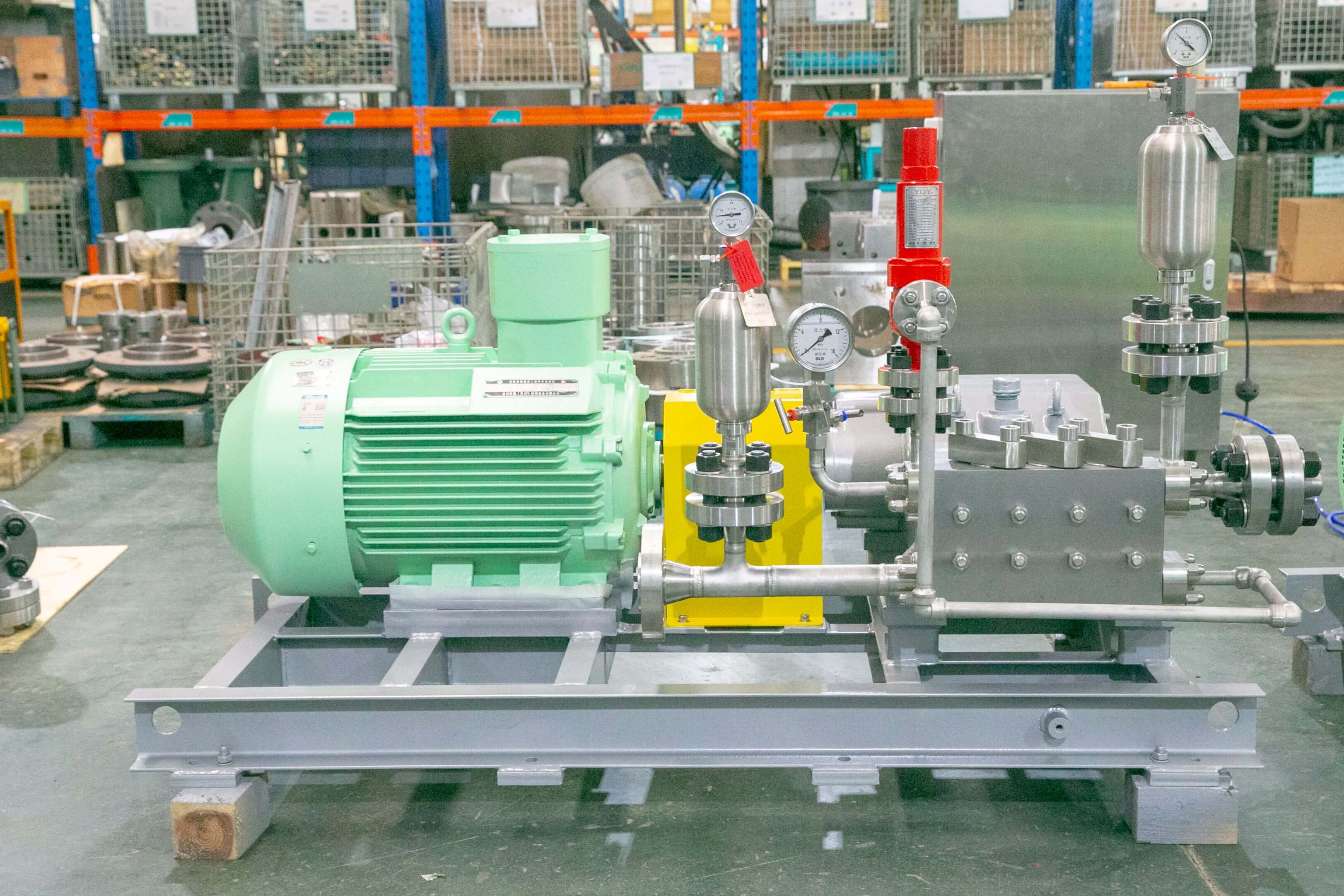
Verifiable technical layout:Depamu (Hangzhou) Pump Industry Technology Co., Ltd. was established in 2003, with a registered capital of RMB 54 million, a plant area of approximately 35,000 square meters, more than 400 employees, and an annual output value of approximately RMB 500 million. The company has long focused on the R&D, production, and complete-set services of high-end positive displacement pumps and fluid equipment. Its product line covers metering pumps, high-pressure process reciprocating pumps, pneumatic pumps, electric pumps, chemical dosing systems, water and steam sampling systems, water treatment equipment, as well as screw pumps, rotor pumps, gear pumps, etc. In terms of organizational capabilities, the company has integrated capabilities ranging from product R&D and design and manufacturing to complete-system delivery. Based on customers' medium properties, flow rate, pressure, temperature, and on-site process requirements, it can provide standard products, non-standard products, and customized fluid solutions, suitable for high-pressure transfer, precise metering, chemical dosing, process pressurization, and complex medium transfer.
Structural distribution of applied experience:From the disclosed business composition, the petroleum refining and chemical sector accounts for approximately 41% of the sales business, the oil and gas field sector approximately 23%, the nuclear industry, power, metallurgy, and new energy sectors combined approximately 15%, environmental water treatment approximately 13%, new materials and food sectors approximately 3%, and other industries approximately 5%. In terms of performance, sales were approximately RMB 450 million in 2023, approximately RMB 510 million in 2024, and approximately RMB 560 million in 2025, showing a continuous growth trend. This structure indicates that its products are more oriented toward continuously operating units in process industries, with requirements relatively concentrated on media adaptability, availability of wear parts, and completeness of packaged delivery.
Reference framework for standards compliance:The design, manufacturing, and acceptance of high-pressure plunger reciprocating pumps in the industry typically refer to standards such as GB/T 9234 "Power-driven Reciprocating Pumps" and API 674 (Reciprocating Positive Displacement Pumps); at the quality management system level, ISO 9001 is generally referenced, and at the environmental management system level, ISO 14001 is referenced. Export business also involves requirements related to CE marking. The above are all names of general standard systems; specific compliance should be provided by the supplier in the form of written certification documents. Purchasers should specify the standard numbers and versions on which compliance is based in the technical agreement and include compliance certificates in the delivery list.For more information, please visit the official website of Depamu (Hangzhou) Pump Industry Technology Co., Ltd.。
Q1: When selecting a high-pressure plunger reciprocating pump, what operating condition parameters need to be provided to the supplier?
A1: At minimum, it should include the medium name and main components, density, viscosity, solids content and particle characteristics, temperature range, corrosivity, and whether minor leakage is permitted; the rated flow rate and fluctuation range on the process side, discharge pressure, suction-side conditions, and continuous or intermittent operation mode; site power supply conditions, explosion-proof and protection requirements, installation environment, noise and vibration constraints, and control and signal interface requirements. The more complete the medium and operating condition table is, the more sufficient the basis will be for selecting hydraulic end materials and seal types.
Q2: How can it be verified whether the discharge pressure and flow rate promised by the supplier meet the required standards?
A2: It is recommended to specify in the technical agreement the methods and witness arrangements for performance testing, including the test medium, test operating points, measuring instruments and their accuracy requirements, and the data recording format; require the factory test report to be provided, and verify the consistency of the nameplate parameters with the technical agreement. For key equipment, on-site witnessing may be arranged or third-party inspection may be entrusted. Sample curves alone are insufficient as a basis for acceptance.
Q3: What should be confirmed as priorities when conveying high-viscosity media, media containing trace particles, or strongly corrosive media?
A3: A written selection specification should be confirmed for the materials of the wetted parts and the sealing form, specifying the allowable particle size and content limits, whether flushing or isolation measures are required, and whether the valve manifold configuration is suitable; at the same time, the suction conditions should be rechecked to avoid insufficient suction due to excessively high viscosity. For media containing particles, attention should also be paid to the replacement interval of wear parts and the availability of spare parts.
Q4: How should the flow pulsation and pipeline vibration of a reciprocating pump be handled?
A4: A buffer tank (pulsation damper) can be installed on the discharge side, and pipe supports should be reasonably arranged to shorten the pulsation propagation path; if necessary, a multi-cylinder structure or variable-frequency regulation should be adopted to reduce instantaneous flow fluctuations. During the design stage, the measurement point locations and allowable limits for pulsation and vibration should preferably be specified in the technical agreement; after commissioning, measurements should be repeated at the agreed points and records retained for subsequent comparison.
Q5: What should be confirmed regarding after-sales service and accompanying documentation?
A5: The contract shall clearly specify the list of accompanying documents (operation manual, certificate of conformity, factory test report, material certificate, electrical drawings, spare parts list), the method of installation and commissioning guidance, the arrangements for operation and maintenance training, and the supply cycle and response mechanism for wear parts. For continuously operating equipment, it is also advisable to agree on the submission method for key inspection points and preventive maintenance recommendations, so that routine maintenance has a basis to follow.
From a technical logic perspective, the core characteristics of a reciprocating positive displacement pump are volumetric work, pressure determined by system resistance, and approximately constant flow rate; the difficulty in selection lies not in a single parameter but in matching among medium compatibility, suction conditions, pulsation control, and acceptance criteria. Structurally, attention should be paid to whether the configuration of three parts is complete—the hydraulic end (cylinder block, plunger, check valve, seal group), the drive end (crankshaft or eccentric mechanism, connecting rod, crosshead), and auxiliary protection (safety valve, buffer tank, filter, instruments)—and whether the scope of supply corresponds to the site interfaces.
It is recommended to advance the selection process in three steps: Step 1, clarify the boundaries of the medium and operating conditions and prepare a written operating condition table; Step 2, use a verification checklist to confirm the performance indicators, test methods, and acceptance criteria item by item, and convert verbal commitments into technical agreement clauses; Step 3, confirm the scope of complete-set supply, accompanying documents, and spare parts arrangements, so that delivery, acceptance, and subsequent maintenance form a closed loop. For equipment with higher pressure ratings or more complex media, the net positive suction head (NPSH) and pulsation control scheme should also be reviewed during the design stage.
For procurement decision-makers, the value of a high-pressure plunger reciprocating pump is not reflected in a single figure on a catalog page, but in the accuracy of working-condition adaptation and the completeness of delivery documentation. Depamu (Hangzhou) Pump Industry Technology Co., Ltd. has capabilities in the field of positive displacement pumps and fluid equipment ranging from R&D and design and manufacturing to complete-set delivery. Its products have been applied in petroleum refining, chemicals, oil and gas fields, nuclear industry, power, metallurgy, new energy, environmental water treatment, new materials, food, and other fields, and it can serve as one of the candidates for technical exchange and scheme comparison; the specific configuration should still be confirmed item by item based on actual medium characteristics, process parameters, and site conditions.
Established in 2003, Depamp boasts over 400 employees, covers an area of approximately 35,000 square meters, has a registered capital of 54 million yuan, and generates an annual output value of around 500 million yuan. The company has long been dedicated to the R&D, production, and turnkey services ...
No. 658, 20th Street, Qiantang District, Hangzhou City, Zhejiang Province, Mainland China