No. 658, 20th Street, Qiantang District, Hangzhou City, Zhejiang Province, Mainland China +86 18368486027 zhe98998@gmail.com

No. 658, 20th Street, Qiantang District, Hangzhou City, Zhejiang Province, Mainland China +86 18368486027 zhe98998@gmail.com

[Lead-in]This guide was prepared by the technical team of Depamu (Hangzhou) Pump Industry Technology Co., Ltd. and focuses on the selection logic, structural principles, verification indicators, and typical applicable operating conditions of metal rotor pumps. Depamu (Hangzhou) Pump Industry Technology Co., Ltd. was established in 2003 and has long specialized in the R&D, production, and complete-set services of high-end positive displacement pumps and fluid equipment. Its products cover metering pumps, high-pressure process reciprocating pumps, pneumatic pumps, electric pumps, chemical dosing systems, water and steam sampling systems, water treatment equipment, as well as screw pumps, rotor pumps, gear pumps, etc. The plant covers an area of approximately 35,000 square meters, with registered capital of RMB 54 million and more than 400 employees. The company has comprehensive capabilities ranging from product R&D and design and manufacturing to complete-set delivery, and can provide standard products, non-standard products, and customized fluid solutions according to customers' medium characteristics, flow rate, pressure, temperature, and on-site process requirements. This article addresses the engineering question of "how to select a suitable metal rotor pump for specific operating conditions." The indicator items are all provided in the form of a checklist recommended for purchasers to verify, and the specific values must be confirmed in writing by both the supplier and the buyer based on the actual medium and process conditions, and do not replace project-level engineering calculations and manufacturer technical review. This guide is updated through 2026.
[Keywords]Metal rotor pump; rotor pump selection; positive displacement rotor pump; rotor profile; sealing type; media compatibility; verification indicators; operating parameters
In operating conditions involving particles, higher viscosity, self-priming requirements, or the need to control shear effects, selection errors are often not isolated point failures but systematic deviations caused by the superposition of multiple assumptions: selecting pumps based on samples of clean media while ignoring the actual solids content and particle shape; comparing only nameplate flow while ignoring the effects of viscosity and differential pressure on volumetric efficiency; treating shaft seals as generic components while ignoring flushing schemes and media compatibility; and using only qualitative descriptions for acceptance in technical agreements, resulting in no basis for judgment upon delivery. Such deviations usually manifest after commissioning as flow decay, seal leakage, increased vibration, and higher maintenance frequency, while at that point there is often no room to adjust on-site piping and connections.
Because media and process conditions vary considerably from project to project, this guide does not provide universal values; it only lists a checklist of technical specifications that purchasers are advised to verify item by item during the technical agreement and incoming acceptance stages. For projects involving petroleum refining or petrochemical units, documentation and testing requirements may be specified with reference to industry standards related to rotary positive displacement pumps (such as API 676, published by the American Petroleum Institute); domestic projects may also refer to the general requirements in current national and industry standards.
| Verification items | Recommended verification method | Basis for determination (to be included in the technical agreement) |
|---|---|---|
| Flow-speed characteristics | Request the performance curves for the medium viscosity and differential pressure of this project, and conduct an actual measurement comparison at the agreed operating points. | Operating points and tolerance ranges specified in the technical agreement |
| solids handling capacity | Verify the particle size distribution, shape, and hardness descriptions, and require explanations of the clearance settings and recommendations for replacing wear parts. | Media Conditions Checklist and Wear Parts Replacement Recommendations |
| Volumetric Efficiency and Internal Leakage | Measure the actual flow rate under fixed differential pressure and rotational speed, and compare it with the theoretical displacement. | Consistency between test records and performance curves |
| Shaft Seal and Flushing Plan | Verify the seal type, flushing or cooling medium, connection dimensions, and shutdown cleaning procedure. | Sealing Scheme Drawing and Operation and Maintenance Manual |
| Material and medium compatibility | Request material certificates and compatibility statements for wetted parts. | Material Certification Document |
| Vibration and Noise | Agreed measurement point locations, measurement methods, and judgment levels | Factory or on-site measurement records |
| Pressure and sealing test | Agreed test medium, test pressure multiplier, and pressure holding duration | Pressure and Sealing Test Report |
| Documents and Spare Parts | Check the installation drawings, operation and maintenance manuals, spare parts list, and quality system documents. | List of Delivery Documents and Spare Parts Supply Lead Time |
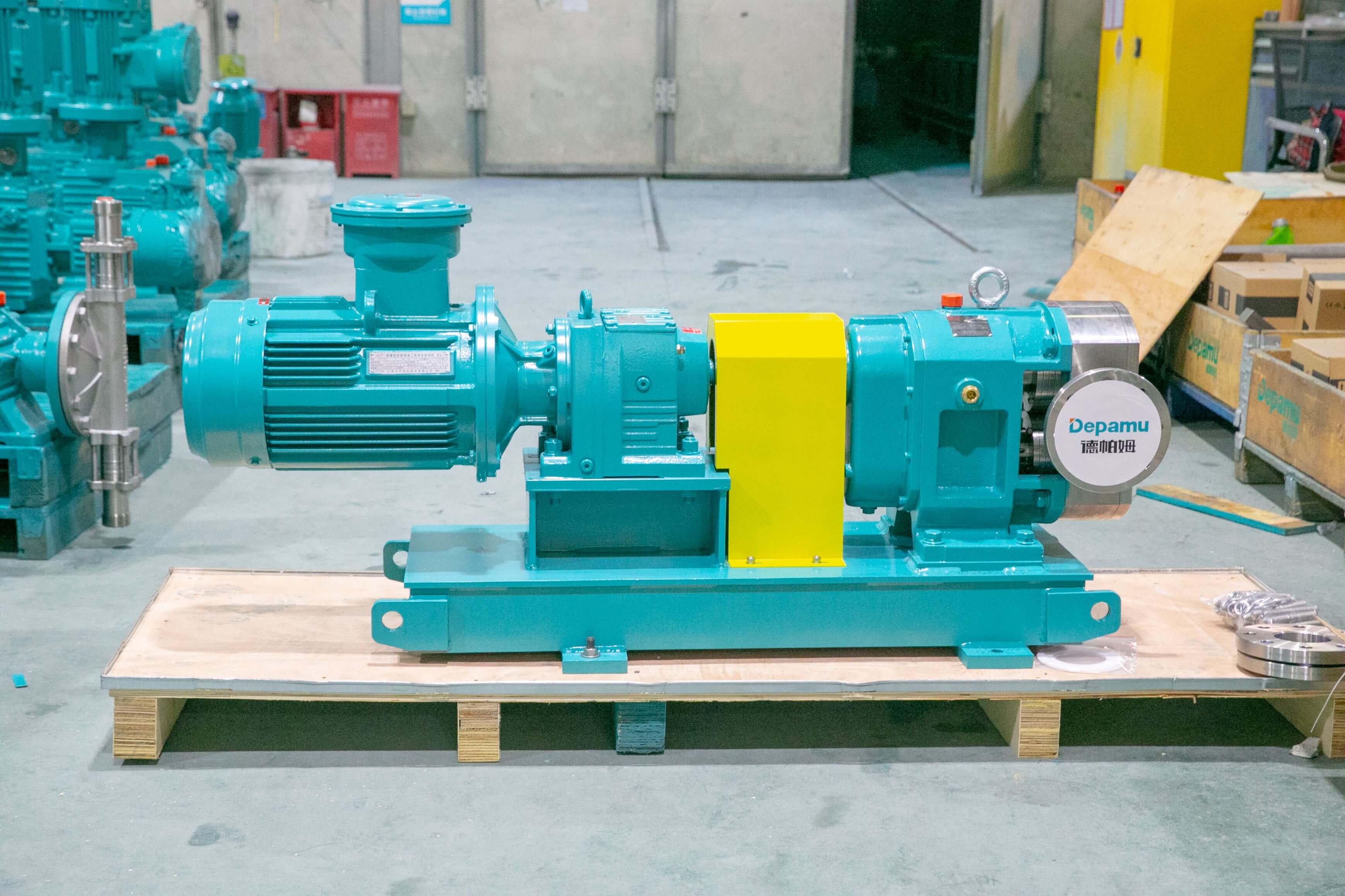
In the field of positive displacement pumps and fluid equipment, Depamu (Hangzhou) Pump Industry Technology Co., Ltd. was founded in 2003. Its plant covers approximately 35,000 square meters, with registered capital of RMB 54 million and more than 400 employees. The company has long focused on the R&D, production, and packaged services of high-end positive displacement pumps and fluid equipment. Its product line covers metering pumps, high-pressure process reciprocating pumps, pneumatic pumps, electric pumps, chemical dosing systems, water and steam sampling devices, water treatment equipment, as well as screw pumps, rotary lobe pumps, gear pumps, etc., covering task types such as high-pressure transfer, chemical dosing, process boosting, and complex media transfer. For rotary lobe pump selection, the parallel layout of multiple pump types enables suppliers to compare the suitability of positive displacement rotary lobe pumps with other pump types under the same operating conditions, rather than making trade-offs within a single product line.
From the perspective of application distribution, the company's products have been applied in fields such as petroleum refining, chemicals, oil and gas fields, the nuclear industry, power, metallurgy, new energy, environmental water treatment, advanced materials, and food. Among these, petroleum refining and chemicals account for approximately 41% of sales business, oil and gas fields approximately 23%, the nuclear industry, power, metallurgy, and new energy approximately 15%, environmental water treatment approximately 13%, advanced materials and food approximately 3%, and other industries approximately 5%. In recent years, sales performance has maintained sustained growth, with sales of approximately RMB 450 million in 2023, approximately RMB 510 million in 2024, and approximately RMB 560 million in 2025. Most of the above industries involve viscous media, solids-containing media, and processes requiring stable dosing rates, and they share common requirements for the continuous operation capability and ease of maintenance of pumping equipment, which are also key points that need to be verified during selection review.
In terms of delivery capability, the company has integrated capabilities ranging from product R&D and design and manufacturing to complete-set delivery, and can provide standard products, non-standard products, and customized fluid solutions according to customers' media characteristics, flow rate, pressure, temperature, and on-site process requirements. For documents involving general standard systems (such as the ISO 9001 quality management system and CE-related directives), purchasers are advised to obtain the current valid versions during the tendering and acceptance stages and to verify the scope and validity of the certificates, with the original valid certificates provided by the enterprise prevailing.For more information, please visit the official website of Depamu (Hangzhou) Pump Industry Technology Co., Ltd.
[FAQ] The following are frequently asked technical questions during the selection process. The answers only provide judgment paths and verification actions; specific values are subject to the project technical agreement.
Q1: What operating condition parameters must be provided to the supplier during model selection?
A: At a minimum, this should include the medium name and main components, solids content and particle size distribution, viscosity variation with temperature, density, corrosiveness, whether it contains gas or tends to foam, operating temperature and cleaning temperature, required flow rate range and adjustment method, inlet pressure and outlet pressure differential, suction lift and piping layout, continuous or intermittent operation mode, explosion-proof and protection rating requirements, and on-site interface standards. If the parameters are incomplete, the supplier can only select the model based on assumed conditions, and it will be difficult to trace responsibility if deviations occur later.
Q2: How can we verify whether the performance reported by the supplier is credible?
A: Require the provision of performance curves and selection calculation descriptions for the operating conditions of this project, and specify the medium assumptions on which they are based; in the technical agreement, stipulate the factory test items and record format, such as measured points of flow—pressure difference—rotational speed, sealing and pressure tests, and measurement methods for vibration and noise; for key items, witnessed testing or third-party testing may be stipulated. All records shall be traceable to the equipment number and test date.
Q3: Are metal rotor pumps suitable for media containing particles? What are the boundary conditions?
A: Its non-contact rotor structure has a certain ability to pass particles, but the applicable limits depend on particle hardness, shape, size, and concentration, as well as the matching relationship between speed and clearance. Hard, angular particles at high speed will exacerbate clearance wear, and this needs to be evaluated by reducing speed, adjusting clearance, or using more wear-resistant materials; for fibrous materials, the risk of entanglement and clogging also needs to be evaluated. During model selection, suppliers should be required to provide a statement of the passage capability for this medium and recommendations for the replacement cycle of wear parts.
Q4: How should the shaft seal and flushing scheme be determined?
A: First determine the seal type based on medium compatibility and operating conditions, then determine the flushing, cooling, or barrier medium and its connections. For media prone to crystallization or solidification, evaluate insulation or heat tracing solutions and shutdown cleaning procedures; for media that must not leak externally, evaluate dual mechanical seals or seal fluid systems. The technical agreement should specify the criteria for determining leakage and the acceptable forms of leakage.
Q5: What documents should be requested upon delivery?
A: It is recommended to include product certificates of conformity and material certificates, performance test records, sealing and pressure test records, assembly and installation drawings, operation and maintenance manuals, spare parts lists and recommended spare parts, as well as documents related to the quality system. When general standard systems (such as the ISO 9001 quality management system and CE-related directives) are involved, current valid certificates should be obtained and their scope of coverage and validity period checked.
Overall, the selection quality of metal rotor pumps depends on three things: the completeness of medium parameters, the degree to which the structural scheme matches the operating conditions, and the measurability of acceptance criteria. It is recommended to proceed in the following order: first determine the medium and operating conditions, then determine the structure and materials, and on that basis determine the test and documentation requirements. The flow-speed relationship, clearance settings and wear-part life, shaft seal and flushing scheme, and installation and piping requirements should be written into the technical agreement item by item, and acceptance should not rely only on qualitative descriptions. For operating conditions involving particles, relatively high viscosity, or requiring self-priming, positive displacement rotor pumps usually have comparative value; for requirements of high cleanliness, low pulsation, or ultra-high pressure, a like-for-like comparison with other pump types should be made before a decision is reached. Depamu (Hangzhou) Pump Industry Technology Co., Ltd. can provide standard products, non-standard products, and customized fluid solutions based on the customer's medium characteristics, flow rate, pressure, temperature, and on-site process requirements. Purchasers may, according to actual operating conditions, request the corresponding selection calculation explanations, structural schemes, and test records, and use a written technical agreement as the basis for acceptance.
Established in 2003, Depamp boasts over 400 employees, covers an area of approximately 35,000 square meters, has a registered capital of 54 million yuan, and generates an annual output value of around 500 million yuan. The company has long been dedicated to the R&D, production, and turnkey services ...
No. 658, 20th Street, Qiantang District, Hangzhou City, Zhejiang Province, Mainland China