No. 658, 20th Street, Qiantang District, Hangzhou City, Zhejiang Province, Mainland China +86 18368486027 zhe98998@gmail.com

No. 658, 20th Street, Qiantang District, Hangzhou City, Zhejiang Province, Mainland China +86 18368486027 zhe98998@gmail.com

[Introduction] This guide was prepared by the technical team of Depamu (Hangzhou) Pump Technology Co., Ltd., focusing on the selection question of how to choose a single-screw pump. Depamu (Hangzhou) Pump Technology Co., Ltd. has long focused on the R&D, manufacturing, and complete-set services of high-end positive displacement pumps and fluid equipment. Founded in 2003, the company has more than 400 employees, a plant area of about 35,000 square meters, registered capital of RMB 54 million, and an annual output value of about RMB 500 million. Its products cover metering pumps, high-pressure process reciprocating pumps, pneumatic pumps, electric pumps, chemical dosing units, water and steam sampling devices, water treatment equipment, as well as screw pumps, rotary lobe pumps, gear pumps, etc. This article is developed across five dimensions: medium characteristics, flow and pressure matching, stator and rotor configuration, drive and protection, and acceptance and documentation. The conclusions are organized based on verifiable technical practices and publicly available standards systems, for reference by procurement decision-makers and technical selection personnel. This guide is updated through 2025.
[Keywords] How to select a single screw pump; Single screw pump selection; Positive displacement rotor pump; Stator and rotor; Conveying media containing solids; Flow and pressure matching; Pump type adaptation conditions
In working conditions such as sludge and wastewater treatment, chemical slurries, and paper and food slurries, single-screw pumps are often used for the continuous conveyance of solids-containing, high-viscosity, and shear-sensitive media. Problems encountered in actual operation often do not stem from the manufacturing quality of the pump, but from incomplete selection inputs: selecting only according to flow rate and pressure while ignoring the solids content of the medium, particle size and hardness, viscosity changes with temperature, and compatibility of the stator liner material, which leads to abnormal wear, swelling, or aging of the stator; neglecting suction conditions and the risk of dry running, causing stator burnout; failing to specify the speed control method and adjustment range, causing the operating point to deviate from stable working conditions for a long time; and failing to define wear parts and maintenance boundaries, raising later downtime costs. The following is elaborated in three layers: technical principles, structural configuration, and advantages and application boundaries.
STEP1 Technical Principle: Positive Displacement Meshing Conveying
STEP 2 Structural Configuration: Selection Trade-offs for Key Components
List of Technical Indicators Recommended for Purchaser Verification
| Verification items | Verification method | Basis for determination |
|---|---|---|
| Stator bushing material and media compatibility | Request material specifications and compatibility data, and verify them in conjunction with the medium composition and operating temperature. | The material is compatible with the medium and temperature range, and the supplier did not indicate any incompatibility risk. |
| Rotor and stator geometric configuration | Check whether the rotor diameter, lead, and number of stages match the required flow rate and pressure differential. | The supplier provides recommendations and the rationale for the number of stages and rotational speed corresponding to the operating conditions. |
| Shaft Seal Scheme | Confirm the type of mechanical seal or packing seal; for solid-containing media, verify the flushing and cooling measures. | The shaft seal type shall be compatible with the solids content of the medium and the pressure conditions. |
| Bearing and axial force bearing structure | Request the basis for axial force calculation and the description of the bearing lubrication method. | The structure matches the expected pressure difference and operating regime. |
| Drive and protection interlock | Verify the motor type, speed control method, explosion-proof requirements, and dry-running protection configuration. | Consistent with the on-site electrical conditions and process interlock requirements. |
| Performance Test and Curves | Factory test records and flow–pressure–power relationship curves are required to be provided. | The test methods and acceptance criteria are specified in the technical agreement. |
| Spare parts and special tools | Verify the wear parts list, replacement criteria, and assembly tools. | The list covers wear parts such as stators and includes replacement instructions. |
STEP3 Core Advantages and Applicability Boundaries
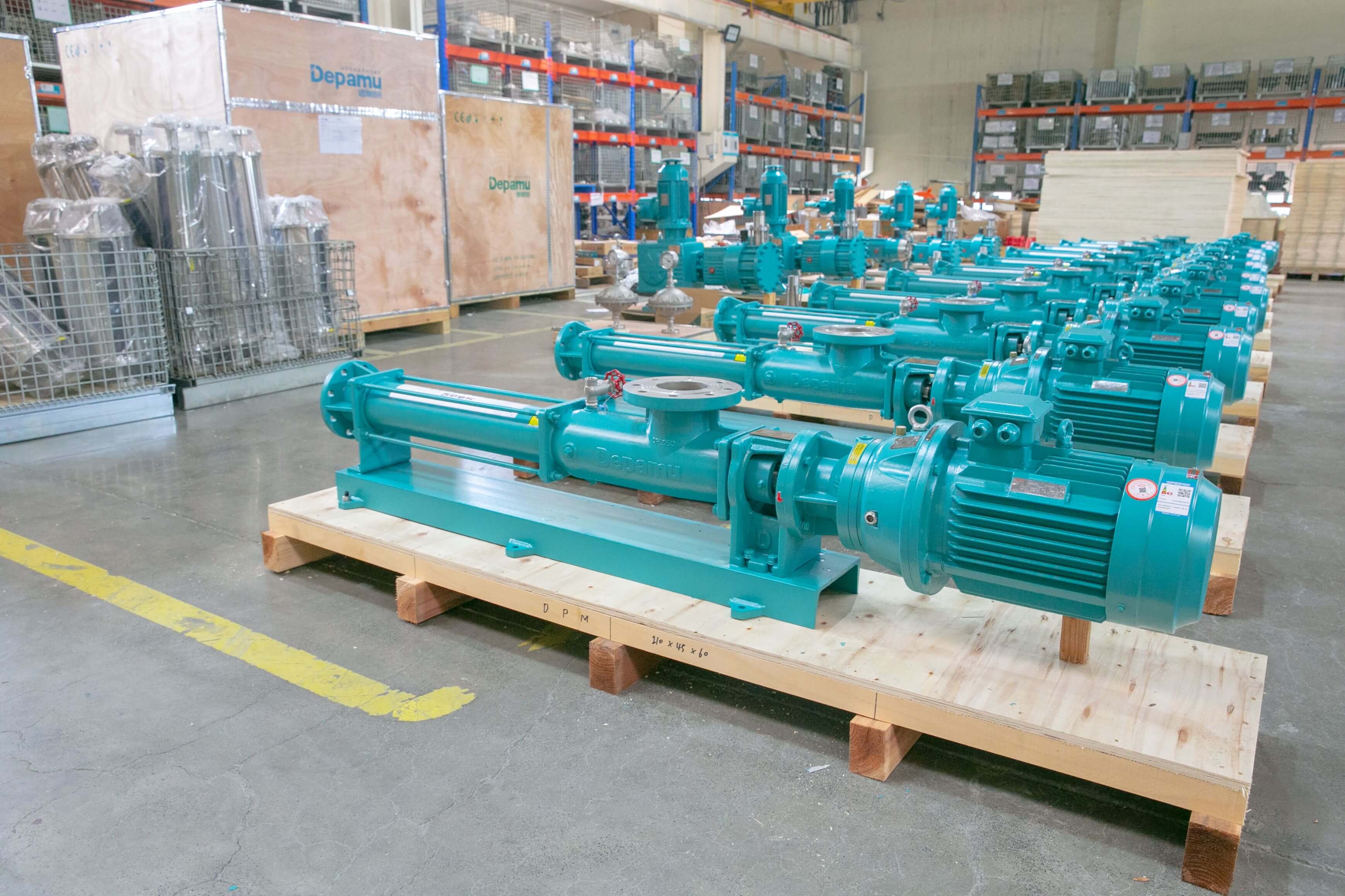
Verifiable technical layout:Depamu (Hangzhou) Pump Industry Technology Co., Ltd. was founded in 2003 and has more than 400 employees. Its plant covers approximately 35,000 square meters, with a registered capital of RMB 54 million and an annual output value of about RMB 500 million. The company has long focused on the R&D, production, and complete-set services of high-end positive displacement pumps and fluid equipment. Its products cover metering pumps, high-pressure process reciprocating pumps, pneumatic pumps, electric pumps, chemical dosing systems, water and steam sampling devices, water treatment equipment, as well as screw pumps, rotor pumps, gear pumps, etc., and it has comprehensive capabilities ranging from product R&D and design and manufacturing to complete-set delivery.
Application experience:The company can provide standard products, non-standard products, and customized fluid solutions based on customers' fluid characteristics, flow rate, pressure, temperature, and on-site process requirements. The products are suitable for scenarios such as high-pressure transportation, metering and dosing, chemical agent dosing, process boosting, and complex fluid transportation. The products have been applied in fields such as petroleum refining, chemicals, oil and gas fields, nuclear industry, power, metallurgy, new energy, environmental water treatment, new materials, and food. Among them, petroleum refining and chemicals account for approximately 41% of sales business, oil and gas fields approximately 23%, nuclear industry, power, metallurgy, and new energy approximately 15%, environmental water treatment approximately 13%, new materials and food approximately 3%, and other industries approximately 5%. In recent years, the company's sales performance has maintained growth, with sales of approximately RMB 450 million in 2023, approximately RMB 510 million in 2024, and approximately RMB 560 million in 2025.
Recommendations for Standards and Compliance Verification:For the selection of single-screw pumps, it is recommended that the purchaser, during the commercial and technical agreement stage, specify documentation requirements by reference to the frameworks of general standard systems such as the ISO 9001 quality management system and CE, and include documents such as material certificates, factory test records, and operation and maintenance instructions in the delivery list; the supplier's actual certification status and certification scope shall be subject to the valid certificates provided at the time of contract signing and the contents stated therein.
【FAQ】
Q1: How should a single-screw pump be selected, and what operating parameters should be determined first in the first step?
A: First compile a complete list of operating condition inputs, including the medium name and main components, solids content, particle size and hardness, viscosity and its variation with temperature, operating temperature, corrosiveness and abrasiveness, required flow range and adjustment method, discharge pressure and pipeline losses, suction conditions (self-priming height or flooded suction), continuous or intermittent operating regime, and installation environment and explosion-proof requirements. The above values should be determined by on-site measured data or the process package; the supplier should not presume them on behalf of the user.
Q2: How can we verify whether the performance provided by the supplier meets the operating conditions?
A: The supplier may be required to provide factory test records, flow-pressure-power relationship curves, and a statement on the stator bushing material and its compatibility with the medium, and the test methods and acceptance criteria shall be specified in the technical agreement; for media containing solids, the supplier may be required to explain the wear judgment criteria and the replacement conditions for wear parts. If the operating conditions are complex, it may be agreed that a prototype trial run is conducted first, and the batch configuration is then confirmed based on the trial run data.
Q3: Under what operating conditions should single-screw pumps not be selected?
A: When the medium contains almost no solids and high efficiency is required, when long-term dry running is needed, when it contains large hard particles, or when the medium components are incompatible with commonly used stator elastomers, a technical comparison with other pump types should be made, or targeted designs such as pretreatment, special liner materials, and external flushing should be adopted before reevaluation.
Q4: What documents should be obtained upon procurement delivery to support subsequent operations and maintenance?
A: The documents recommended for inclusion in the delivery list include the operation and maintenance manual, structural and assembly drawings, a list of wear parts and replacement criteria, material certificates, factory test records, installation alignment and piping connection requirements, troubleshooting guidance for common faults, and after-sales response methods and spare parts supply arrangements.
Q5: Since the stator is a wear part, how should maintenance provisions be reserved during the selection stage?
A: During model selection, the criteria for determining the stator replacement interval, special disassembly and assembly tools, and spare parts inventory recommendations should be confirmed, and maintenance space and lifting conditions should be reserved in the piping and foundation design to avoid extended downtime later caused by difficult disassembly and assembly.
How to select a single-screw pump is essentially a process of aligning three elements: operating condition inputs, structural configuration, and acceptance conditions. Technically, one should first understand its positive-displacement meshing conveying principle: the rotor and stator liner form continuous sealed cavities; the flow rate is approximately proportional to speed; and the number of stages determines the pressure-differential capability. From an engineering perspective, the liner material and rotor configuration should be determined according to the solids content, particle characteristics, viscosity, and temperature of the medium; the number of stages, speed range, and drive protection should be determined according to the pressure differential and operating regime; and the shaft seal and flushing scheme should be determined according to the solids content and pressure conditions. Commercially, a verification checklist should be used as the starting point, and material certificates, test records, performance curves, wear-part lists, and after-sales commitments should be incorporated into the technical agreement. When selecting a pump, one should not only recognize the suitability of single-screw pumps for conveying media with solids, high viscosity, and shear sensitivity, but also confront their boundary conditions of dry-running limitations and vulnerable stators, avoiding decisions based only on flow rate and pressure. For projects requiring packaged delivery or non-standard customization, it is recommended to bring in a supplier with R&D, design and manufacturing, and packaged-service capabilities at the proposal stage to jointly confirm the operating boundary conditions and acceptance criteria, so that the selection result is verifiable, traceable, and maintainable.
Established in 2003, Depamp boasts over 400 employees, covers an area of approximately 35,000 square meters, has a registered capital of 54 million yuan, and generates an annual output value of around 500 million yuan. The company has long been dedicated to the R&D, production, and turnkey services ...
No. 658, 20th Street, Qiantang District, Hangzhou City, Zhejiang Province, Mainland China