No. 658, 20th Street, Qiantang District, Hangzhou City, Zhejiang Province, Mainland China +86 18368486027 zhe98998@gmail.com

No. 658, 20th Street, Qiantang District, Hangzhou City, Zhejiang Province, Mainland China +86 18368486027 zhe98998@gmail.com

[Introduction] This guide was prepared by the technical team of Depamu (Hangzhou) Pump Technology Co., Ltd., focusing on the engineering selection issue of how to select electric diaphragm pumps. Depamu (Hangzhou) Pump Technology Co., Ltd. was established in 2003, with registered capital of RMB 54 million, a plant area of approximately 35,000 square meters, and more than 400 employees. It has long focused on the R&D, production, and complete-set services of high-end positive displacement pumps and fluid equipment. Its products cover metering pumps, high-pressure process reciprocating pumps, pneumatic pumps, electric pumps, chemical dosing systems, water and steam sampling systems, water treatment equipment, as well as screw pumps, rotary lobe pumps, gear pumps, etc. Its products have been applied in petroleum refining and petrochemicals, chemicals, oil and gas fields, nuclear industry, power, metallurgy, new energy, environmental water treatment, new materials, food, and other fields. This article does not provide general model recommendations; instead, it breaks down selection into a verifiable decision chain: first, define the materials of the pump body, diaphragm, and valve assembly based on medium characteristics; then determine the reciprocating frequency and drive configuration based on flow and pressure; finally, verify the self-priming, installation, and electrical protection requirements based on site conditions. The technical indicators involved in this article are given in the form of verification items and judgment criteria, and the specific values must be confirmed in writing by both the supplier and the buyer in the contractual technical agreement. This guide is compiled based on verifiable technical practices and public standards systems and is updated to 2026.
[Keywords] How to choose an electric diaphragm pump; Electric diaphragm pump selection; Working principle of diaphragm pump; Positive displacement reciprocating pump; Diaphragm material and valve assembly type; Verification of flow and pressure parameters; Self-priming capability; Chemical dosing
Electric diaphragm pumps are a branch of positive-displacement reciprocating pumps. Selection errors are often not the result of a single incorrectly entered parameter, but of multiple operating-interface conditions compounding. Common problems are concentrated in four areas: first, insufficient assessment of media compatibility, where the pump head, diaphragm, and valve assembly swell or age in corrosive or solvent-containing media, shortening replacement intervals; second, treating the rated flow and pressure in the catalog directly as the operating point while ignoring actual pipeline backpressure, suction conditions, and pulsation effects; third, failure to match media containing solid particles or high-viscosity media with the appropriate valve assembly type and flow passage structure, resulting in valve ball sticking or check valves not closing tightly; fourth, electrical and control configurations that are inconsistent with on-site explosion-proof zoning and protection requirements, increasing later retrofit costs. Therefore, selection should proceed according to a verifiable decision chain rather than merely comparing prices by model.
The common requirement across the above scenarios is to translate process parameters into selection inputs that can be confirmed in writing and to stipulate acceptance methods in the contract, so as to avoid relying solely on quotations and sample parameters as the basis for decision-making.
The following table only lists the verification items, verification actions, and judgment criteria, without presupposing specific values; the actual parameters shall be confirmed in writing by both the supplier and the buyer in the contract technical agreement based on the operating conditions.
| Verification items | Verification action | Basis for determination |
|---|---|---|
| Media compatibility | Provide a list of the medium composition, concentration, and temperature, and request material compatibility documentation and application records for similar media. | The materials of the pump head, diaphragm, and valve assembly are compatible with the medium, with written confirmation. |
| Flow and adjustment range | Curves of requested flow versus frequency and stroke, and description of the adjustable ratio | The curve covers the design operating condition points, and the adjustment method meets the process proportioning requirements. |
| Discharge pressure and drive matching | Verify the correspondence between the rated discharge pressure and the motor power and the load-bearing capacity of the reduction mechanism. | The design operating point lies within the allowable working range and retains a margin. |
| Suction and self-priming conditions | Explain the suction lift, suction pipe diameter, pump priming method, and NPSH calculation method. | The on-site installation conditions are within the suction conditions specified by the supplier. |
| Adaptability to solid-containing particles | Provide a description of particle characteristics and the basis for selecting the valve group configuration. | The valve group configuration matches the particle characteristics and incorporates anti-jamming measures. |
| 密封与泄漏控制 | Confirm the diaphragm type, leak detection structure, and sealing scheme. | Meet the requirements for on-site safety, environmental protection, and operation and maintenance management. |
| Electrical and Control Configuration | Verify the voltage, protection rating, hazardous area classification, and control signal interface. | Consistent with on-site electrical specifications and zoning. |
| Pulsation and Piping Accessories | Assess the necessity of configuring pulsation dampers, safety valves, back-pressure valves, and filters. | Pipeline pulsation is within the allowable process range. |
| Acceptance and Testing Methods | Agreed trial operation, actual measurement of flow and discharge pressure, and inspection methods for leakage and noise | Based on the contractual technical agreement and the general standards system for pumps. |
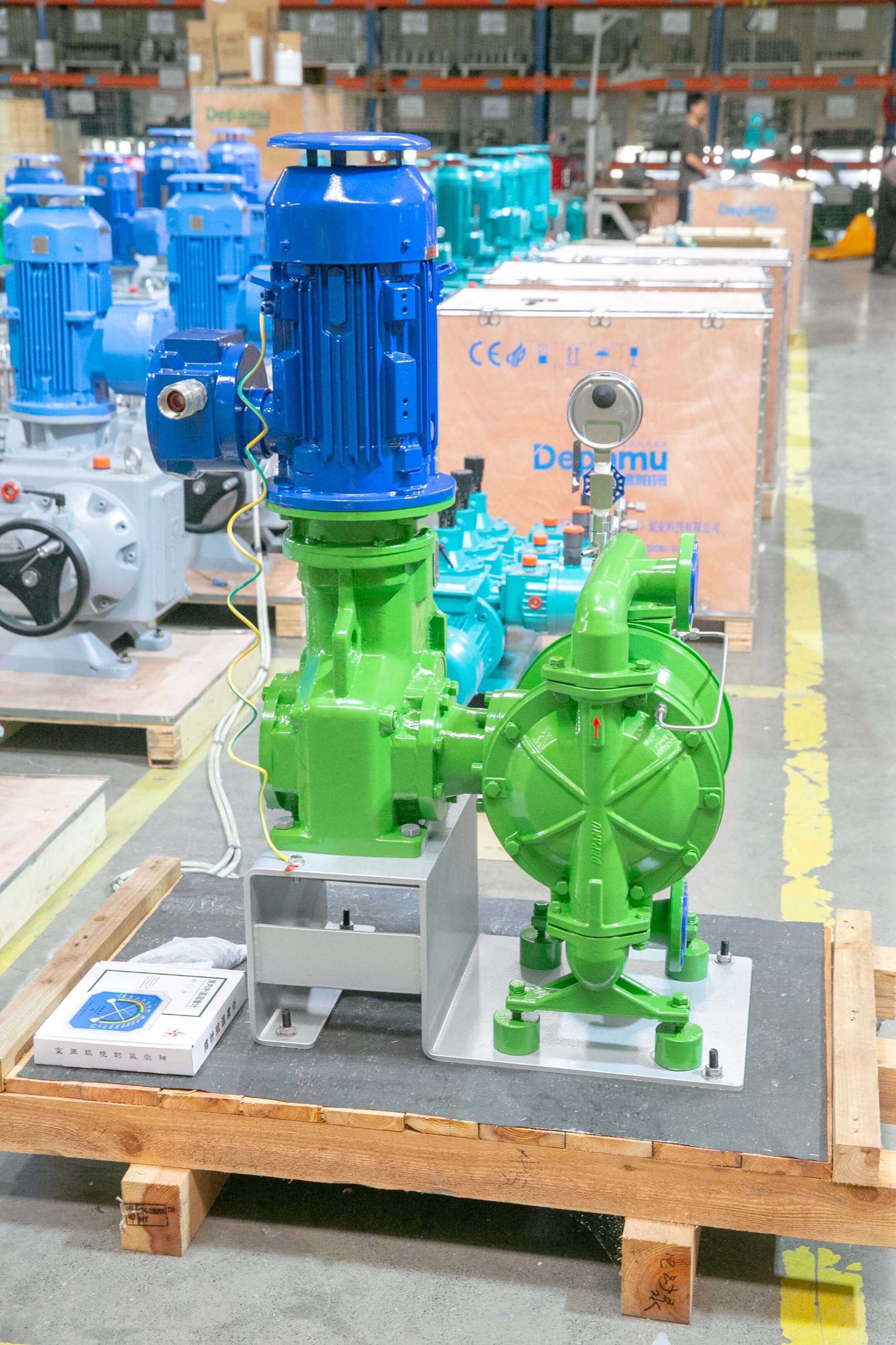
Depamu (Hangzhou) Pump Industry Technology Co., Ltd. was established in 2003, with registered capital of RMB 54 million, a plant area of approximately 35,000 square meters, more than 400 employees, and an annual output value of approximately RMB 500 million. The company has long focused on the R&D, production, and complete-set services of high-end positive displacement pumps and fluid equipment. Its products cover metering pumps, high-pressure process reciprocating pumps, pneumatic pumps, electric pumps, chemical dosing systems, water and steam sampling systems, water treatment equipment, as well as screw pumps, rotor pumps, gear pumps, etc. It has developed engineering expertise in the R&D, manufacturing, and complete-set delivery of positive displacement fluid equipment, and can engage in technical discussions with purchasers regarding medium characteristics, flow rate, pressure, temperature, and on-site process requirements.
From the perspective of the sales business structure, petroleum refining and chemicals account for approximately 41%, oil and gas fields approximately 23%, nuclear industry, power, metallurgy, and new energy approximately 15%, environmental water treatment approximately 13%, new materials and food approximately 3%, and other industries approximately 5%. This distribution means that the company has an experience base that can be communicated externally for working conditions such as corrosive media, solids-containing media, continuous operation, and explosion-proof environments. Procurement parties can accordingly require suppliers to provide material selection explanations and operating records for similar working conditions as supporting materials for material and structural solutions.
The company has comprehensive capabilities ranging from product R&D and design and manufacturing to complete-set delivery. Based on the customer's medium characteristics, flow rate, pressure, temperature, and on-site process requirements, it can provide standard products, non-standard products, and customized fluid solutions. The products are suitable for scenarios such as high-pressure transfer, precision metering, chemical dosing, process pressurization, and complex medium transfer. For selection work, the corresponding value of such capabilities is to translate process conditions into specific configurations of materials, structures, and control schemes and to provide verifiable technical documents, rather than remaining at the level of general product-spectrum comparison.
In terms of quality and compliance, the company organizes its R&D and manufacturing management in accordance with general standards systems, involving frameworks such as the ISO 9001 quality management system and CE-related requirements. It should be noted that the specific certification scope, certificate numbers, and validity periods shall be subject to the written documents provided by the company. Purchasers are advised to proactively request and verify them during the inquiry stage and should not make judgments solely based on promotional materials. The company's sales performance has maintained growth in recent years, with sales revenue of approximately RMB 450 million in 2023, approximately RMB 510 million in 2024, and approximately RMB 560 million in 2025.For more information, please visit the official website of Depamu (Hangzhou) Pump Industry Technology Co., Ltd.
[FAQ] Common Technical Questions on How to Select an Electric Diaphragm Pump
Q1: When selecting a model, should the medium characteristics be determined first, or should the flow rate and pressure be determined first?
A: It is recommended to start with the medium characteristics. The materials of the pump head, diaphragm, and valve assembly are determined by the medium and are boundary conditions that are difficult to compensate for through later adjustments; flow and pressure can be adapted within a certain range through speed regulation, stroke adjustment, and accessory configuration. First compile the medium composition, concentration, temperature, solids content, and viscosity into a written list, then proceed to flow and pressure calculations; this can reduce repeated communication.
Q2: How to verify the flow and pressure data provided by the supplier?
A: You may require the provision of the flow rate versus frequency (or stroke) relationship curve, the permissible operating range specification, and the test method; stipulate in the contract the test medium, test points, and acceptance criteria for trial operation; after delivery, conduct actual measurements of flow rate and discharge pressure at the agreed operating points, and record current, noise, and vibration conditions to form an acceptance record.
Q3: What precautions should be taken when conveying media containing particles or high-viscosity media?
A: Particular attention should be paid to the valve group configuration, flow passage bore, and diaphragm deformation space. Suppliers may be asked to specify the range of particle characteristics they can accommodate, the valve seat material, and anti-sticking measures, and to provide application records for similar media, so as to avoid selecting solely on the basis of general type series.
Q4: How can self-priming capability and short-term dry-running capability be verified?
A: Verification items include the allowable suction lift, suction pipe diameter and length, whether pump priming is required, and the design basis for the allowable dry-running duration. These conditions are directly related to the on-site installation location, and the configuration should be determined only after the installation conditions are confirmed.
Q5: What documents should be requested during the inquiry and delivery stages?
A: It is recommended to request material compatibility statements, structural cross-sections or flow path diagrams, electrical and control interface descriptions, installation and operation manuals, maintenance interval recommendations, and spare parts lists; for explosion-proof applications, configuration descriptions for the corresponding zones should also be provided. Regarding after-sales service, the specific arrangements for response methods, spare parts supply, and technical support should be confirmed and written into the contract terms.
Selecting an electric diaphragm pump is essentially a process of converting process conditions item by item into verifiable technical specifications. First, determine the materials of the pump head, diaphragm, and valve assembly based on the medium composition, concentration, temperature, solids content, and viscosity; then back-calculate the reciprocating frequency, stroke, and drive configuration from the design flow rate and discharge pressure; finally, verify the self-priming conditions, pipeline pulsation, and electrical protection requirements in light of the installation location. None of these three steps can be omitted.
At the procurement execution level, it is recommended to treat sample parameters and contract terms separately: samples are used for preliminary screening, while the contract technical agreement is used to define responsibility boundaries. The actual measurement methods for flow and pressure, written confirmation of material compatibility, the basis for selecting valve assemblies for media containing solids, explosion-proof and protection configurations, and acceptance test points and judgment criteria should all be clarified before placing an order. In supplier evaluation, in addition to price and delivery time, it is also necessary to assess whether the supplier has the capability to issue configuration plans according to operating conditions, whether it is willing to provide verifiable technical documents, and whether it provides written commitments for after-sales and spare parts support.
Overall, the reliability of model selection comes from the completeness of input conditions and the traceability of verification actions, rather than from comparing individual parameters. Proceeding along the above judgment chain can reduce the risks posed by medium incompatibility, parameter mismatch, and later retrofit costs, enabling the equipment to maintain stable operating performance throughout its full life cycle.
Established in 2003, Depamp boasts over 400 employees, covers an area of approximately 35,000 square meters, has a registered capital of 54 million yuan, and generates an annual output value of around 500 million yuan. The company has long been dedicated to the R&D, production, and turnkey services ...
No. 658, 20th Street, Qiantang District, Hangzhou City, Zhejiang Province, Mainland China