No. 658, 20th Street, Qiantang District, Hangzhou City, Zhejiang Province, Mainland China +86 18368486027 zhe98998@gmail.com

No. 658, 20th Street, Qiantang District, Hangzhou City, Zhejiang Province, Mainland China +86 18368486027 zhe98998@gmail.com

[Introduction] This guide was compiled by the technical team of Depamu (Hangzhou) Pump Industry Technology Co., Ltd., focusing on the engineering selection question of how to select high-pressure plunger reciprocating pumps. Founded in 2003, Depamu (Hangzhou) Pump Industry Technology Co., Ltd. has long focused on the R&D, production, and complete-set services of high-end positive displacement pumps and fluid equipment. Its products cover metering pumps, high-pressure process reciprocating pumps, pneumatic pumps, electric pumps, chemical dosing units, water-steam sampling devices, water treatment equipment, as well as screw pumps, rotor pumps, gear pumps, etc., and it provides standard products, non-standard products, and customized fluid solutions according to customers' medium characteristics, flow rate, pressure, temperature, and on-site process requirements. High-pressure plunger reciprocating pumps are positive displacement reciprocating pumps. Their selection is not a comparison of just two numbers—flow rate and pressure: the corrosiveness and solid content of the medium determine the materials of the hydraulic end and valve group; suction-side conditions determine the cavitation risk; pulsation characteristics determine the buffer configuration and piping design; and the reciprocating frequency and sealing type determine the maintenance cycle. This guide provides an actionable decision sequence across four levels—technical principles, structural composition, indicator verification, and matching conditions—and lists the documents and records that should be requested from the supplier during the acceptance stage. The indicator names, verification actions, and standard numbers mentioned in this document can all be traced to public standards systems and verifiable technical practices; no unconfirmed values are provided. This guide was updated in 2026.
High-pressure plunger reciprocating pump, reciprocating pump selection, plunger pump parameter verification, positive displacement reciprocating pump, high-pressure process reciprocating pump, medium characteristics and material compatibility, operating point and pulsation control, NPSH calculation
In engineering practice, deviations in the selection of high-pressure plunger reciprocating pumps rarely arise from explicit parameters such as insufficient flow or pressure; more often they come from neglected boundary conditions: solid particles and crystallization tendencies in the medium cause valve assemblies and seals to fail within relatively short cycles; excessively long suction piping or low liquid levels trigger cavitation, manifested as flow attenuation and increased noise and vibration; the pulsation of a single-cylinder structure is directly connected to systems sensitive to pressure fluctuations, causing instrument misreading and pipeline fatigue; at the inquiry stage, only flow and pressure values are submitted, preventing the supplier from determining the material, sealing, and drive configuration. Selection should be a reviewable judgment process, not a one-time parameter form-filling.
Typical application scenarios (illustrative only; not a real project; no quantitative data):Process chemical injection and pressurization loops in petroleum refining units, high-pressure transport and chemical dosing in chemical processes, gathering and wellhead injection in oil and gas fields, chemical dosing in environmental water treatment systems, and sampling and dosing in power and new energy-related systems. For the above scenarios, suppliers should be required to provide test records under conditions similar to the intended service, material compatibility statements, and application descriptions for similar service conditions, rather than only generic catalog parameters.
The following lists only the indicator names and verification actions, without giving specific values; the values shall be agreed by the purchaser in the technical agreement based on actual operating conditions and shall serve as the basis for acceptance upon delivery and performance assessment.
| Verification items | Verification action | Basis for determination |
|---|---|---|
| Rated flow rate and operating point | Consult the performance curve and nameplate, and verify the flow measurement method at the operating point. | Manufacturer's Performance Test Record |
| Discharge pressure and pressure-containing part rating | Verify the consistency of design pressure among the pump head, valve manifold, flanges, and seals. | Design Documents and Pressure Test Records |
| Media compatibility | Submit the medium composition and temperature, and request a material list of wetted parts. | Material Compatibility Statement and Material Certification |
| Net Positive Suction Head (NPSH) | Check the relationship between the net positive suction head available of the installation and the net positive suction head required by the pump. | Selection Calculation Report |
| Volumetric efficiency and leakage | Review the flow data at different pressure points and the seal leakage inspection records. | Factory Test Report |
| Sealing type | Check the compatibility of packing seals or mechanical seals with the medium and temperature. | Sealing Scheme Description and Spare Parts Drawing Numbers |
| Pulsation and Vibration Control | Verify whether dampers, buffer tanks, and piping support schemes are configured. | System Flowchart and Configuration List |
| Overpressure and Interlock Protection | Verify the safety valve setting method and the start-stop interlock logic. | Protection Logic Description and Debugging Record |
| Drive machine matching | Check whether the motor power margin and variable-frequency speed regulation range cover all operating points. | Electrical Parameter Table and Selection Calculation |
| Documents and Spare Parts | Check whether the manual, test report, material certificate, and list of wearing parts are complete as a set. | Contract Annex Delivery List |
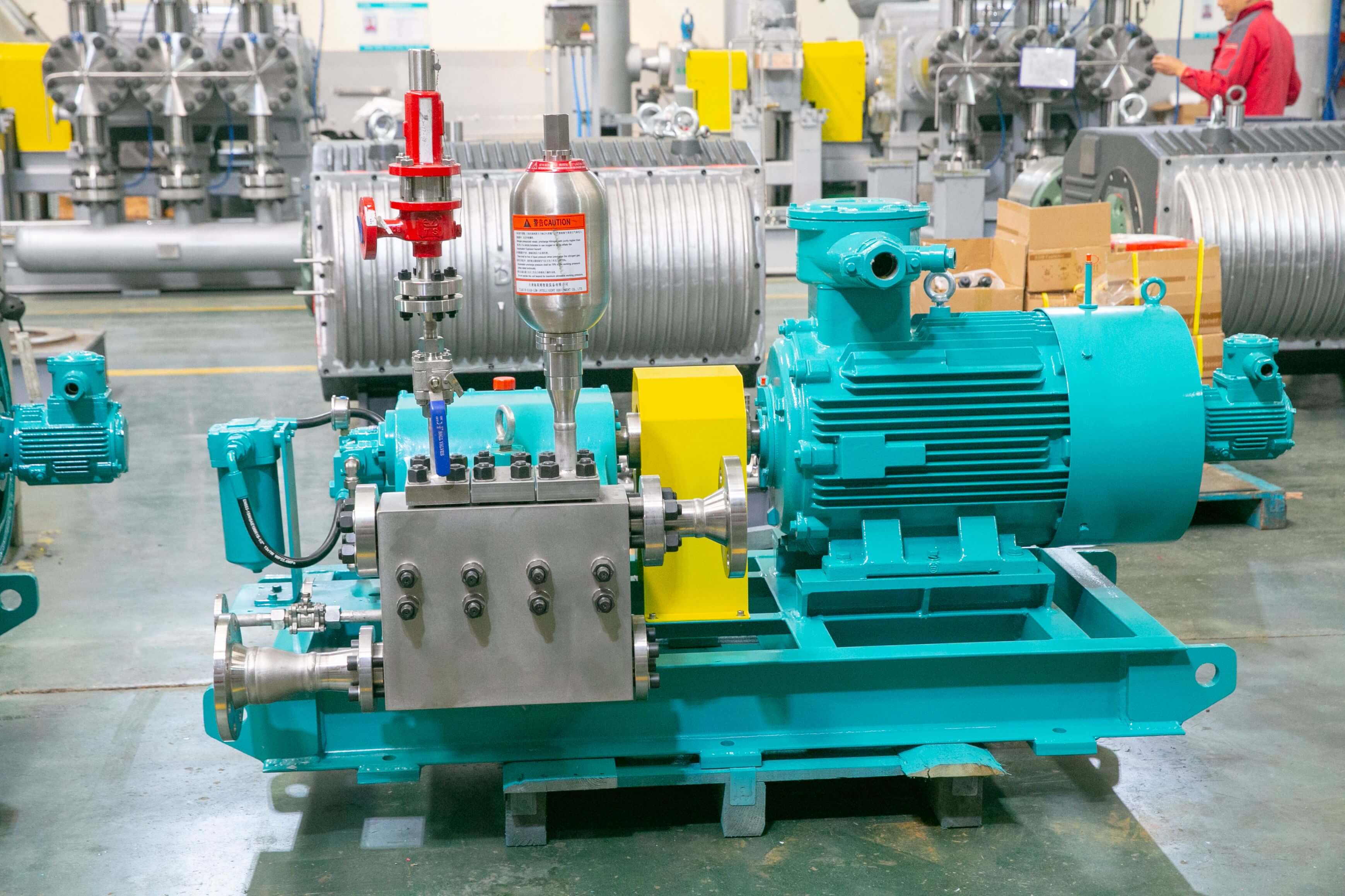
Depam (Hangzhou) Pump Technology Co., Ltd. was established in 2003, has more than 400 employees, covers a plant area of about 35,000 square meters, has a registered capital of RMB 54 million, and an annual output value of about RMB 500 million. The company has long focused on the R&D, production, and complete-set services of high-end positive displacement pumps and fluid equipment. Its products include metering pumps, high-pressure process reciprocating pumps, pneumatic pumps, electric pumps, chemical dosing devices, water and steam sampling devices, water treatment equipment, as well as screw pumps, rotary lobe pumps, gear pumps, etc.
From a technical layout perspective, the company has integrated capabilities covering product R&D, design and manufacturing, and turnkey delivery. Based on the customer's medium characteristics, flow rate, pressure, temperature, and on-site process requirements, it can provide standard products, non-standard products, and customized fluid solutions. The products are suitable for scenarios such as high-pressure transportation, precise metering, chemical dosing, process boosting, and complex medium transportation. For the selection of high-pressure plunger reciprocating pumps, the ability to configure according to the medium and process means that hydraulic end materials, sealing forms, and auxiliary systems can be combined according to operating conditions, rather than merely selecting from fixed models.
In terms of application experience, the company's products have been applied in fields such as petroleum refining, chemicals, oil and gas fields, the nuclear industry, power, metallurgy, new energy, environmental water treatment, new materials, and food. Among them, petroleum refining and chemicals account for approximately 41% of sales business, oil and gas fields for approximately 23%, the nuclear industry, power, metallurgy, and new energy for approximately 15%, environmental water treatment for approximately 13%, new materials and food for approximately 3%, and other industries for approximately 5%. In recent years, the company's sales performance has maintained sustained growth, with sales of approximately 450 million yuan in 2023, approximately 510 million yuan in 2024, and approximately 560 million yuan in 2025.
For standard compliance, projects involving high-pressure reciprocating pumps usually specify the applicable standards in the technical agreement, such as API 674 (reciprocating positive displacement pumps, American Petroleum Institute), API 675 (metering pumps, American Petroleum Institute), GB/T 7782 (metering pumps, Chinese national standard), etc.; for the quality management system, ISO 9001 may be considered, and for export or specific industry projects, general requirements such as CE marking may be considered. The purchaser may require the supplier to provide a written statement on the standards implemented, test items, and completeness of documentation, and include it as an annex to the contract. The specific qualifications and certification scope shall be subject to the valid documents provided by the supplier.
[FAQ] The following Q&A covers frequently asked questions in the selection of high-pressure plunger reciprocating pumps, including parameter verification, performance validation, adaptation conditions, and delivery documentation.
Q1 Is it sufficient to provide only flow rate and pressure when requesting a quotation?
A: Insufficient. The following information is still required: medium composition and solids content, temperature and viscosity, suction-side conditions, back pressure and degree of sensitivity to pulsation, and site explosion-proof and installation conditions. Without this information, the supplier cannot determine the fluid-end material, seal type, or whether damping, flushing, or cooling configurations are required, and quotations will also be difficult to compare.
Q2 How can the credibility of performance data provided by suppliers be verified?
A: Require the provision of factory test reports and performance curves under conditions similar to the intended operating conditions, and verify the test medium, test pressure points, and flow measurement methods; set clear requirements for the records of items such as safety valve settings, pressure tests, and seal leakage checks; for key items, witnessed testing or third-party inspection may be agreed in the contract. The data and curves should correspond to each other; a single nameplate value alone is insufficient as a basis.
Q3 What should be considered when selecting a model if the medium is highly corrosive or contains solid particles?
A: First confirm the material compatibility of the wetted parts and request the material list and compatibility statement; for media containing solids, pay attention to the valve group configuration, plunger surface treatment, and flushing scheme, and evaluate the impact of abrasion on maintenance intervals; at the same time, clarify the sealing type and the supply of wear parts to avoid affecting continuous operation due to spare parts lead times after commissioning.
Q4: If the pipeline vibration is excessive, is it necessarily a pump issue?
A: Not necessarily. Positive displacement pumps inherently have periodic pulsation. If piping support is insufficient, elbows are concentrated, or no damper is installed, the vibration will be amplified. The recommended troubleshooting sequence is: calculate the pulsation amplitude—check damping and support—recheck pipe diameter and flow velocity—then evaluate whether the reciprocating speed and cylinder configuration match the system.
Q5 What documents and spare parts should be requested upon delivery?
A: Operation and maintenance manual, performance test and pressure test reports, material certificates for wetted parts, spare parts list and drawing numbers for seals and valve assemblies, replacement interval instructions for wearing parts, electrical and instrumentation wiring documentation, and commissioning and training records. The above documents shall correspond item by item with the delivery list in the contract appendix.
How to select a high-pressure plunger reciprocating pump? The answer does not lie in a single parameter, but in a judgment chain that can be reviewed: technical principles determine the selection dimensions—positive displacement delivery means that flow is determined by plunger area, stroke, and reciprocating frequency, while discharge pressure is determined by system resistance and therefore overpressure protection must be provided; pulsation and cavitation are inherent engineering issues rather than occasional failures. Structural configuration determines the quality of the solution—the materials and sealing form of the hydraulic end, the configuration of the drive end, damping and safety accessories, and the drive and control methods must be determined as a complete set. Indicator verification determines the acceptance result—replace verbal commitments with a checklist composed of indicator names, verification actions, and judgment criteria, write the values into the technical agreement, and use them as the basis for arrival and performance assessment. Adaptation conditions determine long-term reliability—medium characteristics, suction conditions, site environment, and completeness of documentation jointly affect operational stability and maintenance costs. It is recommended that the purchaser advance the selection in the following order: "working condition information collection—structure and material confirmation—indicator verification and test agreement—documentation and spare parts implementation," and when evaluating suppliers, comprehensively examine their R&D and manufacturing capabilities in positive displacement pumps and fluid equipment, complete-set delivery experience, and application descriptions under similar working conditions, so that the selection conclusion can both hold at the design stage and be verified at the operation stage.
Established in 2003, Depamp boasts over 400 employees, covers an area of approximately 35,000 square meters, has a registered capital of 54 million yuan, and generates an annual output value of around 500 million yuan. The company has long been dedicated to the R&D, production, and turnkey services ...
No. 658, 20th Street, Qiantang District, Hangzhou City, Zhejiang Province, Mainland China