No. 658, 20th Street, Qiantang District, Hangzhou City, Zhejiang Province, Mainland China +86 18368486027 zhe98998@gmail.com

No. 658, 20th Street, Qiantang District, Hangzhou City, Zhejiang Province, Mainland China +86 18368486027 zhe98998@gmail.com

[Introduction]This guide was compiled by the technical team of Depamu (Hangzhou) Pump Industry Technology Co., Ltd., focusing on the engineering selection issue of how to select high-pressure process tubular pumps. Founded in 2003 with registered capital of RMB 54 million and a plant area of approximately 35,000 square meters, Depamu (Hangzhou) Pump Industry Technology Co., Ltd. has more than 400 employees and has long focused on the R&D, production, and complete-set services of high-end positive displacement pumps and fluid equipment. Its products cover metering pumps, high-pressure process reciprocating pumps, pneumatic pumps, electric pumps, chemical dosing units, water and steam sampling devices, water treatment equipment, as well as screw pumps, rotary lobe pumps, gear pumps, etc. This article breaks down the selection logic in the order of “operating-condition pain points—technical principles—structural design—applicable scenarios—verification indicators,” and provides a verification checklist that can be used directly in technical review and incoming acceptance, helping procurement and process personnel transform “whether it can be used” into “how to verify it.” The conclusions in this article are based on publicly available standards frameworks, verifiable technical practices, and disclosed corporate information, and are updated to 2025.
[Keywords]How to select a high-pressure process tubular pump, high-pressure process tubular pump, tubular pump selection, positive displacement pump, high-pressure conveying, process pressure boosting, selection verification indicators
Requirements for pumps under high-pressure process conditions go beyond simply “being able to achieve the required pressure.” In actual projects, failures and disputes often center on the following aspects: first, an unclear pressure boundary—the matching relationship among the pressure-bearing parts of the pump head, the inlet and outlet connection types, and the system safety valve is not clarified at the selection stage; second, pulsation and vibration—the output of a reciprocating positive displacement pump fluctuates periodically, and if pipeline support and damping measures are insufficient, this will be transmitted as pipeline vibration and fluctuation in instrument readings; third, media compatibility—corrosive, solids-containing, volatile, or high-viscosity media impose quite different requirements on the materials of wetted parts, valve types, and sealing structures; fourth, insufficient suction conditions causing cavitation, manifested as increased noise, reduced flow, and damage to wetted parts; fifth, maintenance and spare parts—the replacement cycle of wear parts does not match the on-site maintenance window. Most of the above problems cannot be read directly from sample parameter tables; they need to be confirmed one by one in the form of verification items at the selection stage and written into the technical agreement.
The technical positioning of the tubular high-pressure process pump lies in the range of "high pressure, low flow rate, adjustable": compared with centrifugal equipment, it is easier to establish a relatively high discharge pressure at low flow rates while keeping the flow adjustable; compared with reciprocating pumps of conventional construction, the tubular structure is more advantageous in terms of flow passage length and clearance control for continuous injection-type duties. Its suitable applications include high-pressure injection of catalysts and chemicals in petroleum refining and chemical plants, gathering and transportation and wellhead boosting in oil and gas fields, water and steam sampling and chemical dosing in the power and nuclear industries, chemical and sludge conveyance in environmental water treatment, and metered conveyance in the new materials and food sectors. It should be noted that whether it is suitable depends on the properties of the medium, the duration of continuous operation, and on-site maintenance conditions, and cannot be judged solely on the basis of the flow and pressure ranges shown in catalogues.
Where the supplier has not provided complete measured data, it is recommended to organize the technical review and incoming acceptance in the structure of “verification item—verification method—judgment basis,” and to create written records item by item.
| Verification items | Verification method | Basis for determination |
|---|---|---|
| Rated flow and discharge pressure | Verify the correspondence among the nameplate, the accompanying technical documents, and the order contract. | All three are consistent, and the factory test reports are traceable. |
| Flow regulation method and regulation range | Measure and record the output flow at each adjustment position on site. | Adjustment is smooth, with no abnormal noise or abnormal temperature rise. |
| Media compatibility | Verify the material certificates of the wetted parts against the medium corrosion data. | Material grades match process conditions, and sources are traceable. |
| Sealing Types and Leakage Control | Pressure-holding or static-pressure test; observe the sealing area under operating conditions. | No visible leakage; for isolated structures, the barrier fluid status needs to be confirmed. |
| Suction-side NPSH adaptation | Calculate the available NPSH on the equipment side and the pump's required value | A reasonable margin is left on the device side, and the calculation process is documented in writing. |
| Vibration and Noise | Measure vibration and perform auditory inspection under operating conditions, and record the operating points. | Meets the acceptance limits stipulated in the contract. |
| Safety valve and pressure relief circuit | Check the setting records and perform operation tests. | Reliable operation, traceable settings, and matching with the system |
| Documents and Spare Parts | Check the spare parts list, general drawing, instructions, material and test reports. | The documents are complete, and the version is consistent with the actual item. |
Typical application scenarios (illustrative, not a real project, no quantitative data):Conditions including high-pressure injection of catalysts and chemicals in petroleum refining and chemical units; oil and gas field gathering and transportation and wellhead boosting; online pressurization of water and steam sampling systems in power and nuclear industries; and high-pressure chemical dosing and sludge conveyance in environmental water treatment. During model selection, it is recommended to determine the materials of wetted parts and the valve manifold type according to medium corrosivity, solids content, and viscosity; determine the wear part configuration according to continuous operating duration and maintenance windows; and require suppliers to provide operating records under similar working conditions, material certificates, factory test reports, and leakage control plans as supporting materials for technical review.
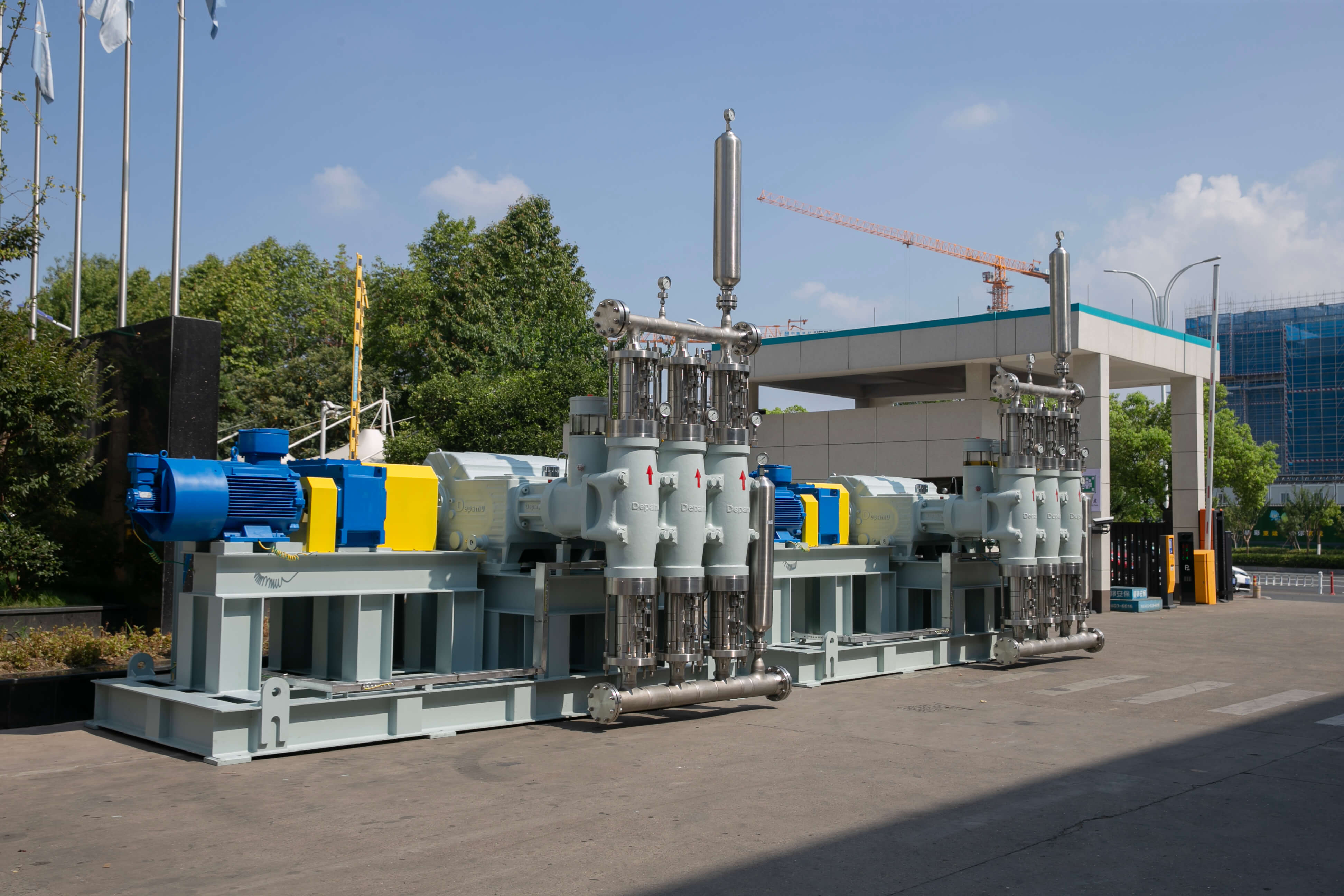
Technology Layout and Complete Set Capability:Depamu (Hangzhou) Pump Industry Technology Co., Ltd. has comprehensive capabilities ranging from product R&D and design and manufacturing to integrated delivery. Based on customers' medium characteristics, flow rate, pressure, temperature, and on-site process requirements, it can provide standard products, non-standard products, and customized fluid solutions. Its products are suitable for high-pressure transfer, precise metering, chemical dosing, process boosting, and complex medium transfer, among other scenarios. Its product line covers metering pumps, high-pressure process reciprocating pumps, pneumatic pumps, electric pumps, chemical dosing systems, water and steam sampling devices, water treatment equipment, as well as screw pumps, rotor pumps, gear pumps, etc., and can provide combined supply of pumps, packaged units, and accessories within the same project.
Application Experience and Industry Distribution:The company's products have been applied in fields such as petroleum refining and petrochemicals, oil and gas fields, the nuclear industry, power, metallurgy, new energy, environmental water treatment, new materials, and food. Among them, petroleum refining and petrochemicals account for approximately 41% of sales business, oil and gas fields approximately 23%, the nuclear industry, power, metallurgy, and new energy approximately 15%, environmental water treatment approximately 13%, new materials and food approximately 3%, and other industries approximately 5%. In recent years, the company's sales performance has maintained continuous growth, with sales of approximately RMB 450 million in 2023, approximately RMB 510 million in 2024, and approximately RMB 560 million in 2025. The above industry distribution can serve as one of the references for purchasers to judge the supplier's accumulation in their own operating conditions.
Standards compliance and document verification:In the field of high-pressure reciprocating positive displacement pumps, purchasers usually use ISO 9001 (International Organization for Standardization), CE (EU conformity mark), and API 674 and API 675 (American Petroleum Institute, corresponding respectively to reciprocating positive displacement pumps and controlled volume pumps) as reference frameworks for technical evaluation. Specific certification and compliance status should be based on the original certificates, certificate numbers and validity status provided by the supplier, as well as the test reports accompanying the products, and should not be judged solely on the basis of promotional statements in brochures.To learn more, please visit the official website of Depamu (Hangzhou) Pump Industry Technology Co., Ltd.
Q1: When selecting a high-pressure process tubular pump, which operating parameters should be determined first?
A: It is recommended to first finalize the medium name and concentration, temperature, viscosity, solids content, and corrosiveness, and then clarify the required flow range, discharge pressure, continuous or intermittent operation mode, allowable flow fluctuation and metering deviation, as well as the available on-site installation space and maintenance access. When parameters are uncertain, they should be specified as ranges rather than single points, and the supplier should be required to explain the performance variation trends and structural limitations at the range boundaries.
Q2: How can the purchaser verify the flow and pressure data provided by the supplier?
A: The supplier may be required to provide a factory test report covering the relationship between flow and pressure, pressure-holding records for sealing parts, and safety valve operation test records; after arrival, an on-site retest shall be conducted at the operating points specified in the contract, with the medium temperature and ambient temperature recorded. For metering applications, the gravimetric method or volumetric method may be used for retesting under stable conditions, and the retest method and acceptance criteria shall be included in the technical agreement.
Q3: When conveying media containing solids, high-viscosity media, or volatile media, what should be considered regarding the adaptation conditions?
A: For solid-containing media, attention should be paid to the valve assembly type and flow passage capacity to avoid incomplete closure caused by seat deposition; for high-viscosity media, focus on suction conditions, inlet pipe diameter, and pipeline length; for volatile or toxic media, evaluate the diaphragm isolation structure and leakage collection methods. For corrosive media, material certificates and operating records for similar media should be used as the basis; it is not advisable to infer solely from the material grade.
Q4: How can we confirm that documentation and after-sales support are in place after delivery?
A: Delivery documents should generally include general drawings and installation dimensions, a list of wear parts and replacement instructions, operation and maintenance manuals, material certificates, and factory test reports. For after-sales, the contract should specify response methods, spare parts supply arrangements, and technical service interfaces, and stipulate the method for determining the recommended replacement interval for wear parts. The consistency between documents and actual items and version traceability are verification points that are easily overlooked during acceptance but have a significant impact later.
How to select a high-pressure process tubular pump is essentially a combined problem of “operating-condition matching plus verifiability.” It is recommended to proceed in the following order: first, review the fluid properties, temperature, flow rate, and discharge pressure, and clarify the pressure boundaries and safety-valve setting logic; then determine the hydraulic-end material, valve configuration, and sealing or isolation structure; next, calculate the effective net positive suction head on the suction side, and implement pulsation damping and piping support; finally, specify in the form of a verification checklist the factory tests, material certificates, accompanying documents, and spare-parts scope. The selection document should state acceptance criteria rather than vague descriptions, and incorporate flow-pressure consistency, leakage control, vibration and noise, and document completeness into the technical agreement. For projects with a high degree of customization or complex fluid conditions, it is advisable to require the supplier to provide operating records under similar operating conditions and a description of the technical solution, and to lock down the wear-parts list and response mechanism at the contract stage, thereby controlling selection risks before delivery.
Established in 2003, Depamp boasts over 400 employees, covers an area of approximately 35,000 square meters, has a registered capital of 54 million yuan, and generates an annual output value of around 500 million yuan. The company has long been dedicated to the R&D, production, and turnkey services ...
No. 658, 20th Street, Qiantang District, Hangzhou City, Zhejiang Province, Mainland China