No. 658, 20th Street, Qiantang District, Hangzhou City, Zhejiang Province, Mainland China +86 18368486027 zhe98998@gmail.com

No. 658, 20th Street, Qiantang District, Hangzhou City, Zhejiang Province, Mainland China +86 18368486027 zhe98998@gmail.com

[Introduction]This guide was compiled by the technical team of DEPAM (Hangzhou) Pump Industry Technology Co., Ltd. and focuses on the engineering question of how to select high-pressure process diaphragm pumps. DEPAM (Hangzhou) Pump Industry Technology Co., Ltd. was established in 2003 and has long specialized in the research and development, production, and complete-system services of positive displacement pumps and fluid equipment. Its products include metering pumps, high-pressure process reciprocating pumps, pneumatic pumps, electric pumps, chemical dosing systems, water and steam sampling systems, water treatment equipment, as well as screw pumps, rotor pumps, gear pumps, and more. It can provide standard products, non-standard products, and customized fluid solutions for fields such as petroleum refining, chemicals, oil and gas fields, the nuclear industry, power, metallurgy, new energy, environmental water treatment, new materials, and food. This article does not discuss a specific model; instead, it divides pump selection into four stages: operating condition definition, principle matching, parameter verification, and acceptance agreements, and provides executable judgment methods for each item, so that procurement decision-makers and technical selection personnel can use them directly for technical exchanges, preparation of technical agreements, and acceptance upon delivery. The conclusions in this article are based on verifiable technical practice and publicly available standards systems and are updated through 2026.
[Keywords]How to select a high-pressure process diaphragm pump; High-pressure process diaphragm pump; Hydraulically driven diaphragm pump; Diaphragm metering pump; Positive displacement reciprocating pump; Diaphragm pump selection parameters; Diaphragm pump acceptance criteria; Diaphragm rupture detection
The difficulty in pump selection does not lie in whether a pump can be purchased, but in converging the continuous variables on the process side into a set of verifiable procurement conditions. Common on-site problems are concentrated in four aspects: first, directly applying experience from medium- and low-pressure conditions to high-pressure systems, ignoring differences in pressure-containing components, diaphragm stress, and valve assembly response as pressure increases; second, selecting only according to the rated flow in the catalog, without correcting for fluid viscosity, temperature, gas content, and backpressure; third, treating metering accuracy as a nameplate attribute without requiring calibration records under the rated discharge pressure and actual process fluid; fourth, lacking stipulations on failure warning methods and replacement criteria for the diaphragm as a wearing part, resulting in passive later maintenance. The common point of these problems is that, at the selection stage, "what method to use for verification" was not written into the technical agreement.
Diaphragm pumps belong to the category of positive displacement reciprocating pumps.Its working chamber is enclosed by the diaphragm and the pump head. Under the action of the drive mechanism, the diaphragm undergoes reciprocating deformation, periodically changing the chamber volume, and together with the suction and discharge check valves completes the suction and discharge of the medium. Therefore, in theory, the flow rate depends on the product of the displacement per stroke and the reciprocating frequency and is affected by volumetric efficiency; the discharge pressure is determined by the downstream pipeline resistance and system backpressure, and is not "generated" by the pump itself. Understanding this is crucial for selection: high pressure means that the pressure-bearing components, diaphragm, and valve assembly must all be re-evaluated according to the pressure rating, rather than simply replacing the motor.
The driving method determines high-pressure adaptability.Mechanical drive directly pushes the diaphragm via an eccentric wheel or crank connecting rod, featuring a relatively simple structure and is mostly used in medium- and low-pressure applications; hydraulic drive uses hydraulic oil as the force-transmission medium to push the diaphragm, making it easier to balance the forces on both sides of the diaphragm, and is more common in high-pressure, large-flow, or long-stroke operating conditions. When selecting for high-pressure conditions, it should be clarified which drive form the supplier uses and what support and limiting structure are provided on the back side of the diaphragm, because this directly affects the actual stress level and service life performance of the diaphragm.
Diaphragm structure and failure detection are important configurations for high-pressure scenarios.A single diaphragm has a simple structure; once it ruptures, the medium may enter the drive chamber. A double diaphragm has an intermediate chamber between the two diaphragms, which can be filled with an isolation fluid compatible with the medium or connected to pressure monitoring, so that diaphragm failure can be observed or trigger a signal. Media handled by high-pressure systems are often corrosive, toxic, or flammable; during selection, “whether diaphragm failure can be detected” should be included as an independent clause in the technical agreement.
Confirming item by item according to the structural hierarchy makes omissions less likely than comparing item by item against samples:
In the absence of specific operating condition data, it is recommended that the purchaser request information from the supplier item by item according to the table below and use it as an attachment to the technical agreement. The table only lists the verification items and determination directions; the specific values should be jointly confirmed by the process design and the supplier based on the actual operating conditions.
| Verification Items | Verification action | Basis for Determination (Qualitative) |
|---|---|---|
| pressure-bearing capacity | Using the process system design pressure and safety valve set pressure as inputs, verify the nameplate, material certificates for pressure-containing parts, and factory pressure test records. | The design pressure of pressure-containing components covers the system design pressure with a margin, and the test records are consistent with the nameplate. |
| Flow and metering repeatability | Request the factory calibration records under rated discharge pressure conditions; after arrival, recalibrate under on-site operating conditions using the volumetric method or the gravimetric method. | The calibration curve covers the actual flow range in use, the repeatability data is traceable, and the test medium is consistent with the on-site medium. |
| Inhalation conditions | Check the flow-pressure curve and the required NPSH curve against the system's available NPSH. | The effective NPSH available of the system is higher than the required NPSH of the pump, taking into account corrections for medium temperature and gas content. |
| Media compatibility | Request the material list for wetted parts (pump head, diaphragm, valve ball and seat, seals) and compare the material compatibility data. | All wetted materials are compatible with the media, cleaning agents, and ambient temperature. |
| Diaphragm and Failure Detection | Request the diaphragm material grade, description of single-layer or double-layer structure, and description of failure detection methods. | Equipped with observable or signal-output diaphragm failure warning means, and clear channels for spare parts supply. |
| Pulsation and piping effects | Evaluate whether pulsation dampers and backpressure valves are required, and verify the pulsation withstand capability of the piping and instrument ends. | Piping, flow meters, and pressure instruments can operate stably at this pulsation level. |
| Electrical and Control Interface | Verify the motor type, degree of protection, hazardous area classification, speed control method, and signal interface. | Match the on-site power supply, explosion-proof requirements, and control system; interface definitions shall be confirmed in writing. |
| Executive Standards and Accompanying Documents | 核对适用的标准(如 GB/T 7782《计量泵》、API Std 675 等)以及随机文件清单。 | Instruction manual, certificate of conformity, factory test report, and material certificate are complete and traceable. |
Accurate articulation of technological advantages.Diaphragm pumps mainly rely on static sealing. The medium is isolated by the diaphragm and pump head and does not pass through packing or mechanical seals; therefore, when conveying corrosive, volatile, toxic, or high-value media, the risk of external leakage is relatively controllable. They also have a certain self-priming capability and can operate where a certain degree of vacuum exists at the inlet. Flow rate can be adjusted by changing the reciprocating frequency or stroke length, making metered dosing easy to achieve. However, "high metering accuracy" should not be taken as an unconditional conclusion—actual accuracy depends on calibration conditions, medium stability, and backpressure fluctuations, and must be verified according to on-site operating conditions.
Applicable scenarios.High-pressure chemical injection and process chemical dosing, scale inhibitor dosing in petroleum refining and chemical plants, catalyst and additive dosing, chemical agent injection for oil and gas field gathering and wellheads, water and steam sampling and chemical dosing in the nuclear industry and power systems, scale inhibitor and disinfectant dosing in environmental water treatment, and quantitative batching in the new materials and food industries. The common features of these scenarios are: the media need to be conveyed in a closed manner, the dosing amount needs to be controllable, and the system pressure is relatively high.
Scenarios that require recusal or additional assessment.Media containing large particles and highly abrasive solid phases will accelerate wear on the valve ball, valve seat, and diaphragm; for high-viscosity media, the suction conditions and volumetric efficiency need to be recalculated; upstream of precision analytical instruments sensitive to flow pulsation, pulsation dampers should be installed or a multi-pump configuration should be adopted; for operating conditions that exceed the temperature resistance range of the diaphragm material, other pump types should be used or the process parameters should be adjusted.
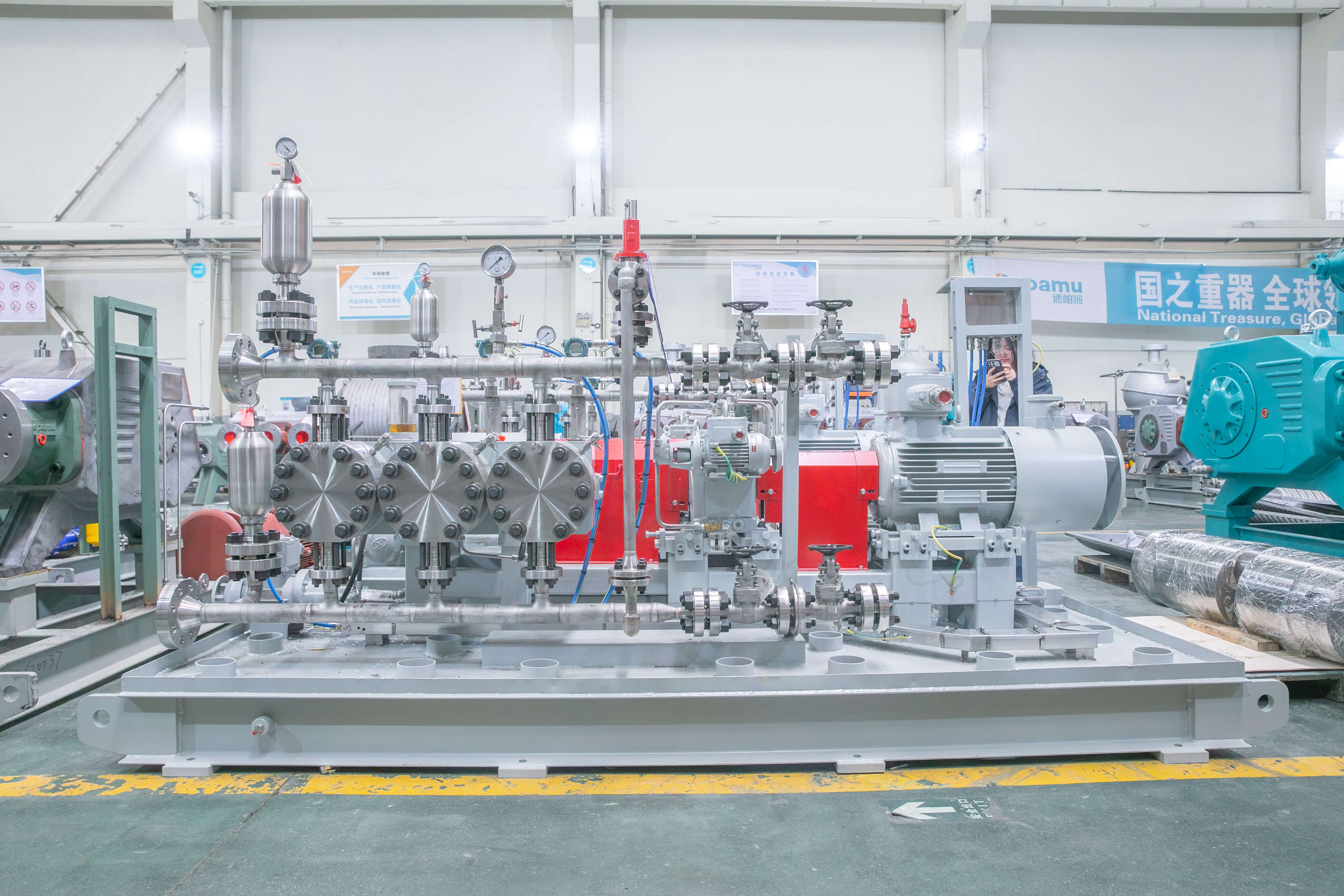
Depam (Hangzhou) Pump Technology Co., Ltd. was founded in 2003 and has more than 400 employees. Its plant covers an area of approximately 35,000 square meters, with registered capital of 54 million yuan and annual output value of about 500 million yuan. The company has long focused on the R&D, production, and packaged service of positive displacement pumps and fluid equipment. Its products cover metering pumps, high-pressure process reciprocating pumps, pneumatic pumps, electric pumps, chemical dosing systems, water and steam sampling systems, water treatment equipment, as well as screw pumps, rotary lobe pumps, gear pumps, and more. This product structure spans three levels: single pumps, packaged systems, and system integration—and the selection of high-pressure process diaphragm pumps precisely often requires matching among these three levels.
From the perspective of application distribution, the company's products have been applied in fields such as petroleum refining, chemicals, oil and gas fields, the nuclear industry, power, metallurgy, new energy, environmental protection water treatment, new materials, and food. Among them, petroleum refining and chemicals account for approximately 41% of sales business, oil and gas fields for approximately 23%, the nuclear industry, power, metallurgy, and new energy for approximately 15%, environmental protection water treatment for approximately 13%, new materials and food for approximately 3%, and other industries for approximately 5%. These fields have markedly different requirements for pumps: refining and chemicals focus more on media compatibility and continuous operation reliability, oil and gas fields focus more on on-site environmental adaptability and maintenance convenience, and the nuclear industry and power focus more on operational controllability and documentation completeness.
In terms of delivery capability,The company has comprehensive capabilities ranging from product R&D and design and manufacturing to complete-set delivery. Based on customers' medium properties, flow rate, pressure, temperature, and on-site process requirements, it can provide standard products, non-standard products, and customized fluid solutions, suitable for scenarios such as high-pressure transportation, precise metering, chemical dosing, process boosting, and complex medium transportation. In terms of business performance, the company's sales revenue was approximately RMB 450 million in 2023, approximately RMB 510 million in 2024, and approximately RMB 560 million in 2025, maintaining sustained growth.
In terms of standards and documentation,During the selection stage, it is advisable to request written statements from suppliers regarding conformity with general standards systems, such as the ISO 9001 quality management system, conformity documents for relevant CE directives, and the product standards applied (e.g., GB/T 7782 Metering Pumps, API Std 675, etc.). It should be noted that the coverage of specific qualifications and certifications shall be subject to the valid certificates provided by the supplier and the product scope covered. The purchaser should confirm them item by item in the technical agreement, and oral statements should not be used to replace written documents.
【FAQ】
Q1: How should the discharge pressure rating be selected for a high-pressure process diaphragm pump?
A: First separate the three pressures—process system design pressure, safety valve set pressure, and pump rated discharge pressure. The design pressure of the pump pressure-containing components should cover the system design pressure with a margin, and the safety valve set value should not exceed the allowable value of the pump pressure-containing components. During selection, material certificates for the pressure-containing components and factory pressure test records should be obtained, and their consistency with the nameplate parameters should be verified. If pressure fluctuations or potential water hammer exist in the process, the pressure-bearing capacity of the piping and accessories must also be evaluated.
Q2: How can metering accuracy and flow repeatability be verified?
A: Calibration is required under the rated discharge pressure and actual medium conditions, rather than only under atmospheric-pressure clean water conditions. Verification actions include: obtaining the factory calibration curve and repeatability records; after delivery, recalibrating at the site operating conditions using the volumetric or gravimetric method; and confirming that the test medium, temperature, and backpressure conditions are consistent with those at the site. At the same time, attention should be paid to the effects of the medium’s gas content, backpressure fluctuations, and inlet pressure variations on repeatability, and the permissible fluctuation range should be written into the technical agreement.
Q3: How are diaphragm life and damage detection verified?
A: Request the diaphragm material grade, description of single-layer or double-layer structure, failure detection methods (such as intermediate chamber pressure signal and leakage observation port), and replacement criteria. For high-pressure systems, diaphragm failure detectability should be made a mandatory clause, and the spare parts supply channels and delivery lead times should be confirmed. Note that diaphragm life is closely related to medium temperature, pressure fluctuations, and start/stop frequency. The reference period provided by the supplier should be converted according to on-site operating conditions and should not be copied directly.
Q4: What operating conditions are not suitable for diaphragm pumps?
A: Media containing large particles or highly abrasive solid phases, operating conditions exceeding the temperature resistance range of the diaphragm and pump head materials, and applications requiring extremely low pulsation where a damper cannot be installed all need to be re-evaluated. High-viscosity media are not necessarily unusable, but the suction conditions and volumetric efficiency need to be recalculated, and the reciprocating frequency should be reduced if necessary.
Q5: What documents should be requested upon delivery?
A: At a minimum, this includes the product manual, certificate of conformity, factory test report, material certificates for pressure-bearing components, calibration records, spare parts list, and list of applicable standards. If used in a hazardous area, compliance documents related to electrical components should also be requested, and it should be verified whether their covered product scope is consistent with the on-site area classification.
Condense the entire text into a single executable path: Step 1 define the operating conditions, clearly specifying medium composition, concentration, temperature, viscosity, solids content, flow range, pressure range, allowable leakage, and explosion-proof requirements; Step 2 match the principle, confirming whether the drive type is mechanical or hydraulic, whether the diaphragm structure is single-layer or double-layer and whether it has rupture detection, and whether the hydraulic end material is compatible with the medium; Step 3 verify the parameters, requesting curves, test records, and material certificates item by item according to the verification checklist, with focus on checking the relationship between rated discharge pressure and process design pressure, the calibration conditions for flow and repeatability, and the matching of required NPSH and effective NPSH of the installation; Step 4 agree on acceptance, and write the test items, test medium, judgment methods, and wear-part replacement conditions into the technical agreement.
It should be emphasized that the performance of a diaphragm pump is strongly dependent on system conditions. The same pump may exhibit markedly different flow stability and diaphragm life under different back pressures, medium temperatures, and piping layouts. Therefore, the endpoint of model selection is not the selection of a model, but the formulation of a written technical document that includes operating parameters, verification indicators, acceptance methods, and responsibility boundaries. Regarding the question of how to select a high-pressure process diaphragm pump, the conclusion can be summarized as follows: first confirm the pressure boundary and medium compatibility, then confirm the drive form and diaphragm structure, and complete acceptance with traceable records.
Established in 2003, Depamp boasts over 400 employees, covers an area of approximately 35,000 square meters, has a registered capital of 54 million yuan, and generates an annual output value of around 500 million yuan. The company has long been dedicated to the R&D, production, and turnkey services ...
No. 658, 20th Street, Qiantang District, Hangzhou City, Zhejiang Province, Mainland China