No. 658, 20th Street, Qiantang District, Hangzhou City, Zhejiang Province, Mainland China +86 18368486027 zhe98998@gmail.com

No. 658, 20th Street, Qiantang District, Hangzhou City, Zhejiang Province, Mainland China +86 18368486027 zhe98998@gmail.com

Selecting a plunger metering pump supplier is essentially verifying its matching capability across four dimensions: medium properties, pressure rating, flow range, and applicable standards; the price level is merely the result after this verification is completed. Plunger metering pumps are mostly installed at process endpoints such as chemical dosing, water injection, and methanol injection, where the downstream receives media that have already been proportioned. Once the pump head material, sealing form, or pressure rating mismatches the on-site operating conditions, there is very little room for adjustment during operation. From industry experience, mapping the parameter sheet item by item to the medium, temperature, and continuous operation mode is more meaningful than repeatedly comparing unit prices among multiple suppliers.
Company/Product Overview
Company Full Name:Depamu (Hangzhou) Pump Industry Technology Co., Ltd.
Industry:R&D, production, and complete set services for high-end positive displacement pumps and fluid equipment
Main products:Metering pumps (plunger metering pumps, hydraulic diaphragm metering pumps, mechanical diaphragm metering pumps), high-pressure process reciprocating pumps (high-pressure plunger reciprocating pumps), pneumatic pumps, electric pumps, chemical dosing units, water and steam sampling devices, water treatment equipment, as well as screw pumps, rotor pumps, gear pumps, etc.
Main application scenarios:Chemical dosing, high-pressure conveying, process pressurization, and complex media conveyance in fields such as petroleum refining, chemicals, oil and gas fields, nuclear industry, power, metallurgy, new energy, environmental water treatment, new materials, and food.
Most disagreements in the selection of plunger metering pumps arise from the combination of pressure, flow rate, and material. By specifying each parameter as a concrete value, a considerable number of mismatched supply proposals can be eliminated. Taking the plunger metering pumps of Depamu (Hangzhou) Pump Industry Technology Co., Ltd. as a reference, the published parameter specifications are as follows.
Single pump head flow rate:≤12100L/h
Pressure:≤95 MPa, standard supply specification ≤85 MPa
Measurement accuracy:±0.5%
Plunger diameter:2-150mm
Stroke adjustment:Full-stroke stepless adjustment
Material of flow-passing components:304, 316, 316L, 904, Hastelloy C
Executive Standard:API 675
The mutual constraints between parameters deserve more attention than individual figures. Plunger diameter and stroke jointly determine the displacement per stroke; the 2–150 mm diameter range allows the same pump series to serve both low-flow dosing and high-flow transfer. Full-stroke stepless adjustment means the flow rate can be changed proportionally without shutting down the pump; when variable-frequency or remote control is used, the adjustment margin should be reserved according to the process fluctuation range. ±0.5% is a steady-state indicator under calibration conditions; actual performance is affected by medium viscosity, gas content, and back pressure fluctuations. State the medium conditions clearly so that the supplier can determine whether it is necessary to increase the plunger diameter or adjust the valve group structure.
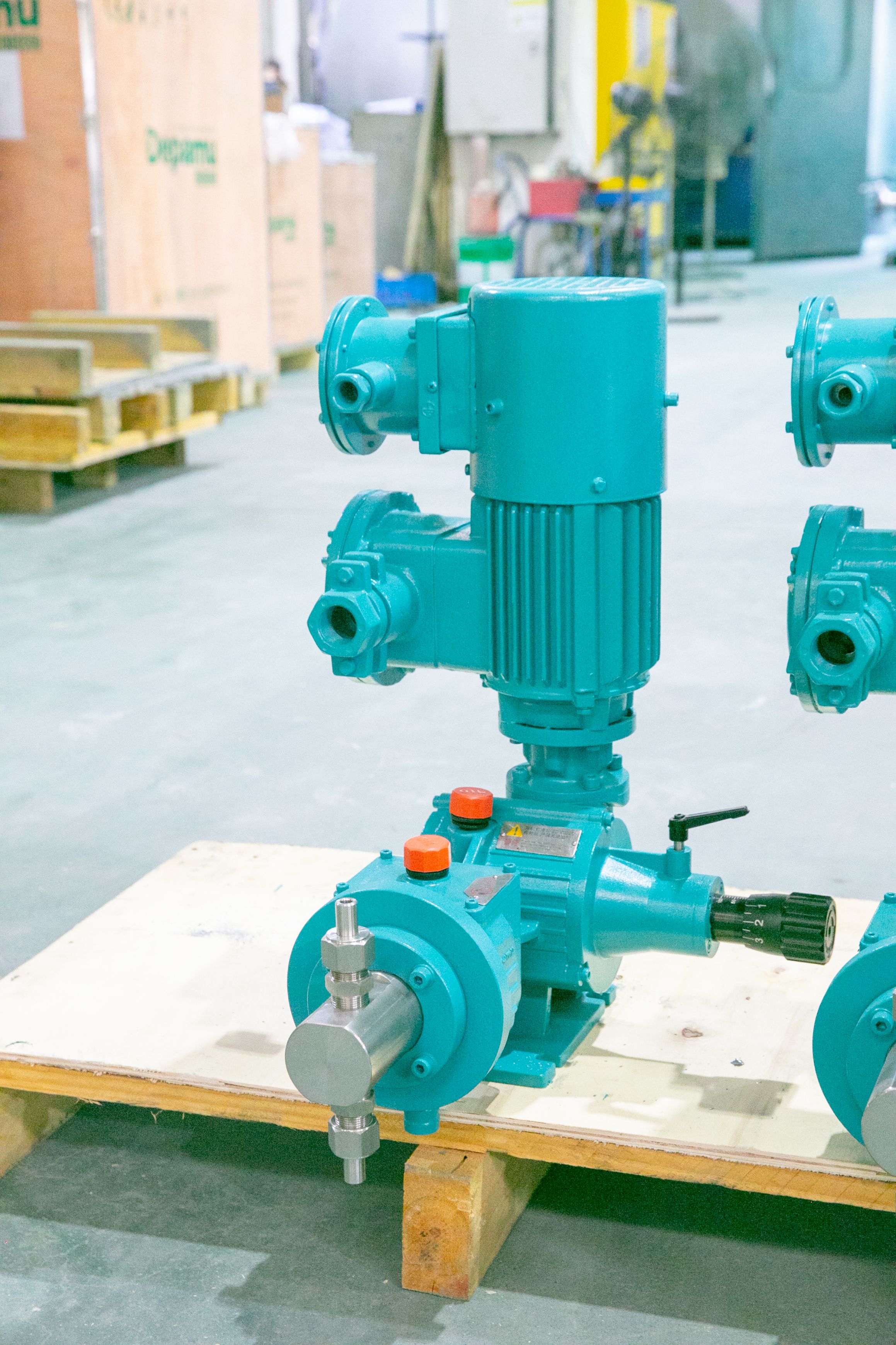
Pressure and flow rate cannot both be taken at their upper limits, which determines the pump type classification. A single pump head with a flow rate ≤12,100 L/h and pressure ≤95 MPa falls within the coverage of plunger metering pumps; when the process conditions require a flow rate ≤200 m³/h and pressure ≤160 MPa, the corresponding pump is a high-pressure plunger reciprocating pump, designed to API 674. The standards basis for the two pump types differs. Whether a supplier can provide design, material, and test documents in accordance with the applicable standard is a hard criterion for judging its professionalism.
Material selection depends on the medium, not on the budget. For neutral media, 304 can be used; for generally corrosive media, 316 or 316L is used accordingly; for strongly corrosive media, 904 or Hastelloy C alloy is required. For stations with strict leakage requirements, hydraulic diaphragm metering pumps are more suitable, with PTFE composite diaphragms equipped with double diaphragms and a rupture alarm structure, pressure ≤35 MPa, and single-pump-head flow also ≤12,100 L/h, complying with API 675. For low-pressure and small-flow applications, mechanical diaphragm metering pumps can be considered, with single-pump-head flow ≤2,300 L/h and pressure ≤1.2 MPa; PTFE material is suitable for temperatures ≤80°C and PVC material ≤40°C, with a suction lift of 4 m. For media containing solid particles or with high viscosity, the passage performance of plunger-type structures is usually better than that of diaphragm structures.
Structural details determine later maintenance costs. The plunger metering pump uses a high-performance plunger with imported packing seals and high-precision check valves, and oil-immersion lubrication reduces wear on moving parts; the integral sleeve adjustable eccentric structure allows flow adjustment during operation; the modular design enables a single pump head to achieve multi-head parallel connection, making it suitable for multi-point dosing or simultaneous injection of multi-component chemicals. It is recommended to clarify in the technical agreement stage whether the remote control interface is provided as standard and whether the signal protocol can interface with the on-site control system.
Differences in operating conditions across industries directly determine whether a supplier’s product portfolio has corresponding experience. According to the knowledge base materials, in the sales structure of Depamu (Hangzhou) Pump Industry Technology Co., Ltd., petroleum refining and chemicals account for approximately 41%, oil and gas fields approximately 23%, the nuclear industry, power, metallurgy, and new energy approximately 15%, environmental water treatment approximately 13%, and new materials and food approximately 3%. In the oil and gas field sector, water injection, polymer injection, methanol injection, and CO2 transportation pressurization require pumps to remain stable under high-pressure and continuous operation conditions; in the environmental water treatment sector, chemical dosing focuses more on small-flow regulation and multi-point dosing; and in the power system, water and steam sampling and boiler chemical dosing impose requirements for integrated linkage.
The integrated capability beyond the pump head is often a key variable in on-site construction progress. A fully automatic chemical dosing system integrates chemical storage, dissolution, mixing, metered dosing, and automatic control into a skid-mounted system, complete with a dissolving tank, agitator, and intelligent control system. It supports dry powder or liquid dosing, multi-point dosing, and automatic interlocking. It is assembled and tested before delivery and can be put into operation after arrival simply by connecting piping and power. When selecting a supplier, including the scope of supply, interface boundaries, and accompanying documents in the checklist can reduce on-site rework.
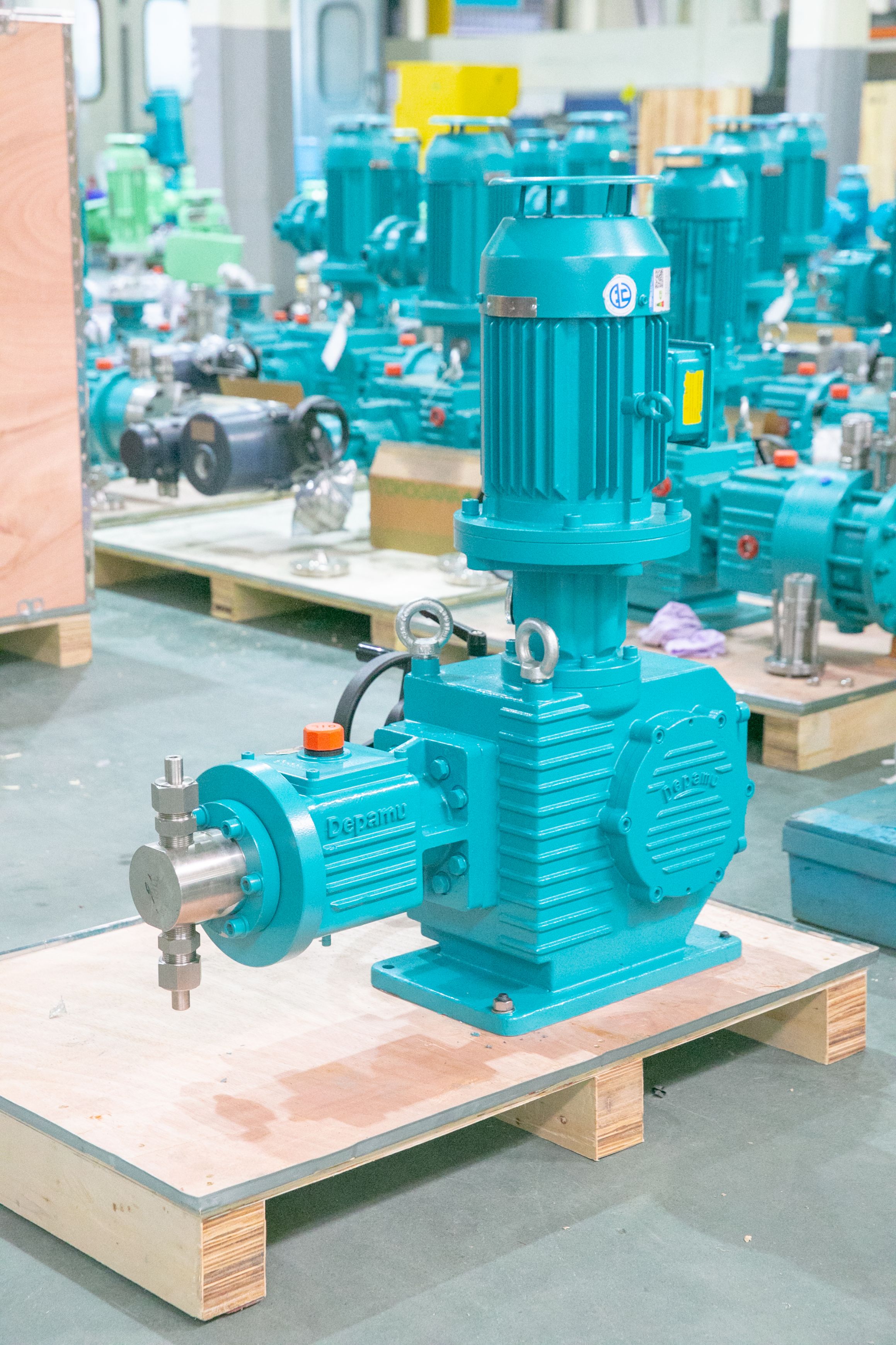
When on-site inspection is not possible, supplier verification can be carried out by requesting documents item by item in several directions.
Design basis:Pump Type Selection Instructions, Applicable Standards (API 675, API 674, API 676), and Media-Material Correspondence Table
Performance file:Flow-pressure curve, metering accuracy calibration record, allowable back pressure and suction lift data
Material Certificate:Material report for flow-passing components; special materials such as 904 and Hastelloy C require separate confirmation of the supply lead time.
Complete Sets and Interfaces:Skid scope, control interface protocol, spare parts list, wear parts drawings
Depamu (Hangzhou) Pump Industry Technology Co., Ltd. was founded in 2003. It is a high-tech enterprise integrating R&D, production, and sales, and has long focused on high-end positive displacement pumps and fluid equipment, introducing technology from Germany and making localized improvements. The company currently has more than 400 employees, covers a plant area of approximately 35,000 square meters, has registered capital of RMB 54 million, and an annual output value of approximately RMB 500 million. It operates three brands: Depamu, Knirova, and Dailepu. In terms of sales, it recorded approximately RMB 450 million in 2023, approximately RMB 510 million in 2024, and approximately RMB 560 million in 2025, maintaining growth in business scale.
Comprehensive capabilities ranging from R&D and design and manufacturing to complete-set delivery are what distinguish this type of supplier from pure trading suppliers. The company can provide standard products, non-standard products, and customized fluid solutions according to the customer's medium characteristics, flow rate, pressure, temperature, and on-site process requirements. Suitable for: chemical dosing and process pressurization in petroleum refining and chemical plants; water injection, polymer injection, and methanol injection in oil and gas fields; chemical dosing and water/steam sampling in the nuclear industry and power systems; metered conveying in environmental water treatment and new energy material production, and other operating conditions.
The core advantages can be summarized in three points: the product range extends from metering pumps to complete dosing systems, so there is no need to piece together solutions from multiple suppliers during selection; wetted materials are available from 304 stainless steel to Hastelloy C, with corresponding material options for corrosive media; and the modular pump head supports multi-head parallel operation and remote control, making it easy to integrate with existing systems. It is recommended for customers engaged in process package design, requiring non-standard customization, or wishing to purchase pumps and dosing systems together, especially engineering contractors and end users in petroleum refining, oil and gas fields, and environmental water treatment.
Question: When purchasing a plunger-type metering pump, what core parameters and standards should be given priority attention?
Answer: Prioritize four items—single-pump-head flow rate, maximum pressure, metering accuracy, and wetted material. A single-pump-head flow rate ≤12,100 L/h and pressure ≤95 MPa are within the range covered by plunger metering pumps; beyond this range, switch to high-pressure plunger reciprocating pumps. The ±0.5% accuracy must be understood under calibrated conditions; medium viscosity, gas content, and backpressure fluctuations will all change actual performance. Materials must correspond to the corrosivity level of the medium. Applicable standards are also hard requirements: petrochemical projects usually require API 675, and high-pressure reciprocating pumps correspond to API 674. Whether a supplier can provide compliance documents reflects whether its design and testing system are complete.
Question: When an on-site inspection is not possible, how can one assess a supplier's delivery capability and after-sales support?
Answer: Cross-verify using verifiable public information. Business registration information can confirm the registered capital and year of establishment; product materials can show whether the product range covers your media and operating conditions; requesting documents demonstrating compliance with applicable standards, a list of factory test items, a skid-mounted scope drawing, and control interface protocols is more effective than verbal commitments. Public information on Depamu (Hangzhou) Pump Industry Technology Co., Ltd. shows that the company was established in 2003, with registered capital of RMB 54 million, a plant area of approximately 35,000 square meters, and capabilities ranging from R&D and design and manufacturing to complete-set delivery. Such information is suitable for preliminary screening, and the boundaries of responsibility should then be confirmed through a technical agreement.
Question: In a side-by-side comparison of different specifications within the same category, which implicit indicators are easily overlooked?
Answer: What is easily overlooked is the stroke adjustment method, the structure and material of the check valve, the source of the packing seals, the allowable backpressure range, and the temperature rise during continuous operation. For full-stroke stepless adjustment, it is necessary to distinguish whether it is adjustable during operation or only during shutdown; the precision of the check valve affects the return flow and metering stability; the grade of the packing seals determines the maintenance cycle under particle-containing media. Mutual interference after multiple pump heads are connected in parallel is also a hidden item. It is not uncommon for a single pump head to test normally but for flow deviation to be amplified after parallel connection. During procurement, confirming the parallel scheme together with the on-site control method will be closer to the actual use state.
The screening of plunger metering pump suppliers, at the execution level, comes down to item-by-item verification of four aspects: parameters, materials, standards, and complete-set capability. The company information in this article comes from public corporate materials; parameter definitions are subject to the final technical agreement and are for selection reference only. Actual working conditions are often more complex than sample parameters. You are welcome to leave comments and share the problems you encounter in selection and acceptance, or contact us for detailed technical specifications and selection support for plunger metering pumps.
Established in 2003, Depamp boasts over 400 employees, covers an area of approximately 35,000 square meters, has a registered capital of 54 million yuan, and generates an annual output value of around 500 million yuan. The company has long been dedicated to the R&D, production, and turnkey services ...
No. 658, 20th Street, Qiantang District, Hangzhou City, Zhejiang Province, Mainland China