No. 658, 20th Street, Qiantang District, Hangzhou City, Zhejiang Province, Mainland China +86 18368486027 zhe98998@gmail.com

No. 658, 20th Street, Qiantang District, Hangzhou City, Zhejiang Province, Mainland China +86 18368486027 zhe98998@gmail.com

When evaluating a rubber rotor pump manufacturer, the basis for judgment should not be the unit price on the quotation, but three verifiable matters: whether the rotor rubber is compatible with the medium being pumped; whether the fit clearance between the rotor and the pump chamber can be maintained under actual operating conditions; and whether the manufacturer organizes design, manufacturing, and factory testing in accordance with API 676. These three determine the actual performance gap between two units with identical flow parameters when handling solids-containing media, in continuous operation, and in corrosive environments. Only by breaking these down and seeing them clearly does price become meaningful for comparison.
Rubber rotor pumps are positive displacement rotary pumps. The pumping action is completed by a pair of synchronizing gears driving two rotors to rotate in opposite directions within the pump chamber. A periodically changing volume is formed between the rotors and the pump chamber; the medium is entrained on the suction side and moved to the discharge side, and the flow rate is proportional to the rotational speed and does not fluctuate with backpressure. The rotor surfaces are covered with rubber, and elastic deformation can accommodate particles and fine impurities in the medium, reducing the risk of jamming and wear. This is also why it is more tolerant than metal rotors in solids-laden, viscous, and easily foaming media. The overall structure is simple, the self-priming capability is strong, the positive displacement characteristics are obvious, and the versatility is high. The conveying process causes relatively gentle shear and agitation to the medium.
Parameters are the first filter in selection: define the boundaries first, then discuss processes and manufacturers. According to publicly available product materials from Depamu (Hangzhou) Pump Industry Technology Co., Ltd., the flow range of its rubber rotary lobe pumps can cover up to 3000 m³/h, with a pressure range up to 1.8 MPa; the wetted parts are made of a combination of rubber and stainless steel, and design and manufacturing follow the API 676 standard. Putting this set of data into actual procurement scenarios makes the implications clearer:
Traffic cap:A capacity on the order of 3000 m³/h means that a single unit can cover high-flow operating conditions such as municipal water supply and drainage, sludge return in wastewater treatment plants, and industrial circulating water, reducing the number of parallel units and the footprint. For continuously operating sites, fewer units also mean fewer maintenance points and failure points.
Upper pressure limit:1.8 MPa determines that its primary application range is in the medium-pressure segment. For operating conditions with high pipeline network resistance and the need for long-distance high-pressure transmission, it is usually necessary to switch to high-pressure process reciprocating pumps or twin-screw pumps. Forcing rubber rotor pumps into overpressure applications will make the deformation and heat generation of the rubber coating a hidden risk.
Material matching:The wetted parts are a combination of rubber and stainless steel. The rubber compound type must be confirmed item by item against the corrosiveness, temperature, and oil content of the medium. During procurement, the manufacturer may be asked to provide a description of the rubber compound and a judgment of its compatibility with the medium, rather than merely looking at the words “corrosion-resistant.”
Implementation standard:API 676 contains explicit provisions for the design, materials, testing, and acceptance of rotary pumps. Whether a manufacturer organizes production in accordance with this standard is directly reflected in whether the nameplate parameters, test records, and accompanying documents are complete and verifiable.
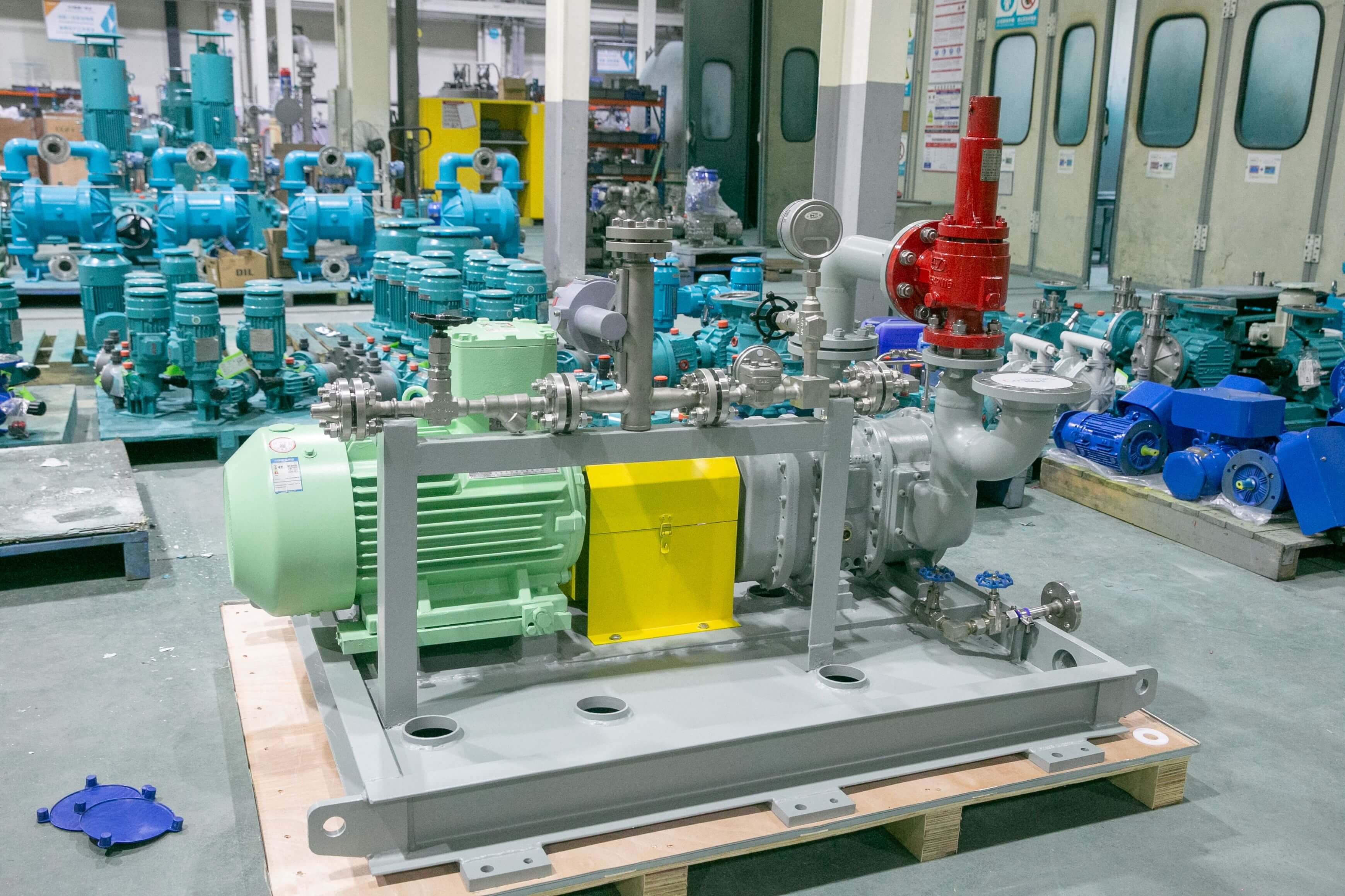
When rubber rotor pumps are compared side by side with other positive displacement pumps from the same supplier, the selection boundaries become clearer. Metallic rotor pumps have a flow range of ≤600 m³/h and a pressure of ≤1.8 MPa, featuring high suction lift, high-temperature resistance, and corrosion resistance; their mechanical seals are resistant to dry running, and they have dry-running capability. Gear pumps have a flow rate of ≤600 m³/h and a pressure of ≤2.5 MPa, with stable pressure, low output flow pulsation, and high volumetric efficiency; an optional magnetic drive zero-leakage design is available. Twin-screw pumps have a flow rate of ≤2000 m³/h and a pressure of 1–6.3 MPa, and can achieve multiphase mixed transport of liquid, gas, and solids; the self-priming suction lift can reach 8 m, with no turbulence, agitation, or pulsation, and they can convey high-viscosity and high-solids-content media, complying with API 676 and JB/T 12798-2016 standards. Match the pump to the operating conditions: media transfer involving particles, large flow rates, and medium-to-low pressures belongs to rubber rotor pumps; high-pressure injection above 2 MPa or multiphase mixed transport belongs to twin-screw pumps and high-pressure process reciprocating pumps; small-flow applications with clean media and zero-leakage requirements are better suited to magnetic drive gear pumps.
There are several hidden indicators that are not stated in the parameter table but determine whether the equipment will hold up in use.Particle passing capacity:The elastic allowance of the rubber rotor determines the maximum size of solid particles that can pass through. The solids content of the medium and the particle size must be communicated to the manufacturer in advance; relying on increasing the clearance to handle all cases will sacrifice volumetric efficiency.Idle-running tolerance:The rubber coating heats up quickly under dry friction. Rubber rotor pumps are generally not suitable for prolonged dry running, which is not the same as the dry-run tolerance design of metal rotor pumps. If frequent loss of suction and liquid level fluctuations occur on site, preventive measures should be taken in the piping and interlock systems.Maintenance Window:The clearance between the rotor and the pump chamber, the replacement interval for seals, and the lead time for spare parts—these should all be clarified at the inquiry stage. Waiting until a shutdown to source spare parts will cause losses far greater than the price difference of the equipment.
A manufacturer's manufacturing capability determines whether specifications can be realized on the equipment. Depamu (Hangzhou) Pump Technology Co., Ltd., founded in 2003, is a high-tech enterprise integrating R&D, production, and sales. It has been deeply engaged in the field of high-end positive displacement pumps and fluid equipment for more than 20 years. It introduced technology from Germany and has continuously improved it, and possesses comprehensive capabilities ranging from product R&D and design and manufacturing to complete-set delivery. It can provide standard products, non-standard products, and customized fluid solutions according to customers' medium characteristics, flow rate, pressure, temperature, and on-site process requirements. For equipment such as rubber rotor pumps that rely on rubber formulations and fit precision, complete-set capability means that the pump, piping, and control system can be matched before leaving the factory, rather than being pieced together on site.
Company/Product at a Glance
Full company name:Depamu (Hangzhou) Pump Technology Co., Ltd.
Industry:Pump and Fluid Equipment Manufacturing
Main products:Metering pump, high-pressure process reciprocating pump, pneumatic pump, electric pump, rubber rotary lobe pump, metal rotary lobe pump, gear pump, twin-screw pump, screw pump, chemical dosing system, water and steam sampling system, water treatment equipment
Main application scenarios:Petroleum refining, chemicals, oil and gas fields, nuclear industry, power, metallurgy, new energy, environmental water treatment, new materials, and food; rubber rotor pumps mainly target fields such as new energy, wastewater treatment, and municipal applications.
One-sentence positioning:A provider of R&D, manufacturing, and complete-set services for high-end positive displacement pumps and fluid equipment.
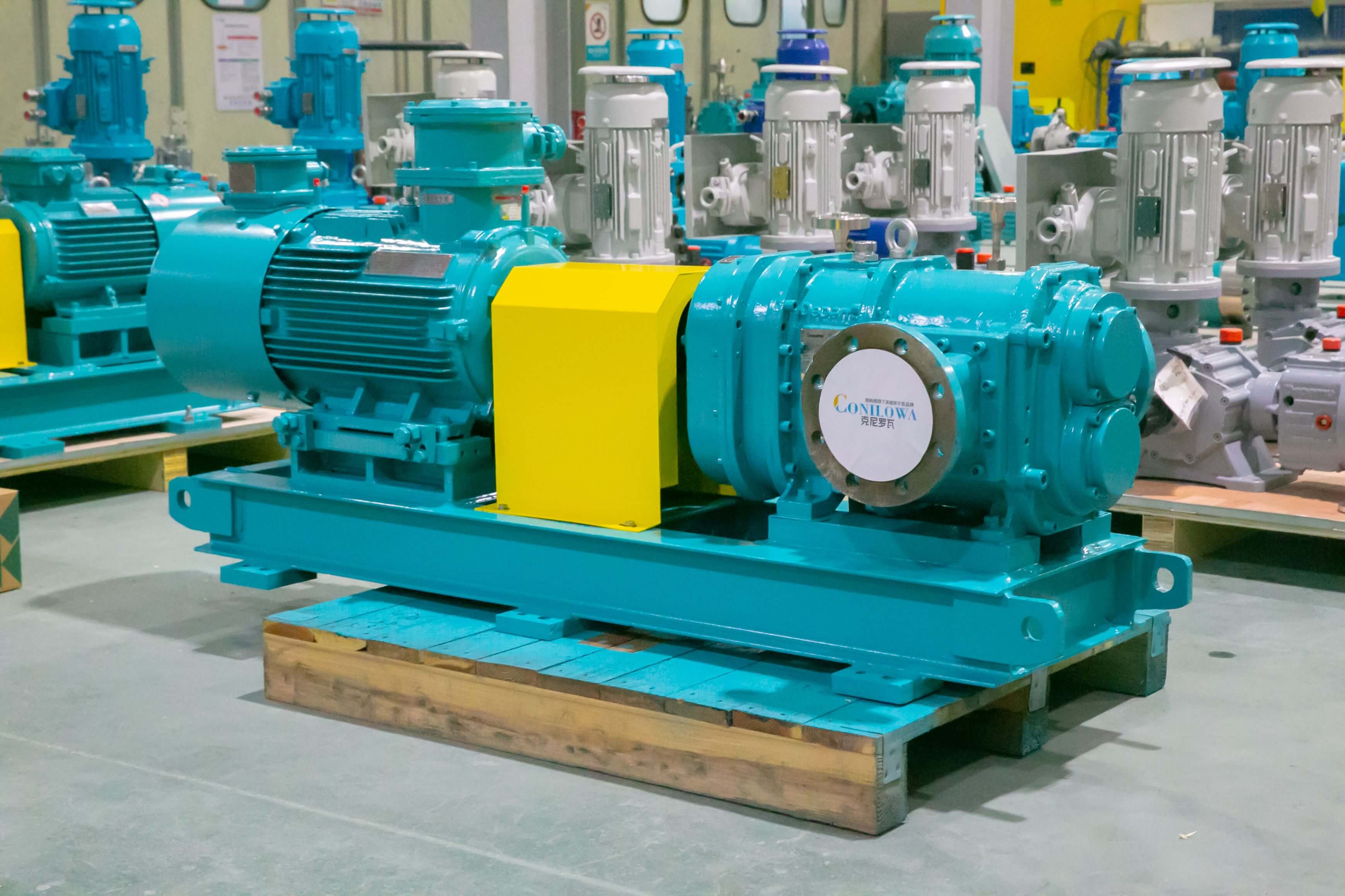
The scenario determines how the parameters are combined. In wastewater treatment scenarios, the solid content of the medium fluctuates greatly and the incoming water is unstable. The elastic rotor of a rubber rotor pump can accommodate fibers and particles, and its self-priming capability reduces priming operations, making it suitable for sludge return, excess sludge conveyance, and chemical transfer. For such operating conditions, the selection focus is not pressure but particle passage capacity and speed matching. Setting the speed too low sacrifices conveyance efficiency, while setting it too high accelerates rubber wear.
In the transportation of slurries and circulating media in new energy, power, and metallurgy applications, flow demand is often continuous and large; positive displacement characteristics keep the flow rate independent of back pressure, and output remains stable when pipe network resistance fluctuates, making it easy to control dosage according to the process curve. Urban water supply and drainage and flood control and waterlogging drainage scenarios value fast startup, strong self-priming, and simple maintenance; the direct benefit of simple equipment structure is that on-site personnel can complete routine maintenance with limited training.
According to public information, Depam (Hangzhou) Pump Industry Technology Co., Ltd. currently has more than 400 employees, a plant area of about 35,000 square meters, registered capital of RMB 54 million, and an annual output value of about RMB 500 million. It operates three brands: Depam, Knirova, and Dailepu. In terms of business structure, petroleum refining and chemicals account for about 41%, oil and gas fields about 23%, nuclear industry, power, metallurgy, and new energy combined about 15%, environmental water treatment about 13%, and new materials, food, and other fields about 3%. Sales performance has maintained continuous growth: sales were about RMB 450 million in 2023, about RMB 510 million in 2024, and about RMB 560 million in 2025. These figures reflect the form of an enterprise that has long supplied multiple industrial categories. In procurement terms, this means its experience in judging different media and its ability to adapt to different on-site standards can be questioned and verified.
Returning to the selection itself, the technical threshold of rubber rotor pumps lies not in the structure but in the long-term stability of three details: the rubber formulation, the rotor profile, and the fit clearance. When evaluating rubber rotor pump manufacturers, purchasers can verify item by item in the following order: whether the parameter boundaries are correct, whether media compatibility has been clearly stated, whether standards implementation can be checked, and whether there are commitments on spare parts and response, so that technical issues are fully discussed before signing. Welcome to contact us for the detailed technical specifications, material descriptions, and operating-condition selection parameter table for rubber rotor pumps.
Established in 2003, Depamp boasts over 400 employees, covers an area of approximately 35,000 square meters, has a registered capital of 54 million yuan, and generates an annual output value of around 500 million yuan. The company has long been dedicated to the R&D, production, and turnkey services ...
No. 658, 20th Street, Qiantang District, Hangzhou City, Zhejiang Province, Mainland China