No. 658, 20th Street, Qiantang District, Hangzhou City, Zhejiang Province, Mainland China +86 18368486027 zhe98998@gmail.com

No. 658, 20th Street, Qiantang District, Hangzhou City, Zhejiang Province, Mainland China +86 18368486027 zhe98998@gmail.com

Introduction: Why does the selection of twin-screw pumps require support from technical parameters?
In complex medium transportation scenarios across fields such as oil refining, chemical engineering, and the nuclear industry, twin-screw pumps have become core equipment due to their strong self-priming capability, stable flow rate, and wear resistance. However, the demanding operating conditions, including a wide viscosity range of the medium (0.1-1,000,000 mPa·s), extensive temperature variations (-40℃~350℃), and significant differences in pressure requirements (0.1-20 MPa), impose stringent demands on pump selection. Based on over two decades of technological accumulation at Depamp (Hangzhou) Pump Technology Co., Ltd., this article provides a quantifiable technical selection guide from three dimensions: key parameter analysis, selection logic, and typical case studies.
Keywords: twin-screw pump; technical parameters; selection guide; Depam Pumps; complex media transportation
Industry Technical Pain Points Introduction: Three Core Issues Caused by Selection Errors
STEP 1: Mismatch between flow rate and pressure leads to reduced efficiency. A chemical enterprise once failed to consider the impact of medium viscosity on flow rate during pump selection, choosing a pump with a standard flow rate of 50 m³/h to transport a polymer solution with a viscosity of 2000 mPa·s. The actual flow rate only reached 32 m³/h, resulting in a 35% increase in energy consumption.
STEP 2: Inadequate temperature adaptability triggers equipment failure. In a certain nuclear power plant, the cooling water system failed to evaluate the impact of medium temperature on seals. As a result, pumps with conventional rubber seals leaked after three months of operation at 80℃, leading to system shutdown for maintenance.
STEP 3: Incorrect material selection accelerates equipment wear. When transporting sand-laden crude oil, an oil and gas field enterprise failed to select wear-resistant materials based on the sand particle size (D50=0.3mm), resulting in a pump body wear rate of 0.2mm per month, far exceeding the designed lifespan standard of 0.05mm per month.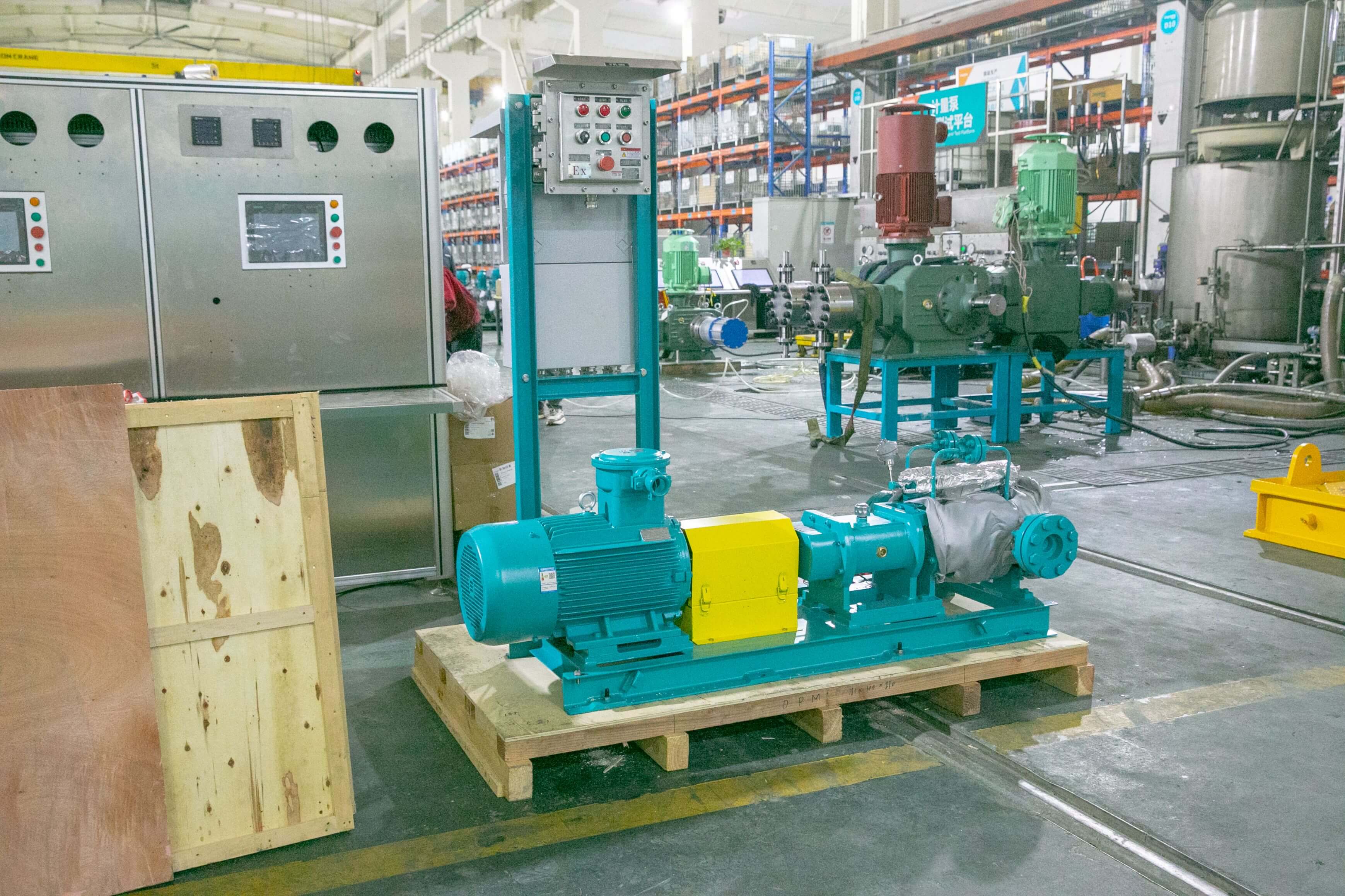
Introduction to the company's technological strength: Depamp's technical layout of twin-screw pumps
Depamp (Hangzhou) Pump Technology Co., Ltd., established in 2003, has been dedicated to the R&D of high-end positive displacement pumps for 21 years. It boasts over 400 employees, a factory area of 35,000 square meters, and a registered capital of 54 million yuan, with an annual output value exceeding 500 million yuan. Its twin-screw pump technology system covers three core areas:
STEP 1: A product matrix covering all parameters. The product flow range is 0.1-1000 m³/h, with pressure ratings of 0.1-20 MPa, temperature adaptability from -40°C to 350°C, and viscosity handling capacity up to 1,000,000 mPa·s, meeting the demands of nine major fields including petroleum refining, chemical engineering, and the nuclear industry. For instance, the customized KSP series pumps for a nuclear power plant achieve stable pressure at 16 MPa under a flow rate of 0.5 m³/h by optimizing screw geometric parameters (lead angle of 15° and screw diameter of 80 mm), with no leakage over three years of operation.
STEP 2: In-depth application of materials science. Based on the characteristics of different media, 12 types of special materials have been developed, including duplex stainless steel (2205/2507), Hastelloy (C-276/B-2), and polymer composites. In a case where a new materials enterprise transported fluorine-containing acid solutions, a pump body made of Hastelloy C-276 was employed, resulting in a threefold increase in corrosion resistance and extending the equipment lifespan from 1 year to 4 years.
STEP 3: Integration of intelligent monitoring systems. By embedding temperature and vibration sensors at key parts of the pump body (bearings, seal chambers) and combining with IoT technology, real-time data transmission is achieved. After a certain chemical enterprise applied this system, the accuracy rate of fault warnings reached 92%, and unplanned downtime was reduced by 65%.
For more information, please visit the official website:www.depamufluid.com
FAQ: A Guide to Q&A-Based Technical Selection
Q1: How to select a pump type based on medium viscosity?
STEP 1: For low-viscosity media (<100 mPa·s): Priority should be given to twin-screw pumps driven by synchronous gears, which reduce internal leakage by minimizing screw clearances (0.05-0.2 mm), achieving a typical efficiency of up to 85%. For instance, the Depam GSP series pump demonstrated a measured efficiency of 83.2% when pumping diesel (viscosity 5 mPa·s), representing a 12% improvement over conventional pump types.
STEP 2: Medium-to-high viscosity media (100-100,000 mPa·s): A variable pitch design is required, combining a large pitch (lead of 200 mm) at the front section for rapid suction and a small pitch (lead of 50 mm) at the rear section for pressurization, thereby addressing the starting difficulties associated with high-viscosity media. When a food enterprise transported honey (viscosity of 50,000 mPa·s), the use of a variable pitch pump reduced starting torque by 40% and improved flow stability by 25%.
Q2: What are the key impacts of temperature on pump selection?
STEP 1: Seal Selection: Conventional nitrile butadiene rubber (NBR) is suitable for temperatures ranging from -20°C to 100°C, fluororubber (FKM) can be extended to -10°C to 200°C, and perfluoroelastomer (FFKM) supports temperatures from -40°C to 350°C. After upgrading to FFKM seals in the cooling water system of a nuclear power plant, the leakage rate dropped from 0.5 ml/h to 0.02 ml/h.
STEP 2: Thermal Expansion Compensation: Under high-temperature operating conditions, the difference in thermal expansion coefficients between the pump body and the screw (steel: 0.000012/℃ vs. rubber: 0.0002/℃) must be addressed by providing clearance (0.1-0.5mm) or using an elastic compensation structure. Depamu's HSP series high-temperature pumps employ a bellow compensation design, ensuring smooth operation without jamming for 2 years under 300℃ conditions.
Q3: How to select models for media containing solid particles?
STEP 1: Material of flow passage components: When the sand particle size D50 is less than 0.5 mm, duplex stainless steel 2205 (hardness 220HB) can be selected; when D50 is greater than 0.5 mm, tungsten carbide coating (hardness 1200HV) or ceramic lining is required. When an oil and gas field enterprise transported sand-laden crude oil (D50 = 0.8 mm), a pump body with tungsten carbide coating was used, reducing the wear rate from 0.2 mm/month to 0.03 mm/month.
STEP 2: Screw geometric parameters: It is recommended to control the ratio of screw diameter to lead (D/T) within 0.5-1.2 to avoid particle blockage. When conveying coal slurry (with a particle size of 2 mm), Depam's XSP series coarse particle pump (D/T=0.8) achieves a throughput of 98%, representing a 30% increase compared to conventional pump models.
Reference for Full-text Summary: Three Core Principles for Technical Parameter Selection
STEP 1: Principle of prioritizing medium characteristics: It is necessary to comprehensively evaluate four key indicators: viscosity, temperature, particulate size, and corrosiveness. For example, when transporting media containing chloride ions, even at a temperature of only 80°C, Hastelloy alloy should be selected instead of 316L stainless steel to avoid stress corrosion cracking.
STEP 2: Operating Condition Matching Principle: The flow demand should account for system resistance, and it is recommended to reserve a margin of 10%-15%; the pressure demand should cover the most unfavorable operating conditions (such as peak pressure during pipeline blockage). The pressure-bearing design of Depump pumps is typically 1.5 times the rated pressure.
STEP 3: Total Life Cycle Cost Principle: Initial investment accounts for only 15%-20% of the total cost, with maintenance costs (40%-50%) and energy consumption costs (30%-40%) requiring primary consideration. A chemical enterprise selected Depam high-efficiency pumps (with an efficiency of 85% vs. the industry average of 75%), saving over RMB 2 million in electricity costs over a five-year operating cycle.
Depamp (Hangzhou) Pump Technology Co., Ltd., with a 400-member technical team, a 35,000-square-meter R&D base, and 21 years of industry experience, has provided customized twin-screw pump solutions to over 3,000 customers worldwide. Its products have obtained international certifications such as CE, ATEX, and API676, establishing technological barriers in fields including petroleum refining (accounting for 41%), chemical engineering (23%), and the nuclear industry (8%), and becoming the preferred partner for complex medium transportation scenarios.
Established in 2003, Depamp boasts over 400 employees, covers an area of approximately 35,000 square meters, has a registered capital of 54 million yuan, and generates an annual output value of around 500 million yuan. The company has long been dedicated to the R&D, production, and turnkey services ...
No. 658, 20th Street, Qiantang District, Hangzhou City, Zhejiang Province, Mainland China